
.png)

.avif)


.webp)
If you are a nurse practitioner thinking about becoming a certified registered nurse anesthetist (CRNA), the first thing worth knowing is that the path is open, but there is no shortcut. Plenty of NPs make this move. What none of them do is convert an NP license into a CRNA credential through a special bridge program, because no such program exists. You apply to a full doctoral nurse anesthesia program the same way any registered nurse does.
This guide covers how the NP to CRNA transition actually works in 2026: whether a bridge program exists, what counts toward the critical care experience requirement, how your specialty and current degree factor in, how long it takes, what it costs, and how CRNA pay compares to NP pay. Everything here is grounded in current requirements from the organizations that govern nurse anesthesia education and certification.
TL;DR: How to Become a CRNA as an NP in 2026?
- Yes, but there is no shortcut. No accredited NP to CRNA bridge program exists. You apply to a full doctoral nurse anesthesia program like any other registered nurse.
- The path: hold an active RN license, gain bedside critical care (ICU) experience as an RN, complete an accredited DNP or DNAP nurse anesthesia program, and pass the National Certification Examination (NCE).
- Timeline: about three years for the program itself, plus any time needed to build ICU RN experience before you apply.
- Pay: CRNAs earn a median of about $236,590 a year (BLS, May 2025), compared with roughly $132,300 for nurse practitioners.
- Your NP clinical hours do not count toward the ICU requirement. Programs want bedside RN critical care experience.
- If you are still an NP student, a strong clinical foundation keeps future options open. You can create a free NPHub account to find vetted clinical rotations.
Is there an NP to CRNA bridge program?
No. Despite how often people search for one, there is no accredited NP to CRNA bridge program in the United States. The Council on Accreditation of Nurse Anesthesia Educational Programs (COA) accredits every nurse anesthesia program in the country, and none of them offers a shortened pathway reserved for nurse practitioners. Your NP or DNP coursework does not transfer into a nurse anesthesia curriculum in any way that meaningfully shortens the training.
The reason is structural. Nurse anesthesia is a separate advanced practice specialty with its own accreditation standards, clinical hour requirements, and national exam. Whatever APRN role you hold now, you enter through the same door as every other applicant: a bachelor's degree in nursing (or an equivalent a program accepts), an active RN license, critical care experience as an RN, and admission to an accredited doctoral program.
So if a search for a bridge program is what brought you here, read that as the wrong map rather than a locked door. The route to nurse anesthesia is available to you. It simply runs through a standard, accredited program.
The NP to CRNA Career Transition
Transitioning from nurse practitioner to certified registered nurse anesthetist is a significant professional decision. It involves additional education, advanced clinical training, and often time in a high-acuity critical care environment.
For some NPs, anesthesia offers greater procedural focus, increased autonomy in perioperative settings, and a different pace of clinical practice. For others, the educational commitment, financial investment, and required ICU experience may change the equation.
CRNAs provide anesthesia services across hospitals, surgical centers, trauma units, and rural facilities. In many settings, they serve as primary anesthesia providers and play a direct role in patient safety and surgical outcomes.
If you are exploring this path, understanding the realities of education requirements, clinical preparation, and current job market conditions is essential. The goal is not to accelerate a decision. It is to help you evaluate whether this transition aligns with your professional goals and long-term sustainability.
NP to CRNA: What is a CRNA?
A Certified Registered Nurse Anesthetist, or CRNA, is an advanced practice registered nurse who specializes in anesthesia care. The profession dates back to the late 1800s, when nurse anesthetists first began administering anesthesia in surgical settings. Over time, the role has evolved into one of the most clinically intensive and highly regulated advanced nursing specialties.
Today, CRNAs are responsible for managing anesthesia across a wide range of healthcare environments.
Core Responsibilities of a CRNA
CRNAs are typically responsible for:
- Conducting pre-anesthesia patient assessments
- Developing individualized anesthesia care plans
- Administering anesthesia during surgical and procedural cases
- Monitoring vital signs and physiological responses
- Managing airways and responding to complications
- Overseeing patient recovery from anesthesia
They practice in hospitals, surgical centers, trauma units, obstetric settings, outpatient facilities, and military environments. In many rural or underserved communities, CRNAs serve as the primary anesthesia providers.
The role requires advanced knowledge of pharmacology and physiology, strong clinical judgment, and the ability to make rapid decisions in high-acuity situations.
For nurse practitioners considering this transition, the distinction is important. While NPs often manage ongoing patient care in primary or specialty settings, CRNAs focus on perioperative anesthesia, procedural sedation, and acute physiologic stability.
This is not simply a vertical career move. It is a shift in clinical focus, pace, and daily responsibilities.
CRNA vs NP: how the roles compare
Both roles sit under the advanced practice registered nurse (APRN) umbrella, but they are distinct in nearly every practical way.
Daily Duties and Responsibilities of a Certified Registered Nurse Anesthetist
The role of a CRNA as a healthcare professional is both demanding and rewarding. Their daily duties require meticulous attention to detail and the ability to make critical decisions under pressure. Here’s a closer look at what a typical day might involve for a CRNA:

Work Settings
CRNAs work in a variety of clinical sites, reflecting the diverse nature of their skills and the demand for their expertise. While they are commonly found in hospital operating rooms, their work is not limited to these environments. CRNAs also play vital roles in:
- Cardiac catheterization laboratories: Where they assist in providing anesthesia for procedures such as angioplasties and stent placements.
- Labor and delivery wards: Managing anesthesia for epidurals and C-sections.
- Outpatient clinics and surgery centers: Administering anesthesia for minor surgical procedures and pain management.
- Physician and dental offices: Providing anesthesia for procedures ranging from dental surgeries to cosmetic enhancements.
- Plastic surgery clinics: Where their skills are crucial in ensuring patient safety during elective procedures.
- Mobile surgical units: CRNAs are often part of mobile teams that bring surgical care to remote or underserved areas.
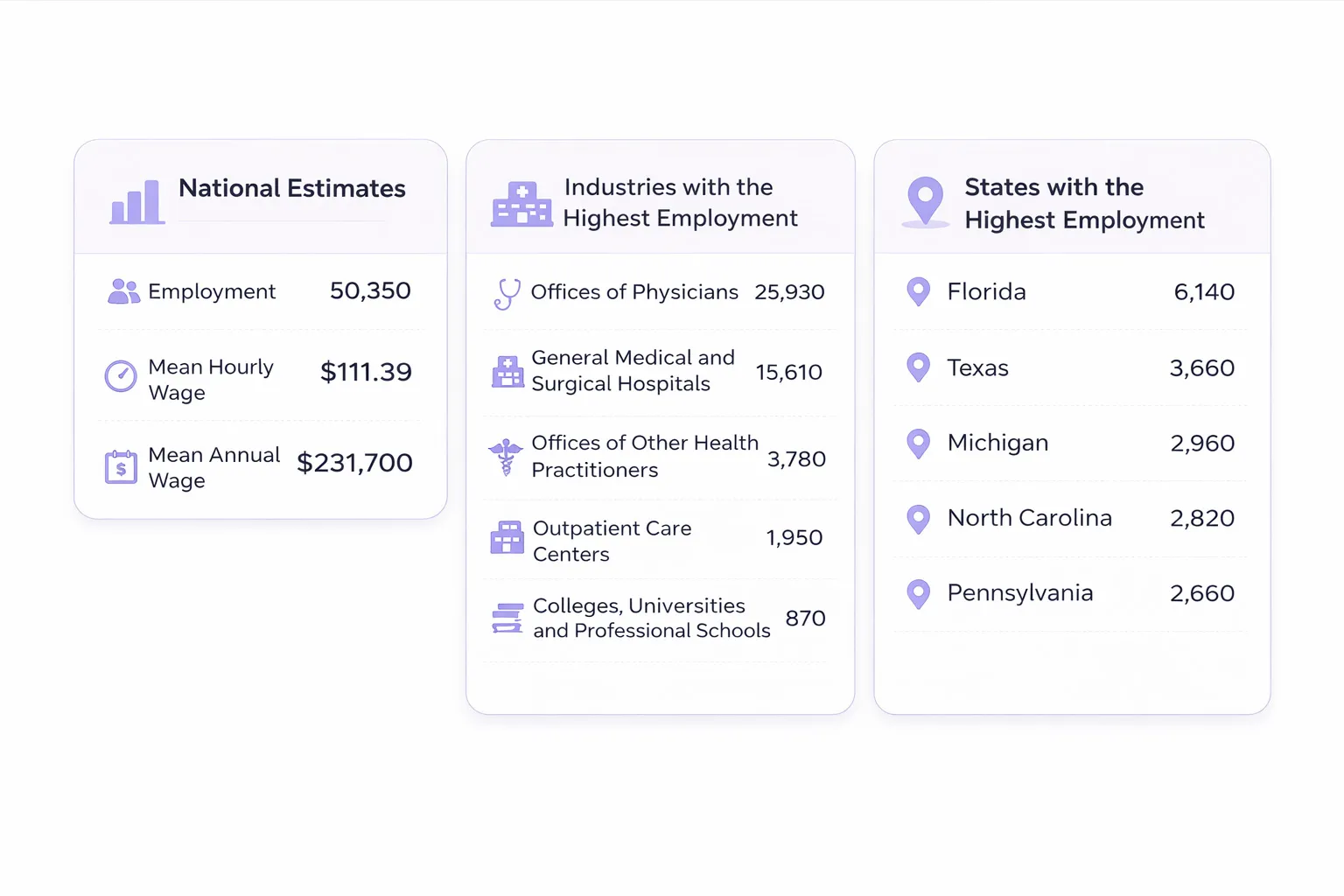
The versatility of CRNAs allows them to adapt to various clinical environments, making them invaluable members of the healthcare team. Additionally, here's an overview of their employment based on data from the US Bureau of Labor Statistics:
Necessary Skills and Qualities for a CRNA
Transitioning from nurse practitioner to CRNA requires more than meeting educational requirements. The role demands a specific combination of clinical expertise, technical precision, and emotional steadiness in high-acuity environments.
While many competencies overlap with advanced nursing practice, anesthesia care places unique demands on decision-making, monitoring, and physiologic management.
Core Skills and Qualities of a Successful CRNA
CRNAs typically demonstrate:
- Advanced knowledge of pharmacology and physiology, particularly related to anesthesia agents and cardiovascular and respiratory function
- Strong critical thinking skills in rapidly changing clinical situations
- Precision and attention to detail when calculating dosages and monitoring anesthesia depth
- Calm decision-making under pressure, especially in emergency or trauma settings
- Clear communication skills when collaborating with surgeons, anesthesiologists, and perioperative teams
- Emotional resilience and focus in high-stakes procedural environments
Many nurse practitioners already possess foundational strengths in patient assessment, treatment planning, and interdisciplinary collaboration. However, anesthesia practice requires comfort with acute physiologic instability and procedural intensity rather than longitudinal patient management.
Understanding this distinction helps clarify whether the CRNA role aligns with your clinical strengths and long-term professional goals.
Which NP specialties are closest to the CRNA path?
Your NP specialty does not earn you a shortcut, but it does shape how far you are from meeting the critical care requirement. The difference comes down to how much bedside ICU experience your background tends to include.
None of this reflects your ability. It is a practical read on how much critical care RN experience you may still need to build. An FNP or PMHNP who worked in an ICU as an RN before moving into their NP role can be well positioned, while an acute care NP who never spent time in an ICU may still need to log bedside hours. Either way, programs are looking for the high-acuity clinical work and strong clinical judgment that come from real time at the ICU bedside.
If you are still completing your NP program, the strength of your clinical training now shapes the options you have later, whether you stay in advanced practice or pivot toward a specialty like anesthesia down the road. You can create a free NPHub account to find and secure vetted clinical rotations and keep your graduation timeline on track.
The Path to Becoming a CRNA
For those keen on this specialized nursing trajectory, a structured path exists to become a CRNA:
- Acquire a BSN degree.
- Successfully clear the NCLEX-RN.
- Enroll in accredited nurse anesthesia educational programs.
- Pass the CRNA certification exam.
- Recertify on a four-year cycle through NBCRNA.
Here are more details on the steps you need to follow:
1. Obtain a Bachelor of Science in Nursing (BSN)
The first step toward becoming a CRNA is earning a Bachelor of Science in Nursing (BSN). This degree forms the foundation of your nursing education and prepares you for advanced practice roles.
Many nurse practitioners already hold a BSN, which provides a head start on the pathway to CRNA. Additionally, pursuing a master's degree in nursing can further strengthen your qualifications and expand future career opportunities.
2. Pass the NCLEX-RN
After completing your BSN, you must pass the National Council Licensure Examination for Registered Nurses (NCLEX-RN).
This exam is required to become a licensed registered nurse (RN) and is a prerequisite for entering any advanced practice nursing program, including nurse anesthesia programs.
3. Gain Clinical Experience
Most programs require at least 1 year of full-time critical care experience as a registered nurse at the bedside, often in a medical, surgical, or cardiovascular ICU. The key word is bedside. Hours you logged as a nurse practitioner, along with the clinical rotation hours from your NP program, generally do not count toward this requirement.
For many nurse practitioners, this is the real hurdle. If you moved into an outpatient or primary care role and have been away from bedside critical care, you may need to return to an ICU staff RN position to build or refresh that experience before you apply.
4. Enroll in an Accredited Nurse Anesthesia Program
Once you have the required clinical experience, the next step is applying to an accredited nurse anesthesia program.
These programs typically award either a Doctor of Nursing Practice (DNP) or a Doctor of Nurse Anesthesia Practice (DNAP) degree, reflecting the advanced level of education required for CRNAs.
The curriculum includes advanced pharmacology, physiology, and anesthesia practice, along with extensive clinical training. Most doctoral programs also require a scholarly or capstone project, though the exact form varies by program.
5. Pass the National Certification Exam
After completing a nurse anesthesia program, graduates must pass the national certification exam.
This examination, known as the National Certification Examination (NCE) for Nurse Anesthetists, is administered by the National Board of Certification and Recertification for Nurse Anesthetists (NBCRNA). The exam evaluates knowledge and clinical competency in anesthesia practice and is required to obtain CRNA certification.
6. Maintain Certification and Recertification
CRNAs recertify on a four-year cycle through NBCRNA. As of 2026, CRNAs are being enrolled in the Maintaining Anesthesia Certification (MAC) Program, which replaced the older Continued Professional Certification (CPC) Program. MAC keeps the four-year timeline and uses shorter, recurring knowledge checks in place of the former assessment exam, alongside continuing education and ongoing competency requirements.
This process involves completing continuing education credits and demonstrating ongoing competency in anesthesia practice. Maintaining certification ensures that CRNAs remain current in the field and continue delivering high standards of patient care.
If you're still in your NP program or planning upcoming clinical rotations, the strength of your clinical foundation matters more than you think. Securing high-quality preceptorships can expand your long-term options, whether you remain in advanced practice or eventually pursue a transition like CRNA. You can create your free NPHub account to explore vetted preceptor opportunities and stay in control of your clinical path.

The Salary and Job Outlook for CRNAs
Certified Registered Nurse Anesthetists continue to earn some of the highest salaries among advanced practice nurses.
According to the Bureau of Labor Statistics (OEWS, May 2025), nurse anesthetists earn a median wage of about $236,590 per year and a mean of about $248,320, with pay running from roughly the mid-$150,000s at the lower end to the mid-$300,000s at the upper end. That places CRNAs among the highest-paid advanced practice nurses.
Compensation varies based on experience, geographic location, facility type, and clinical specialization. Rural and high-need areas may offer competitive salaries to attract experienced providers, while high-cost states often reflect stronger compensation overall.
Job Outlook for CRNAs
The job outlook for CRNAs remains strong. Growth in anesthesia services, an aging population, and expanded access to surgical and procedural care continue to drive demand.
CRNAs practice across hospitals, outpatient surgical centers, rural facilities, and specialized clinical sites. As healthcare systems prioritize efficiency and access, CRNAs remain central to anesthesia delivery nationwide.
For nurse practitioners evaluating the transition, the financial upside is significant. However, the timeline, education requirements, and shift in clinical focus should be weighed alongside compensation.
The Transition from Nurse Practitioner to CRNA: Challenges and Rewards
Transitioning from an NP to a certified registered nurse anesthetist is a significant career shift for healthcare professionals, which comes with its own set of challenges and rewards. While this journey requires dedication, the rewards are substantial, both professionally and personally.
Challenges
- Educational Demands: The transition requires completing a rigorous nurse anesthesia program, which can be demanding in terms of time and effort. Balancing work, studies, and personal life becomes particularly challenging when managing required courses, clinical rotations, and maintaining written communication standards expected in advanced practice programs, especially for those with family responsibilities.
- Financial Considerations: Nurse anesthesia educational programs can be expensive, and the investment required may be a concern for some nurse practitioners. However, the potential for a substantial increase in salary as a registered nurse anesthetist CRNA often offsets this initial financial burden within the first few years of practice.
- Critical Care Experience: If an NP's background does not include significant experience in acute care settings, they may need to gain this experience before applying to a CRNA program. This requirement can be a hurdle for nurse practitioners who have specialized in other areas outside of intensive care unit environments, potentially delaying their application timeline.
Rewards
- Increased Autonomy: CRNAs often have a higher level of autonomy in their nursing practice compared to NPs, particularly in states that allow independent practice. This autonomy can be professionally fulfilling and allows for greater control over anesthesia care decisions, especially when working in rural areas or clinical sites with limited physician oversight.
- Financial Benefits: The financial rewards of becoming a CRNA are significant, with salaries that reflect the advanced level of expertise required. This financial stability can enhance quality of life and provide opportunities for further professional development, continuing education, and career advancement within global communities of anesthesia professionals.
- Professional Growth: The CRNA role is highly respected within the healthcare community. Achieving this designation through rigorous nursing education and clinical scholarship can open doors to leadership positions, academic roles at a school of nursing, and opportunities to influence healthcare policy and practice while contributing to evidence-based research in anesthesia services.
Conclusion
Aspiring to become a certified registered nurse anesthetist as a nurse practitioner is an ambitious yet rewarding pursuit. This career path not only elevates your professional standing but also plays an integral role in patient care, ensuring optimal healthcare outcomes during and after surgical procedures. For NPs considering this transition, understanding the rich history, significance, responsibilities, and growth avenues of the CRNA role is essential for success in advanced practice.
While the journey through nurse anesthesia educational programs is undoubtedly challenging, it is a pathway that promises immense professional and personal rewards. The financial benefits, increased autonomy, and opportunities for professional growth make this a highly attractive career option for healthcare professionals willing to invest the time and effort required to complete a rigorous DNP program and pass the national certification examination.
Frequently Asked Questions About Becoming a CRNA as an NP
1. Can a nurse practitioner become a CRNA?
Yes. A nurse practitioner can pursue a transition to become a Certified Registered Nurse Anesthetist (CRNA). However, admission into a nurse anesthesia program typically requires recent critical care experience and meeting specific doctoral-level program prerequisites.
2. Do NPs need ICU experience to apply to CRNA programs?
Most accredited nurse anesthesia programs require at least 1 year of experience in a high-acuity critical care setting, such as an intensive care unit (ICU). If an NP does not have recent ICU experience, they may need to obtain it before applying.
3. How long does it take to become a CRNA after being an NP?
CRNA programs generally take about three years to complete and award a doctoral degree, such as a Doctor of Nursing Practice (DNP) or Doctor of Nurse Anesthesia Practice (DNAP). The total timeline depends on whether ICU experience requirements are already met.
4. What degree is required to become a CRNA in 2026?
As of 2026, all new CRNAs must complete a doctoral-level nurse anesthesia program. Programs award either a DNP or DNAP degree before graduates are eligible to sit for the national certification exam.
5. What is the average CRNA salary in 2026?
Based on BLS data (OEWS, May 2025), the median wage for nurse anesthetists is about $236,590 per year, with a mean of about $248,320. Actual pay varies by state, experience, and practice setting.
6. Is becoming a CRNA worth it financially?
CRNAs are among the highest-paid advanced practice nurses. While the salary increase can be significant, the transition requires substantial time, education, and financial investment. Each NP must weigh compensation against program rigor and career shift considerations.
7. What is the difference between an NP and a CRNA?
Nurse practitioners typically provide ongoing patient care in primary or specialty settings. CRNAs specialize in anesthesia management during surgical and procedural care, focusing on perioperative physiology, airway management, and acute monitoring.
8. What certification exam do CRNAs have to pass?
Graduates of accredited nurse anesthesia programs must pass the National Certification Examination (NCE), administered by the National Board of Certification and Recertification for Nurse Anesthetists (NBCRNA), to obtain CRNA certification.
9. How often do CRNAs need to recertify?
CRNAs recertify on a four-year cycle through NBCRNA. As of 2026 they are enrolled in the Maintaining Anesthesia Certification (MAC) Program, which replaced the CPC Program and uses recurring knowledge checks rather than a single assessment exam. If a source says you recertify every two years, that information is out of date.
10. Can strong NP clinical experience help with CRNA applications?
Yes. Experience in high-acuity or critical care environments can strengthen an application to a CRNA program. A strong clinical foundation, advanced assessment skills, and comfort managing complex patients are valuable in anesthesia training.
11. Does your current degree (MSN, DNP, or post-master's) change anything?
Not in the way most people hope. Holding an MSN or a DNP does not let you skip into a nurse anesthesia program or shorten it. Since 2025, all nurse anesthesia programs award a doctoral degree, so even if you already hold a DNP in another specialty, you still complete a separate DNP nurse anesthesia program (or DNAP) to become a CRNA. Some programs may review prior graduate coursework case by case and grant limited transfer credit for a non-anesthesia course, but this is neither guaranteed nor enough to meaningfully shorten your training. There is also no post-master's or post-DNP certificate that turns an existing APRN into a CRNA without completing a full anesthesia program.
12. Is a CRNA a nurse practitioner?
No, though the mix-up is understandable. A CRNA and an NP are both advanced practice registered nurses, which is the umbrella both fall under, but they are separate roles with separate education, certification, and scope. A nurse practitioner diagnoses and manages patients across primary or specialty care, and in most settings can prescribe medications under their own prescriptive authority. A CRNA specializes in anesthesia care. Terms like nurse practitioner anesthesiologist, anesthesia nurse practitioner, and nurse practitioner anesthetist turn up in searches, but they are not accurate titles. The correct term for a nurse who provides anesthesia is certified registered nurse anesthetist, or CRNA. Anesthesiologists, by contrast, are physicians, which is a different profession entirely.
Article details
- Last updated
August 24, 2026 - Fact-checked by
NPHub Clinical Placement Experts & Student Support Team - Sources and references
- https://data.bls.gov/oesprofile/
- https://nursingeducation.org/careers/certified-registered-nurse-anesthetist/
- https://www.nphire.com/blog/top-np-skills-you-need-to-excel-in-your-career-in-2025
- https://www.bls.gov/news.release/pdf/ocwage.pdf
- https://www.nbcrna.com/certification-programs/mac
- https://www.nbcrna.com/certification-programs/mac/mac-faq
Find a preceptor who cares with NPHub
Book a rotation.webp)
.jpeg)

.webp)
.jpeg)


%20(3)%20(2).svg)
.webp)