
.png)



.webp)
TL;DR: How to Find an NP Preceptor in Utah Without Losing Your Mind
If you’re reading this while juggling coursework, clinical hours, and maybe even 12-hour nursing shifts, take a breath. You are not alone, and finding preceptors in Utah—while challenging—is absolutely doable when you have the right approach.
Here’s what works:
- Confirm your school and Utah Board of Nursing requirements first so you don’t waste outreach on sites that won’t qualify
- Start your search 6–9 months before each NP rotation to allow time for contracts, credentialing, and backup plans
- Target the Wasatch Front cities (Salt Lake City, Provo, Ogden) where preceptor density is highest, plus neighboring areas if you’re flexible
- Combine multiple strategies: personal networking, Utah NP associations, faculty introductions, and direct outreach to clinics
- Consider structured matching or preceptorship services if your timeline becomes at-risk—this is about protecting your graduation, not admitting defeat
- Utah’s full-practice authority means completing your rotations here can seamlessly lead into local practice, with NP salaries averaging around $118,000–$125,000 statewide (and higher in Salt Lake City and high-demand specialties like PMHNP)
- The rest of this article walks step-by-step through building your outreach plan, drafting emails, tracking contacts, navigating preceptor conversations, and understanding your NP career prospects in Utah
- Tired of the endless Utah preceptor search? Ditch the cold calls and spreadsheet chaos. Find and secure your next clinical rotation, easy and simple. Open your free NP Hub account now and get matched with available Utah preceptors—from Salt Lake City to St. George.
None of these strategies are “musts.” They’re options to mix and match based on your personal comfort, schedule, family obligations, and finances. You get to choose what works for you.
.webp)
Understanding the NP Preceptor Landscape in Utah
Utah presents a unique environment for nurse practitioner students seeking clinical training. With a fast-growing population, significant rural healthcare needs, robust hospital systems, and full-practice authority for APRNs, the state offers both opportunity and competition when it comes to finding preceptors.
What’s driving demand in Utah:
- Utah’s population has grown significantly since 2015, with the state consistently ranking among the fastest-growing in the nation. This growth has intensified demand for primary care and behavioral health services.
- More healthcare providers are needed, but that same growth means more NP students from multiple programs are competing for the same experienced preceptors.
- The state’s NP-to-population ratio sits at approximately 1:1,800—better than the national average of 1:2,100—but projections suggest Utah will need roughly 1,500 new NPs by 2030.
Utah’s full-practice authority advantage:
Utah grants full practice authority to APRNs who meet state requirements. After obtaining your Utah nurse practitioner license, you can evaluate, diagnose, and prescribe independently. This makes completing your clinical rotations with Utah-based nurse practitioner preceptors especially valuable—you’ll build relationships and learn local practice patterns where you may want to work.
The competitive reality:
Multiple NP programs draw from Utah’s preceptor pool: University of Utah in Salt Lake City, Brigham Young University and Rocky Mountain University of Health Professions in the Provo area, Westminster University, plus dozens of online platforms with students who want to complete rotations locally. This creates a tight but navigable market.
Pressures on preceptor supply include:
- Growing NP enrollment across programs
- Faculty shortages limiting school-coordinated placements
- Preceptor burnout (many NPs see 25–30 patients daily)
- Paperwork burdens when precepting students from multiple schools
- Uncompensated time (preceptors average 100–200 unpaid hours annually supervising students)
Despite the competition, many NP students successfully secure placements every semester. Diversifying your strategies—combining networking, associations, direct outreach, and potentially paid options—significantly improves your odds of finding preceptors on time and protecting your graduation date.
Planning your next clinical rotation in Utah? Secure a preceptor by signing up for a free NP Hub account today!

Step 1: Clarify Your Utah NP Rotation Requirements Before You Reach Out
Clarity reduces anxiety and prevents wasted outreach. Before you contact any potential preceptors, you need crystal-clear answers about what your school requires.
Verify these items with your NP program:
- Minimum and maximum clinical hours per rotation (typically 135–180 hours per course)
- Total required NP clinical rotations (usually 500–1000+ hours across your program, covering areas like family practice, women’s health, pediatrics, psych/mental health, and acute care depending on your specialty track)
- Whether non-NP preceptors (MD, DO, PA, CNM) are allowed for specific courses
- Your school’s required preceptor credentials: board certification, years of experience, population focus matching your track
Confirm Utah-specific regulatory details:
- Whether your RN license (often via the Nurse Licensure Compact) covers student clinical practice in Utah
- Any site affiliation agreement requirements between your school and Utah clinical sites
- Preconditions for final immersion rotations or capstone experiences
Clarify geographic flexibility:
- Does your program accept hours only from Utah, or also from neighboring NLC states like Idaho, Colorado, or Wyoming?
- Are telehealth rotations with Utah-based preceptors allowed for any portion of your hours?
- Are there restrictions on distance from your home address or campus?
Create your “Rotation Snapshot” document:
Assemble a simple one-page summary including:
- Your school name and NP program
- Degree track and specialty
- Course code and title
- Proposed date range
- Required clinical hours
- Allowed preceptor credentials
- Your malpractice coverage details
- Contact information for your clinical coordinator
This one-pager gives potential preceptors peace of mind immediately. They can see exactly what you need and confirm quickly whether they can help. It demonstrates professionalism and respect for their time.
Collaborate with your clinical coordinator:
Ask directly: “Do you have any Utah nurse practitioners or clinical sites you recommend I approach first?” Document any site restrictions or past placement successes. Your school may have relationships you don’t know about—warm introductions beat cold emails every time.
Step 2: Where to Find NP Preceptors in Utah (With a Focus on the Big Three Cities)
Utah’s NP preceptor opportunities concentrate in three main metropolitan areas, each with distinct advantages. Understanding these hubs helps you target your outreach strategically.
Salt Lake City and Salt Lake County
This is Utah’s largest market for nurse practitioner rotations. Major systems include:
- Intermountain Health: One of the largest healthcare systems in the Intermountain West, with numerous clinics spanning family practice, internal medicine, urgent care, and specialties
- University of Utah Health: Academic medical center with diverse rotation opportunities and strong ties to the University of Utah nursing programs
- Large FQHC networks: Community Health Centers serving underserved populations, often open to students and offering loan repayment opportunities for future employment
Salt Lake City offers the widest variety of clinical sites for almost every specialty track—FNP, PMHNP, AGACNP, and WHNP students can all find relevant placements here.
Provo–Orem (Utah County)
The Provo area benefits from proximity to BYU and Rocky Mountain University of Health Professions:
- Strong opportunities in family practice, pediatrics, and women’s health
- Growing psych/mental health and community health options
- Suburban and semi-rural settings that offer different patient populations than Salt Lake City
- Utah Valley Hospital and surrounding clinic networks
Ogden–Clearfield and Northern Utah
This region (including Layton, Bountiful, and extending to Logan) offers:
- A mix of hospital-based NPs and outpatient clinics
- Often less saturated than Salt Lake City, which can advantage motivated students willing to commute
- McKay-Dee Hospital and community health networks
- Approximately 35–45 minutes from downtown Salt Lake City, making it accessible from the Wasatch Front
Beyond the Wasatch Front
More rural Utah areas present unique opportunities:
- St. George: Growing southern Utah hub with expanding healthcare needs
- Price, Vernal, Moab: Rural communities where primary care NPs serve broad populations and may welcome students
- Richfield and central Utah: Family medicine and emergency/urgent care settings
These locations may require 2–4 hour drives from Salt Lake City but often have less competition for preceptorships and offer exposure to rural healthcare challenges.
Utah settings to target by specialty:

Stop the endless Utah preceptor search! Open your free NPHub account today to instantly review and secure all available preceptor openings across the state.
Explore City-Specific NP Preceptor Guides Across Utah
While this guide gives you a statewide strategy, preceptor availability, competition levels, and outreach tactics can look very different depending on where you focus your search.
If you want more detailed, city-level guidance, explore our in-depth Utah city guides below:
- Salt Lake City Guide for Nurse Practitioner Students
- Finding and Securing Preceptors in St. George, Utah
Step 3: Using Utah Associations and Networks to Find Free or Low-Cost Preceptors
Many students overlook professional associations, but these can be among the most student-friendly and low-cost routes to find NP preceptor support in Utah. Joining professional communities connects you with practicing NPs who remember what it was like to be in your position.
Utah Nurse Practitioners (UNP) Network
The utah nurse practitioners network operates a platform where students can post profiles seeking preceptors and NPs can list their availability. This fosters direct student-preceptor matches across specialties.
- Student membership often opens access to local meetings and informal networking
- Some members offer mentorship even outside formal preceptorship arrangements
- The network isn’t exclusively Utah-focused but is highly relevant for local connections
- Access via utahNP.eNPnetwork.com
Specialty-Specific Groups
Utah APRN and specialty groups can connect you with preceptors in your specific track:
- Psych/mental health NP circles for PMHNP students
- Women’s health NP networks for WHNP or FNP OB/GYN rotations
- Family practice NP meetings and informal gatherings
- Some groups maintain mentorship lists or online directories
AORN of Utah
The AORN of Utah (Association of periOperative Registered Nurses) focuses on perioperative nursing. While more surgical-focused, it can help:
- Acute care NP students seeking OR exposure
- Students needing to network with CRNAs and surgeons
- Those whose programs allow perioperative hours
Faculty and School Connections
Don’t underestimate what your school already knows:
- Ask faculty and clinical coordinators about established relationships with Utah nurse practitioner preceptors
- Request warm introductions rather than cold outreach when possible
- Many schools maintain informal lists of former students who now precept
LinkedIn and Social Media
Strategic use of LinkedIn and local Facebook groups can yield results:
- Search phrases like “Utah NP,” “family nurse practitioner Salt Lake,” or “PMHNP Utah”
- Send personalized connection requests highlighting your student status and flexibility
- Join Utah nursing or healthcare groups where practitioners discuss local practice
The emotional benefit: Belonging to a professional community helps you feel supported rather than isolated. These relationships often extend beyond your clinical experience—preceptors you meet through associations may become references, mentors, or even future colleagues.
Step 4: Independent Outreach in Utah – Email, Phone, and In-Person Strategies
Cold outreach can feel intimidating, but having scripts and a plan makes it manageable. Many students find that taking direct action—rather than waiting and hoping—actually reduces anxiety.
Start with Clinic Managers, Not Directly with NPs
Most successful outreach begins with practice administrators or clinic managers. These staff members coordinate schedules, contracts, and liability policies. The nurse practitioner you want to work with may be interested, but the manager makes the logistics happen.
Email Template for Utah Clinics
Subject line: NP Student Rotation Request – [Your Specialty] – [Date Range]
Dear [Clinic Manager/Practice Administrator],
My name is [Your Name], and I am a [specialty] NP student at [School Name]. I am seeking a clinical placement for my [Course Name] rotation from [Start Date] to [End Date], requiring approximately [X] clinical hours.
I am particularly interested in [Clinic Name] because [brief, genuine reason—patient population, specialty focus, or location]. I am flexible with scheduling and committed to being a prepared, professional addition to your team.
I have attached a one-page summary of my rotation requirements, including my school’s contact information and malpractice coverage details. I would be grateful for the opportunity to discuss how I might complete my rotation with your practice.
Thank you for your time and consideration.
Sincerely, [Your Name] [Phone Number] [Email]
Phone Call Approach
- Call outside peak clinic hours (early morning, lunch, or late afternoon)
- Introduce yourself: “Hi, I’m [Name], an NP student looking for a clinical placement in [specialty]. May I ask who coordinates student rotations at your practice?”
- If you reach the right person: “I’d love to email you details about my rotation needs. Would that be helpful?”
- Be brief, respectful, and ready to follow up in writing
In-Person Visits
For smaller offices in Salt Lake City, Provo, or Ogden, polite in-person visits can work well:
- Bring a printed one-page summary and your resume
- Dress professionally
- Respect boundaries if the office is busy—leave materials and ask when might be better to call
- Some Utah practices still prefer face-to-face introductions
Track Everything
Create a simple spreadsheet with columns for:
- Clinic name
- City
- Contact person
- Date of initial contact
- Follow-up date
- Outcome
This reduces mental load and prevents missed opportunities. Seeing your progress documented also helps you feel more in control of the process.
Follow-Up and Gratitude
- Follow up every 7–10 days unless told otherwise
- Always thank offices for their time, even if they decline
- A gracious response to “no” preserves future options—staffing and availability change
Looking for the fastest route from NP student to practicing Utah NP? Stop clicking through endless directories. We've done the work. The preceptors you need—from Family Practice to PMHNP—are ready to meet you. Secure your rotation right now. Open your free NP Hub account today!
Step 5: Utah-Specific Tips for Different NP Specialties and Preceptorships
Preceptorship nursing needs vary widely by track. Here’s how to approach Utah specifically based on your specialty.
Family Nurse Practitioner (FNP)
FNP students have the broadest options in Utah but also face the most competition:
- Target family practice clinics, internal medicine offices, and pediatric practices along the Wasatch Front
- Urgent care can supplement hours but confirm with your program whether it counts as primary care
- FQHCs offer diverse patient populations and often have teaching missions
- Both large systems (Intermountain, University of Utah Health) and independent practices are viable
Psychiatric-Mental Health Nurse Practitioner (PMHNP)
PMHNP rotations are among the most competitive in Utah due to rising mental health needs:
- Focus on outpatient psychiatric clinics in Salt Lake County and Utah County
- Community mental health centers serve underserved populations and may welcome students
- Substance use treatment centers offer specialized experience
- Telepsychiatry groups based in Utah have expanded since 2020 and some accept students for virtual rotations (if program-approved)
- Start your outreach earliest for psych rotations—6–9 months is not too early
Adult-Gerontology and Acute Care NP
For students in AGACNP or other acute care tracks:
- Target hospitalist groups at major hospitals: University of Utah Hospital, Intermountain Medical Center in Murray, Ogden Regional
- Specialty cardiology and pulmonary clinics offer focused experience
- AORN of utah networks can connect you with OR NPs and surgical teams for perioperative exposure where program rules allow
Women’s Health NP and FNP OB/GYN Hours
For WHNP students or FNPs needing women’s health hours:
- OB/GYN practices in Salt Lake City, Provo, and Ogden offer outpatient prenatal and gynecological care
- Midwifery groups can provide birth center or clinic experience
- Women’s health-focused community clinics may be less competitive than hospital systems
- Confirm with your school whether labor and delivery units or outpatient prenatal clinics best meet your learning objectives
A note on flexibility: Some specialties—particularly PMHNP and acute care—are especially competitive in Utah. Willingness to commute (for example, from Salt Lake City to Ogden or from Provo to more rural areas) can make the difference between an on-time and delayed graduation.
Each specialty strategy connects to both practical outcomes (meeting course objectives, accumulating required hours) and emotional benefits (feeling prepared for certification exams, building confidence for your first Utah NP job).
Free vs Paid Paths to Find NP Preceptor Utah: Tradeoffs and Emotional Impact
The decision between free/low-cost preceptor routes and paid preceptor matching services isn’t about one being “right”—it’s about understanding the tradeoffs and choosing what fits your situation.
Advantages of Free Routes
Using school connections, the utah nurse practitioners network, AORN of Utah, personal networking, and cold outreach offers:
- No or minimal financial cost—protecting your budget during an already expensive education
- More organic relationships—you choose who you work with based on fit, not availability in a database
- Long-term mentorship potential—connections made through networking often lead to job offers, references, and ongoing professional network relationships
- Personalized matching process—you control the vetting and can prioritize what matters to you
Challenges of Free Routes
- Higher time investment—you’re doing all the research, outreach, and follow-up yourself
- Possible rejections and emotional fatigue—hearing “no” repeatedly can be discouraging
- Risk of last-minute cancellations—if a preceptor cancels, you’re back to square one without a backup system
- Requires 6–9 month lead time—this approach doesn’t work well for last-minute placements
Rationale for Paid Services
Paid preceptor matching services and clinical placement support exist because the system places an unfair burden on NP students. These services can provide:
- Faster access to vetted preceptors—reducing uncertainty about credentials and availability
- Clearer timelines—knowing when you’ll have confirmation
- Help with contracts and paperwork—taking administrative burden off your plate
- Backup support—if something falls through, you’re not alone
Potential Drawbacks of Paid Routes
- Financial cost—often several hundred to several thousand dollars per rotation
- Limited availability—may not have options in specific Utah specialties or rural areas
- Variable quality—important to review contracts and refund policies carefully
- Less personal connection—you may have less iNPut on preceptor personality and teaching style
Making Your Choice
Honestly assess:
- Your risk tolerance for delays
- Your financial situation
- Family obligations and flexibility
- Your mental health and capacity for rejection
- How much significant time you can dedicate to the search
Many students use a hybrid approach: lead with free networking and association connections while keeping paid options available if deadlines approach. This preserves both your budget and your graduation timeline.
Talk to Your School
Ask your program directly:
- How do they view paid preceptorships?
- Are there any restrictions on using external services?
- Does the school maintain internal Utah preceptor lists that should be tried first?
Transparency with your clinical coordinator protects you from surprises later.
For further assistance in making your selection, create a free NP Hub account today to gain access to valuable information and support.
.webp)
Navigating Conversations With Potential Utah NP Preceptors
Reaching out is one thing. Having the actual conversation is another. It’s normal to feel anxious about “the ask.” Most students do. But remember: every NP practicing today was once in your position.
What to Share in Your First Conversation
- Your NP program and school
- Your specialty track and where you are in your education
- Why you want to practice in Utah (or this specific city/region)
- Proposed rotation dates and your weekly schedule flexibility
- School expectations and how paperwork will work
- How you plan to add value: reliability, preparation, respect for workflow
Questions to Ask Potential Preceptors
Understanding your preceptor’s approach helps ensure a good fit:
- “What’s your teaching style with students?”
- “Have you precepted students before? What worked well?”
- “What does success look like to you at the end of my rotation?”
These questions demonstrate maturity and help you assess whether this preceptor will provide the constructive feedback and role model qualities you need.
Logistics to Discuss
Before confirming, clarify:
- EHR training requirements and timeline
- Parking costs and clinic orientation procedures
- Expected patient load per day
- Any clinic policies about student involvement with specific patient populations
- Schedule (which days, what times, how many clinical hours per week)
Be Transparent About Paperwork
From the beginning, acknowledge:
- Affiliation agreement timelines (some Utah hospitals take 4–6 weeks)
- Evaluation forms and when they’re due
- Background check or immunization verification processes
- Who your preceptor should contact at your school if questions arise
Show Appreciation
Acknowledge that preceptors give their time without compensation. Consider:
- Handwritten thank-you notes at rotation end
- Small thank-you gifts within clinic policy
- Nominating them for teaching awards through your school or professional organizations
This builds goodwill for future cohorts and strengthens your professional network.
Handling “No” Gracefully
If a potential preceptor declines:
“Thank you so much for considering my request. I really appreciate your time. If anything changes in the future, I’d love to stay in touch. Would you happen to know anyone else in the area who might be open to precepting students?”
This response preserves the relationship and sometimes leads to referrals.
Utah Nurse Practitioner License Pathway and Why It Matters for Rotations
Understanding how your NP clinical rotations connect to your longer-term career helps you make strategic decisions about where and with whom you train.
Basic Steps to Utah NP Licensure
- Hold an active RN license—often through the Nurse Licensure Compact if you’re already licensed in another NLC state
- Graduate from an accredited NP program
- Obtain national certification in your chosen specialty (ANCC, AANP, or other recognized certifying body)
- Apply for Utah APRN licensure through the Utah Division of Professional Licensing (DOPL)
Full Practice Authority
Utah allows full practice authority for NPs who meet state requirements. This means that after licensure—and when required, a transition-to-practice period—you can evaluate, diagnose, and prescribe independently without a physician collaboration agreement.
This is a significant advantage compared to restricted-practice states. Your Utah rotations help you learn to practice with the autonomy you’ll have as a licensed provider.
Why Utah Preceptorships Matter for Your Career
Completing your clinical hours under Utah-based nurse practitioner preceptors offers practical benefits:
- Familiarity with local documentation systems—EHR workflows vary by region and system
- Understanding of referral patterns—knowing who to call and how
- Community resource knowledge—social services, specialty care access, patient assistance programs
- Professional connections—preceptors become references and sometimes employers
Ask Your Preceptors About Licensure
During rotations, experienced preceptors can share insights about:
- Common pitfalls in the Utah licensing process
- Local employer expectations for new NPs
- Preferred certifications and typical onboarding structures
- How long the process actually takes in practice
This information is more nuanced than what official websites provide.
Continuing Education Requirements
Utah requires ongoing continuing education, including pharmacology hours. Good preceptors can model how they maintain their license and stay current clinically—ask about their approach.
Tired of the endless Utah preceptor search and risking your graduation? You're one click away from securing your required hours and launching your NP career. Stop refreshing inboxes and start your clinical rotation. Open your free NP Hub account now to instantly access available, vetted Utah preceptors in Salt Lake, St. George, and more.
Working and Thriving as a Utah Nurse Practitioner After Graduation
The stress of finding an NP preceptor has a purpose: preparing you to practice confidently and competently in Utah.
Salary Expectations
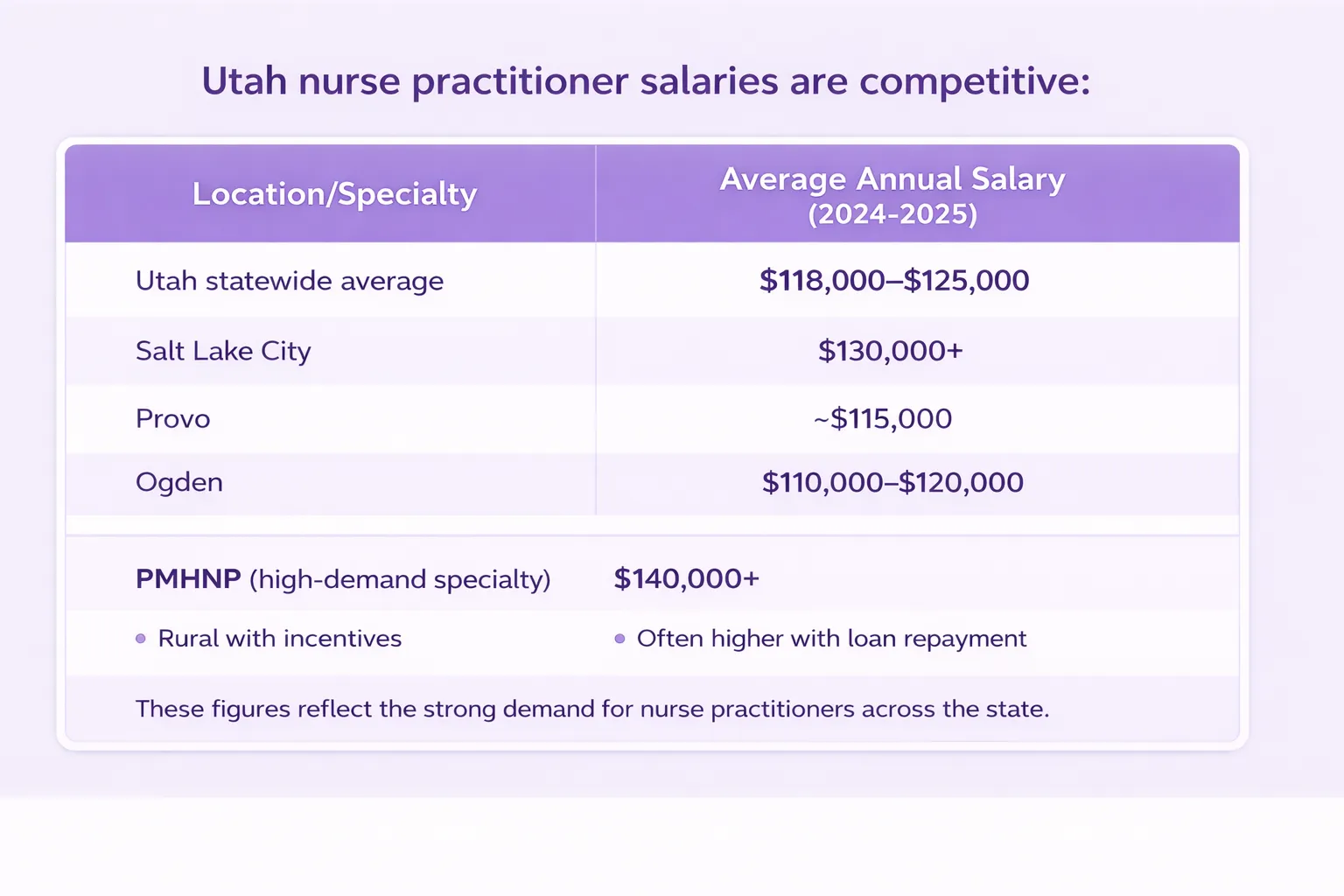
Typical NP Roles in Utah
Practice opportunities span:
- Primary care clinics—family practice, internal medicine, pediatrics
- Specialty practices—cardiology, orthopedics, dermatology, endocrinology
- Urgent care centers—particularly in growing suburban areas
- Hospitalist teams—acute care roles in major hospitals
- Telehealth—expanded significantly since 2020
- Community mental health agencies—high demand for PMHNP providers
- FQHCs and community health centers—mission-driven work with underserved populations
High-Demand Areas
Certain specialties and locations face particular shortages:
- Family practice in growing suburbs—Utah’s population growth drives need
- Psych/mental health services—post-pandemic demand remains elevated
- Rural primary care—communities outside the Wasatch Front need healthcare providers
- Acute care and cardiology specialties—aging population increases demand
These align with the preceptor search strategies discussed earlier—finding experience in high-demand areas positions you well for employment.
Work-Life Balance Considerations
Utah offers various schedule structures:
- Many clinics offer 4x10-hour shifts
- Traditional 5-day weeks remain common
- Hospital and rural roles may include on-call responsibilities
- New grads should negotiate for adequate orientation, mentorship, and manageable patient panels
Burnout is real—NPs often see 25–30 patients daily. Advocating for sustainable practice patterns starts in your job search.
Carry Forward Your Rotation Relationships
The preceptors who invest in your clinical training often become:
- References for job applications
- Advocates within their organizations
- Colleagues in professional associations
- Sometimes, your future employers
Maintain these relationships after graduation.
Planning Your NP Rotations Timeline in Utah to Graduate On Time
A clear timeline reduces anxiety and keeps your graduation date secure. Here’s a practical roadmap.
9–12 Months Before Your First Rotation
- Confirm all school requirements for clinical placement
- Identify preferred regions (Salt Lake City vs. Provo vs. Ogden vs. rural)
- Create your list of potential sites and Utah nurse practitioners to approach
- Join the utah nurse practitioners network and relevant specialty associations
- Request any available preceptor information from your clinical coordinator
6–9 Months Before
- Begin active outreach using email, phone, and networking strategies
- Attend local NP association events and make connections
- Apply online to large health systems that have student application portals
- Track all contacts in your spreadsheet
3–4 Months Before
- Aim to have written confirmation from preceptors
- Initiate affiliation agreement processes (these can take 4–8 weeks for Utah hospital systems)
- Complete any required background checks or immunization documentation
- Confirm your preceptor accepts your school’s evaluation and hour-logging requirements
Building Buffer Time
Major Utah systems (Intermountain, University of Utah Health) often have multi-week credentialing processes. Build this into your timeline so a time consuming process doesn’t derail your start date.
Stagger Your Outreach
Don’t try to secure all rotations simultaneously:
- Focus on the next semester first
- Keep an eye on future rotations, especially hard-to-find specialties
- PMHNP and acute care rotations often need the longest lead time
Backup Plans
Maintain a “Plan B” list:
- Other Utah clinics and preceptors you’ve contacted
- Faculty recommendations for emergency placements
- Neighboring NLC states if your program allows
- Awareness of paid matching services as a last resort
If a preceptor cancels close to your start date, you’ll have options ready.
The Emotional Benefit of Planning
Having a clear calendar, outreach plan, and contingency options significantly reduces anxiety. You can focus on learning during your fulfilling clinical experience rather than constantly worrying about logistics.
Looking to quickly secure a preceptor in Utah? Open your free NPHub account today to review all our available openings across the state.
Key Takeaways
- Start looking for Utah nurse practitioner preceptors 6–9 months before your NP clinical rotations begin; use multiple local resources including Utah nurse practitioner associations, hospital systems, faculty connections, and personal networks while maintaining backup options
- The best cities to find NP preceptor opportunities in Utah are Salt Lake City, Provo–Orem, and Ogden–Clearfield, with particularly strong opportunities in family practice, psych/mental health, and acute care specialties
- Utah operates as a full-practice authority state with a clear Utah nurse practitioner license pathway, making it an attractive place to stay and practice after graduation
- Combining free and low-cost preceptor routes (through associations and networking) with paid services when needed gives you more control over stress, timing, and your budget
- This article concludes with key definitions, FAQs, and reference links so you can quickly review program requirements or explore specific topics when you’re ready
Final Thoughts
Finding an NP preceptor in Utah requires effort, but thousands of former students have navigated this process successfully—and you can too. The combination of strategic outreach, professional associations, faculty support, and flexibility with location gives you real options.
Remember: this challenging clinical placement process is temporary. The preceptorships you complete, the clinical skills you develop, and the professional relationships you build all serve one purpose—preparing you to provide excellent patient care as a Utah nurse practitioner.
Start your outreach plan this week, even if it’s just one email or one association membership. Every step forward is progress toward graduating on time and launching your NP profession.
You’ve got this.
.webp)
Key Definitions for NP Clinical Rotations in Utah
NP Clinical Rotations: Supervised, course-based experiences in real patient care settings where NP students apply classroom knowledge to patient assessment, diagnosis, and management. Total hours typically range from 500–1000+ depending on the Utah NP program and specialty track.
NP Preceptor: A licensed nurse practitioner or other approved clinician (such as MD, DO, or in some cases PA, depending on school policy) in Utah who mentors, supervises, and evaluates NP students during rotations. The right preceptor provides guidance, hands on experience, and constructive feedback.
Preceptorship or Preceptorship Nursing: The structured learning relationship between a student and preceptor, focused on gradually increasing responsibility in clinical decision-making while maintaining patient safety. The preceptor serves as a role model for clinical practice and professional development.
Clinical Placement or NP Clinical Site: The specific Utah clinic, hospital, or telehealth organization where the rotation occurs. Includes details like address, patient population, and specialty focus. Clinical sites must meet school requirements for student supervision and EMR access.
Utah Nurse Practitioner License (APRN License): Authorization granted by Utah DOPL for qualified NPs to practice in the state. Requires RN licensure, completion of an accredited NP program, national certification, and background checks. Utah offers full practice authority after meeting requirements.
Nurse Licensure Compact (NLC): A multi-state agreement allowing nurses to hold one multistate RN license and practice in all compact states, including Utah. Simplifies aspects of doing rotations or working across state lines for registered nurse students and practicing nurses.
Clinical Match: The process of being paired with a preceptor and site that meet both program requirements and student learning objectives. Can occur through school coordination, independent outreach, or preceptor matching services.
Available Preceptors: Healthcare professionals currently accepting NP students for clinical training. Availability fluctuates based on clinic schedules, existing student commitments, and credentialing requirements from multiple schools.
Frequently Asked Questions About Finding NP Preceptors in Utah
How early should I start looking for an NP preceptor in Utah?
Students should ideally begin planning 9–12 months before their first rotation and start active outreach 6–9 months in advance. This is especially important for competitive areas like Salt Lake City and specialties like PMHNP or acute care where available preceptors are limited.
Hospital systems and universities in Utah may require several weeks to months for affiliation agreements. Earlier outreach protects your graduation timeline and reduces the stress of last-minute scrambling.
Can I complete Utah NP rotations if I live in another state?
Many students from other states do complete clinical hours in Utah. However, you must hold the proper RN license—often a multistate NLC license—and obtain school approval for out-of-state rotations.
Confirm with both your NP program and the Utah Board of Nursing that your license, malpractice coverage, and affiliation agreements meet Utah’s requirements before beginning any rotation. Some programs have geographic restrictions that may limit options.
Do Utah NP preceptors expect to be paid for preceptorships?
Expectations vary widely. Many Utah nurse practitioners precept students at no cost as part of professional service or academic roles. Others—especially in high-demand specialties like PMHNP—may expect compensation or work through paid matching services.
Ask preceptors or clinics directly and respectfully about any compensation expectations. Align your approach with school policies, your personal budget, and your comfort level. Neither free nor paid preceptorships are inherently better—they’re different tools for different situations.
What if my Utah NP preceptor cancels close to my rotation start date?
Immediately contact your school’s clinical coordinator to explore internal options and request help with urgent placements in Utah or neighboring states if allowed.
Activate your backup plan list: other Utah clinics you’ve previously contacted, faculty recommendations, or potentially paid services. Document all efforts so your school understands the situation. Most programs have seen this before and can help problem-solve.
Can urgent care in Utah count as primary care hours for my FNP rotation?
Many NP programs do not count urgent care as full primary care because of limited continuity and focus on acute issues rather than ongoing patient care relationships. However, policies vary significantly by school.
Get written clarification from your program before committing to an urgent care preceptorship if your goal is to satisfy primary care requirements. Some programs allow partial hours or count urgent care for specific competencies only.
What if I can’t find any available preceptors in Utah despite my best efforts?
If free routes have been exhausted and deadlines are approaching, consider several companies that offer preceptor matching services. While these involve cost, protecting your graduation may justify the investment.
Also explore neighboring NLC states if your program permits—Idaho, Colorado, and Wyoming may have less competition. Finally, talk honestly with your clinical coordinator about timeline extensions if needed. A short delay is frustrating but far better than rushing into an unsuitable placement.
Article details
- Last updated
February 3, 2026 - Fact-checked by
NPHub Clinical Placement Experts & Student Support Team - Sources and references
- Utah Division of Professional Licensing (DOPL) – APRN/NP Licensure: Official application steps, fees, and continuing education standards for Utah nurse practitioner license https://dopl.utah.gov/nurse/
- Utah Board of Nursing: Scope of practice information and Nurse Licensure Compact participation details https://dopl.utah.gov/
- Utah Nurse Practitioners (UNP) Network: Statewide professional group offering membership, meetings, and student networking/mentorship opportunities https://utahNP.eNPnetwork.com/
- AORN of Utah: Association of periOperative Registered Nurses for surgical/acute care networking and potential OR rotation contacts https://www.AORN.org/
- Intermountain Health: Major Utah health system with education and clinical placement information https://intermountainhealthcare.org/
- University of Utah Health: Academic medical center with nursing education resources and preceptor recruitment information https://healthcare.utah.edu/
- American Association of Nurse Practitioners (AANP): National organization with guidance on clinical education and certification preparation https://www.aaNP.org/
- University of Utah College of Nursing – Preceptor Information: Resources for preceptors and students on rotation requirements and expectations https://nursing.utah.edu/
- https://research.com/careers/how-to-become-a-nurse-practitioner-in-utah#:~:text=This%20translates%20to%20the%20creation,populations%2C%20particularly%20in%20rural%20regions.
- https://pubmed.ncbi.nlm.nih.gov/38501818/#:~:text=Nurse%20Preceptor%20Burnout:%20Contributing%20Factors,96.7%25)%20enjoyed%20their%20role.
- https://research.com/careers/utah-nursing-license-requirements#:~:text=In%20Utah%2C%20a%20nursing%20license,navigate%20their%20career%20paths%20effectively.
- https://utcommunityhealth.jobs/#:~:text=About%20Us%20Wayne%20Community%20Health,Overview%20We%20are%20seeking%20a%E2%80%A6
- https://rm.edu/
- https://intermountainhealthcare.org/locations/mckay-dee-hospital?utm_campaign=gmb&utm_medium=organic&utm_source=local
- https://utahnp.enpnetwork.com/
- https://www.npschools.com/blog/finding-an-np-preceptor#:~:text=Nursing%20and%20other%20healthcare%20provider,%2C%20networking%2C%20or%20cold%20calling.
- https://aornu.nursingnetwork.com/
- https://web.facebook.com/groups/availablepreceptorsfornps
- https://www.nphub.com/blog/fnp-np-preceptor
- https://www.nphub.com/blog/paying-for-a-nurse-practitioner-preceptor
- https://www.nphub.com/blog
- https://www.nursecompact.com/FAQs.page
- https://commerce.utah.gov/dopl/nursing/apply-for-a-license/advanced-practice-registered-nurse-or-certified-registered-nurse-anesthetist/
Find a preceptor who cares with NPHub
Book a rotation.webp)
.jpeg)

.webp)
.jpeg)


%20(3)%20(2).svg)
.webp)