
.png)



.webp)
TL;DR
- Placement capacity is the real ceiling on enrollment, not classroom seats or applicant demand. Every nurse practitioner student must complete required clinical hours at approved sites before graduating, and that capacity cannot expand as fast as a class list. You can enroll more students with a signature; you cannot secure the clinical sites and preceptors they need with the same signature.
- Enrollment growth stalls at the clinical phase because it is a supply problem, not an effort problem. Demand for clinical training has outpaced the supply of clinicians willing to precept. Master's enrollment grew 6.8% and applications keep rising, yet schools turned away a record 93,176 qualified applications, with insufficient clinical placement sites named among the primary barriers.
- When enrollment outpaces capacity, the strain spreads across the whole institution. Delayed graduations defer tuition cycles, faculty get pulled from teaching into sourcing, and ad-hoc sourcing widens the documentation gaps that surface during CCNE or ACEN review. One semester's placement backlog becomes the next semester's starting point.
- Programs scale by building capacity ahead of demand, not scrambling each term. That means treating sourcing as a continuous function, separating recruiting from coordination, applying structured allocation of preceptors by specialty and geography, and keeping documentation audit-ready by default so capacity holds up as the program grows.
- NPHub builds that capacity as infrastructure through clinician-led recruiting, not transactional matching. Board-certified NPs source and vet every preceptor, sites are approved separately, and active preceptors are re-verified every 45 days, so added capacity is defensible under review rather than just larger. Get in touch with the NPHub university team to map your planned enrollment growth against your current placement capacity.
Enrollment growth is one of the clearest priorities a nursing program's leadership carries. It shows up in board conversations, in strategic plans, and in the mission itself:
- Workforce demand: the healthcare system needs more nurse practitioners, and programs are positioned to supply them.
- Tuition revenue: responsible growth strengthens the institution's financial footing.
- Serving the profession: every additional qualified graduate extends a program's reach and reputation.
The demand is there, and so is the pressure to meet it.
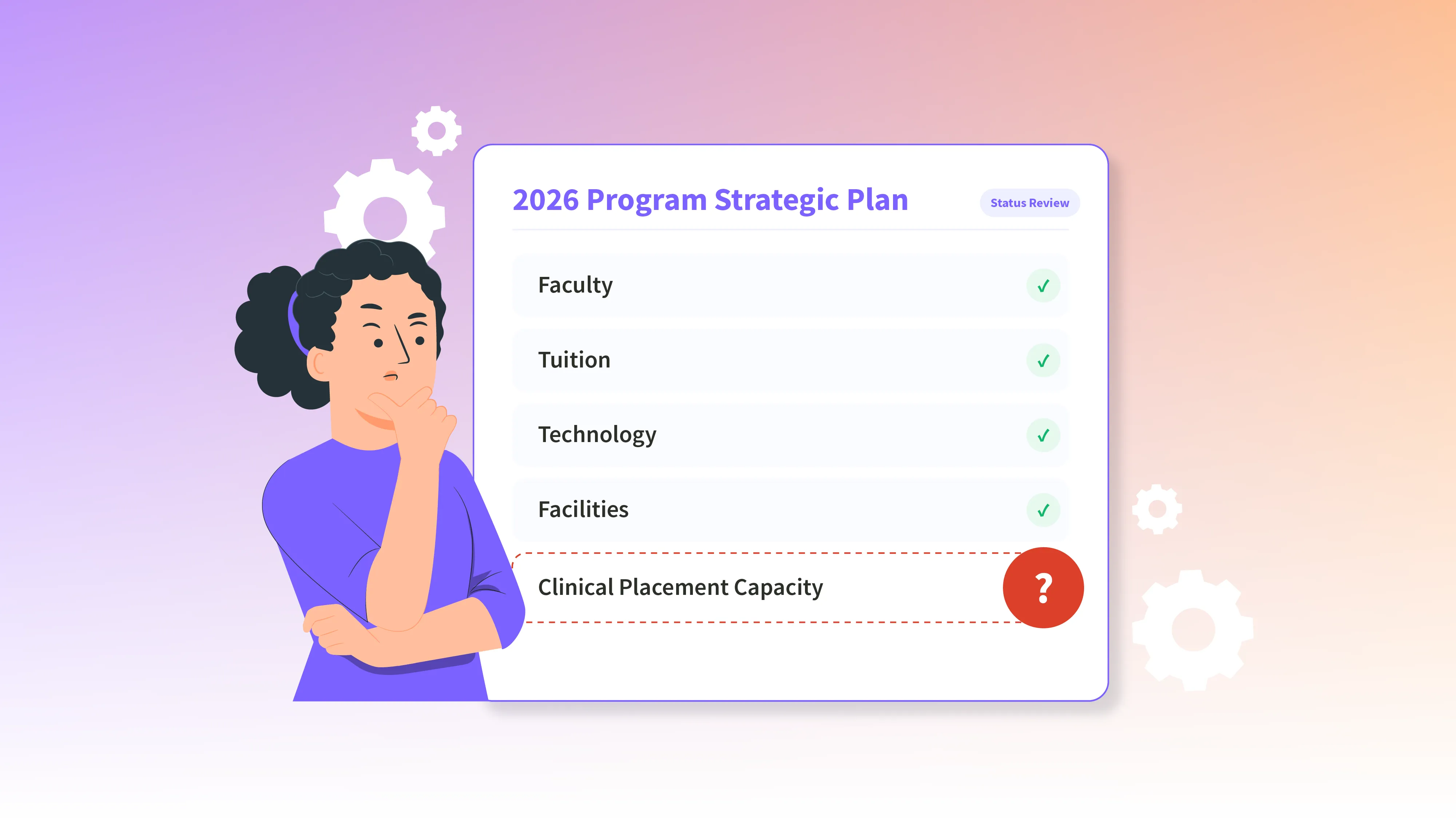
But the decision to grow enrollment depends on a variable that most strategic plans never model. A larger cohort requires a proportional increase in clinical placements, and clinical placement capacity does not expand as quickly as an admissions decision. You can enroll more students with a signature. You cannot secure the clinical sites, preceptors, and approved clinical rotations they will need with the same signature. That gap, between the enrollment a program plans for and the placement capacity it can actually deliver, is where growth either holds or stalls.
This is the part of nursing education that tends to get filed under logistics: a scheduling task, a coordinator's problem, something handled downstream once the real planning is done. Treated that way, capacity becomes the ceiling nobody budgeted for. The programs that grow enrollment without eroding quality tend to do the opposite. They treat placement capacity as infrastructure, a strategic input planned alongside faculty lines and tuition modeling, rather than a support function that reacts after the cohort is already admitted.
This article looks at how clinical placement capacity shapes enrollment growth, why the constraint is structural rather than a matter of effort, and what a sustainable model looks like for programs planning to scale. If your program is weighing an enrollment increase and wants to understand what it would take to support it on the clinical side, the NPHub university team works directly with NP and PA programs on exactly that question.
Does clinical placement capacity limit enrollment in nurse practitioner programs?
Yes. Clinical placement capacity is the true ceiling on enrollment because every nurse practitioner student must complete their required hours at approved clinical sites before they can graduate, and that capacity cannot expand as quickly as a class list. When admissions outpace a program's ability to secure clinical rotations, the shortfall does not show up at the point of admission. It surfaces mid-program, as students wait for placements they were told they would have access to.
The core issue is a mismatch in speed. Enrollment scales fast. A program can approve a larger cohort in a single planning cycle. Clinical placement capacity moves slowly, because each new placement requires a real clinician willing to precept, a site approved to host, and documentation that holds up. Those do not appear on demand.
That asymmetry means the binding constraint on growth usually is not where programs look first:
- Classroom seats rarely cap NP programs, especially when coursework is delivered online.
- Faculty lines matter, but they are not the first wall a growing cohort hits.
- Clinical placements are the actual limit, because approved sites and available preceptors are the scarcest input in the entire system.
The national data makes the ceiling visible. In its 2025-2026 survey, the American Association of Colleges of Nursing reported that master's-level nursing enrollment grew 6.8% and DNP programs marked their 22nd consecutive year of growth, yet schools still turned away a record 93,176 qualified applications, with insufficient clinical placement sites named among the primary barriers. Nearly 17,000 of those turned-away applications were to graduate programs, the exact pipeline that feeds advanced practice.
Why does NP enrollment growth stall at the clinical phase?
Enrollment growth stalls at the clinical phase because demand for clinical training has risen faster than the supply of clinicians willing to precept. A program can admit a larger cohort, but it cannot manufacture preceptors to match the cohort. Programs relying on faculty personal networks, alumni contacts, or student self-placement all run into the same bottleneck, and it is the same problem across the sector, not any one program's failure.
- Rising enrollment across graduate nursing education: Master's-level enrollment grew 6.8% in the most recent AACN survey, and DNP programs marked their 22nd consecutive year of growth. More students entering the pipeline each year means more demand for a finite number of clinical rotations.
- A thin supply of willing preceptors: The workforce is large, but the share available to teach is small. In one survey of nurse practitioners, 60% reported they were not currently precepting, with 32.8% saying their employer restricted it and others citing productivity pressure. The clinicians who do precept are contacted by multiple programs each term, which turns a limited supply into active competition.
- Fragmented sourcing with no shared process: In many programs, knowledge of who will precept lives in individual faculty inboxes and personal relationships rather than a shared system. When a faculty member leaves, those relationships leave with them, and the program restarts from a weaker position.
- Specialty concentration: The shortage is worst where demand is highest, because eligible clinicians in those areas are already stretched and heavily recruited.
The pattern underneath all four is consistent: enrollment is an internal decision a program controls, but preceptor supply is an external constraint it does not. That is why adding students does not, on its own, add capacity, and why the clinical phase is where ambitious enrollment plans most often meet their limit.
What happens when enrollment outpaces clinical placement capacity?
When enrollment grows faster than clinical placement capacity, the impact rarely stays within the clinical office. Delayed graduations, postponed tuition revenue, faculty spending time sourcing placements rather than teaching, and increased accreditation risk tend to surface simultaneously. The answer to the question, "How many students can we add?" is usually straightforward: growth can only happen as quickly as your network of approved clinical sites and qualified preceptors expands. Once enrollment moves beyond that capacity, one semester's placement backlog often becomes the starting point for the next.
The challenge comes down to a simple imbalance. A program can approve a larger incoming class during a single planning cycle, but building clinic partnerships, securing preceptors, and completing approval processes for those placements take much longer. When enrollment outpaces placement infrastructure, the consequences usually appear later in the program, when students are ready to begin clinical rotations, but there are not enough placements available.
At that point, the pressure spreads across the institution:
- Graduation and the tuition cycle: Delayed clinical hours defer completion, and every deferred completion pushes back the tuition cycle and the workforce entry tied to it. One slow placement affects one student; slow placement as the default drags the whole cohort's graduation timeline.
- Faculty strain: When sourcing has no dedicated home, the work flows to faculty, pulling hours away from teaching, mentorship, and research, the working core of a program's quality.
- Accreditation exposure: CCNE and ACEN reviewers expect documented, repeatable processes for preceptor qualification and clinical site approval. Growth built on ad-hoc sourcing widens documentation gaps, and one missing record per cohort is not a finding, but a pattern across cohorts is.
- Reputation and future admissions: Students share unstable placement experiences with peers and future applicants, so instability in one cycle quietly weakens recruiting for the next.
A program can hold strong site relationships and still run short of usable capacity in the exact specialty a cohort needs, which is why securing capacity by specialty matters more than a single headline number.
The takeaway for leadership is that responsible enrollment growth is capacity-constrained by design. A program grows as fast as it can build placement capacity, not as fast as it can admit. If your program is weighing an enrollment increase and wants to pressure-test it against real clinical capacity before the cohort is committed, the NPHub university team works with NP and PA programs to map exactly that.
How can NP programs grow enrollment sustainably?
NP programs grow enrollment sustainably by building placement capacity ahead of demand rather than scrambling to catch up to it each term. In practice, that means treating sourcing as a continuous function rather than a seasonal task, applying structured allocation of preceptors across cohorts and specialties, and running a shared process that endures faculty turnover rather than living in individual inboxes. The shift is from reactive placement filling to proactive capacity planning.
Five moves separate programs that scale from programs that stall:
- Build a continuous sourcing pipeline ahead of enrollment decisions: Capacity built before a cohort is admitted is the difference between planning and panicking. A standing network of vetted preceptors, developed by specialty and geography before students need them, gives a program room to grow without the next bottleneck arriving a semester later.
- Separate recruiting from coordination: These are different jobs on different timelines. Coordination is downstream and deadline-driven; recruiting is upstream, sourcing and vetting preceptors before they are needed. When one person owns both, recruiting always loses to the urgent, so giving it dedicated focus is what lets it happen at all.
- Apply more structured allocation across specialties and geography: Capacity only helps if it maps to the cohort a program actually plans to admit. Structured allocation matches preceptor supply to projected demand by specialty and region, so a program is not left with open primary care slots while its psychiatric-mental health students wait.
- Make vetting clinician-led so added capacity is defensible, not just larger: Growth that cannot survive a review is not real capacity. Clinician-led vetting confirms scope, teaching readiness, and clinical fit, and the verification records it produces are what hold up when accreditors ask how each preceptor was qualified.
- Keep documentation audit-ready by default and relationships continuous across cohorts: A shared system that maintains records as work happens, and retains preceptors term over term rather than rebuilding the network each cycle, is what turns a one-time win into compounding capacity.
Programs that respond to shortages as they arise stay locked in a term-to-term cycle of outreach and follow-ups. Programs that create the pipeline in advance gain visibility into pipeline strength, specialty coverage, and long-term capacity, which is exactly the visibility leadership needs to admit a larger cohort with confidence.
How NPHub builds placement capacity ahead of enrollment demand in nursing education
NPHub's preceptor recruiting function is built to expand placement capacity before a program needs it, through clinician-led oversight rather than transactional matching. The distinction matters for growth: a marketplace fills one seat and steps away, while a recruiting function builds a standing network a program can enroll into. The five pillars below exist so that added capacity holds up under accreditation review as the program scales, not just in the term it was sourced.
- A clinician-led recruiting team: Board-certified NPs source and vet every preceptor, because judging whether a clinical setting fits a rotation is a clinical decision before it is an administrative one. That judgment is what separates an available clinician from a genuinely qualified preceptor.
- A structured NP-to-NP vetting interview: Every prospective preceptor completes a focused conversation with a board-certified NP that evaluates scope of practice, specialty alignment, patient population, and teaching readiness, not just willingness to take a student.
- Credential and license integrity screening: Active licensure and board certification are verified for every preceptor, with any restriction triggering disqualification. This is the verification layer that protects a program against compliance findings later.
- Clinical site approval, handled separately from the preceptor: The site itself is reviewed for administrative readiness and program fit, because a strong clinician at an unprepared site still produces a failed placement.
- 45-day re-verification of active preceptors and sites: Clinical settings change mid-rotation as schedules shift and patient mix evolves, so preceptors and sites are re-checked on a set cadence rather than cleared once and forgotten.
Because these layers run as part of the normal workflow, the audit-ready documentation a program needs accumulates as a byproduct of the work rather than something reconstructed under review pressure. The practical effect is that capacity added this way is defensible, consistent, and built to support quality across every cohort, not just larger ones.
That is the difference between a vendor and infrastructure. A vendor is a relationship a program has to manage. Infrastructure is something a program can lean on to grow. To see how this maps to your cohort size and specialty mix, get in touch with the NPHub university team.
Capacity is a growth strategy, not a support function
Enrollment growth and clinical placement capacity are the same conversation, even when they are managed by different offices. A program can only responsibly graduate as many nurse practitioners as it can place, so the capacity to source, vet, and maintain preceptors is not a downstream logistics task. It is a strategic input that belongs in the same planning conversation as faculty lines and tuition modeling.
The programs that treat it that way are the ones positioned to scale. Demand for advanced practice is not slowing, and applicants are ready. The constraint is capacity, and capacity is buildable, but only by programs that start treating placement as infrastructure to invest in rather than a shortage to manage each term. That shift, from reacting to shortages toward building capacity on purpose, is what lets a program grow enrollment without compromising the quality of the education it delivers or the readiness of the nurse practitioners it prepares.
None of this requires a program to have the answer fully worked out. Most are somewhere in the middle of this shift, which is a reasonable place to be. Get in touch with our university team to map your planned enrollment growth against your current placement capacity and pinpoint where the gaps are.
Frequently asked questions
Does clinical placement capacity really limit enrollment growth?
Yes. Placement capacity is the true ceiling on how many nurse practitioner students a program can responsibly graduate, because every student must complete required clinical hours at approved sites before finishing. A program can admit a larger class quickly, but the clinical sites and preceptors that class needs cannot be secured on the same timeline, which is why enrollment growth stalls at the clinical phase rather than at admission.
Can an NP program grow enrollment without hiring more faculty?
In most cases, yes, because faculty headcount is rarely the first constraint a growing cohort hits. The binding limit is usually the supply of approved clinical sites and available preceptors. Moving sourcing off faculty and into a dedicated recruiting function frees faculty for teaching and research while a continuous pipeline builds the capacity growth actually requires.
How far ahead should programs build placement capacity before increasing enrollment?
Capacity should be built before a larger cohort is admitted, not after. Because sourcing, vetting, and site approval take far longer than an admissions decision, capacity assembled reactively arrives a term too late. Programs that scale well develop a standing network of vetted preceptors by specialty and region ahead of the enrollment increase, so the placements exist when students reach the clinical phase.
How does placement capacity affect accreditation as a program grows?
Growth built on ad-hoc sourcing widens documentation gaps, and those gaps are what surface during accreditation review. CCNE and ACEN reviewers expect documented, repeatable processes for how preceptors are qualified and how each clinical site is approved, and those requirements get harder to meet by hand as volume rises. A structured recruiting function keeps records audit-ready by default, so scaling enrollment strengthens compliance posture rather than eroding it.
What is the difference between expanding enrollment and expanding placement capacity?
Expanding enrollment is an internal decision a program controls; expanding placement capacity depends on external supply, which it does not. A signature can add students, but it cannot add clinicians willing to precept or sites approved to host. Sustainable growth means treating the two as one connected decision rather than admitting first and hoping capacity follows.
How does structured allocation of preceptors support enrollment growth?
Structured allocation matches preceptor supply to projected demand by specialty and geography, so capacity maps to the cohort a program actually plans to admit. Without it, a program can end up with open placements in one specialty while students in another wait, which looks like a shortage but is really a distribution problem. Allocating deliberately across areas turns a raw count of preceptors into usable, cohort-ready capacity.
Should NP students secure their own placements when a program grows?
For most programs, student self-placement is a last resort rather than a growth strategy. It shifts a structural program responsibility onto the people with the least leverage, produces uneven clinical experiences, and leaves thin compliance records that resurface at review time. Keeping placement inside a program-owned process, whether staffed internally or through a partner, produces more equitable outcomes and cleaner documentation as enrollment scales.
Find a preceptor who cares with NPHub
Book a rotation.webp)
.jpeg)

.webp)

.jpeg)

%20(3)%20(2).svg)
.webp)