
.png)



.webp)
TL;DR - Key Takeaways for NP Students
- AANP’s NPFinder and ANCC directories are the most reliable free resources for finding legitimate clinical preceptors willing to mentor nurse practitioners in training
- Professional nursing associations like NAPNAP and state NP organizations offer vetted preceptor connections with established credibility
- Students are responsible for managing their preceptor search, including being aware of the financial and logistical aspects involved
- Professional organizations often provide discounted membership fees for NP students, giving access to a wide range of benefits
- Finding preceptorships requires persistence and research, but it’s absolutely possible with the right approach and dedication
- Do your homework first using free resources, then consider professional help if needed—especially for rural areas or tight timelines
- Many paid “preceptor guarantee” services may not offer the reliability you need—they often require upfront fees and might not provide the same level of refund protection or guaranteed rotation placement as trusted platforms like NPHub
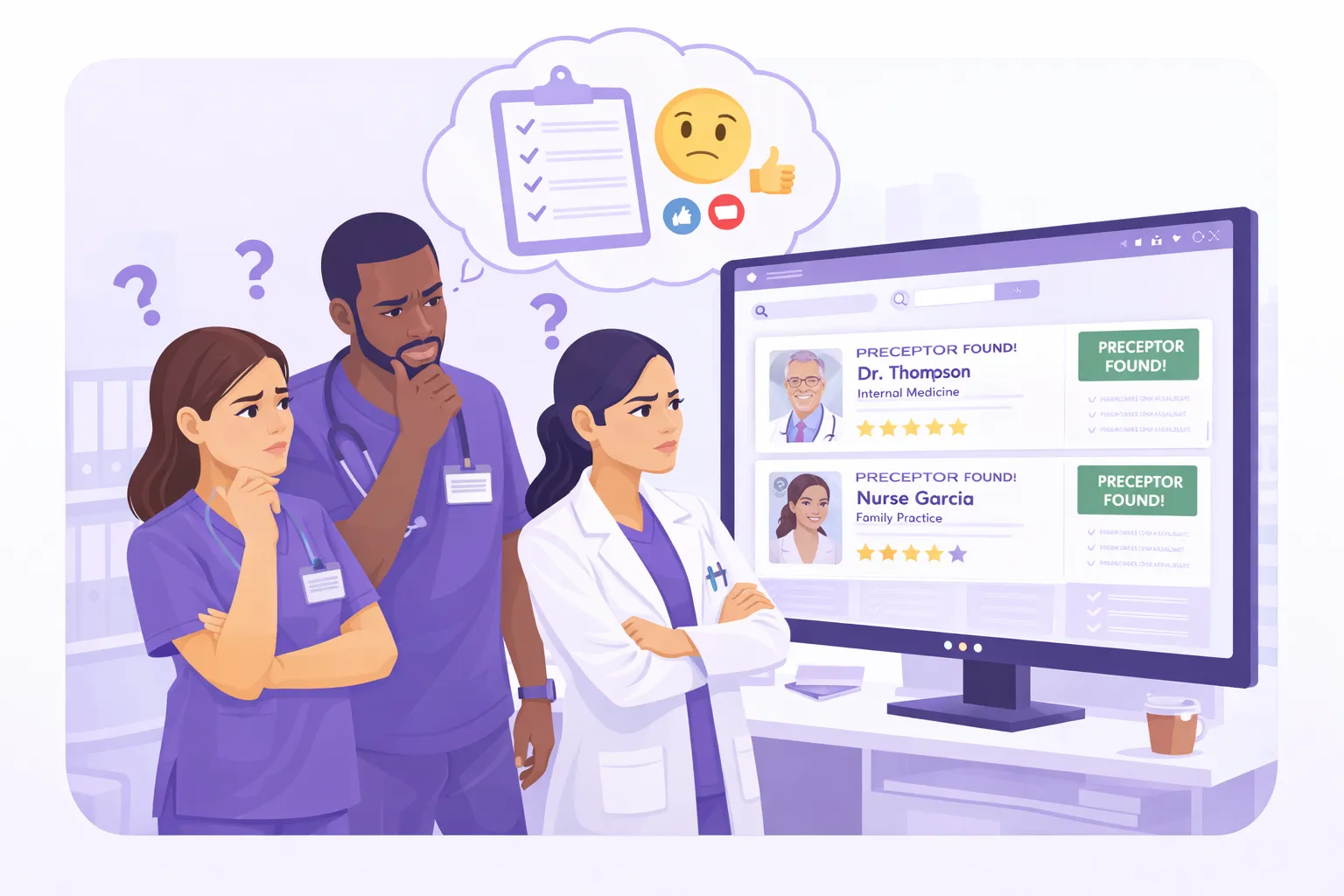
Finding a clinical preceptor can feel like searching for a needle in a haystack. You’ve worked hard to get into your NP program, conquered countless exams, and now you’re facing what many students consider the most frustrating hurdle: securing clinical placements. Using a reliable NP preceptor directory offers significant benefits, such as saving time, reducing stress, and improving placement outcomes.
The good news? Quality resources exist. The bad news? So do predatory services waiting to take advantage of stressed-out students.
This guide breaks down the np preceptor directory landscape—what works, what doesn’t, and how to tell the difference between legitimate resources and outright scams. Finding an NP preceptor directory is critical for bridging the gap between academic theory and real-world practice. Whether you choose to navigate this process yourself or seek professional help, you’ll walk away with a clear roadmap for finding the preceptor you need.
Introduction to Clinical Placements
Clinical placements are the heartbeat of every nurse practitioner’s education, transforming textbook knowledge into real-world nursing practice. Whether you’re chasing a master’s degree, a DNP, or a post-grad certificate, these hands-on clinical rotations are where you sharpen your advanced practice skills and clinical instincts.
During rotations, NP students dive into diverse clinical sites—think primary care offices, acute care hospitals, family practice clinics, women’s health centers, and pediatric units. Here, you’ll tackle acute and chronic conditions head-on, apply evidence-based care, and build the confidence to deliver top-notch patient outcomes.
Organizations like the American Nurses Credentialing Center (ANCC) know clinical experience isn’t just a checkbox—it’s the foundation for certification and licensure. Nursing programs typically require 500 to over 1,000 clinical hours, depending on your specialty and degree level. These hours are non-negotiable stepping stones to becoming a competent healthcare provider.
But let’s be real—finding preceptors and locking down clinical placements can be a major headache. With limited spots in hot specialties like family nurse practitioner, acute care, and pediatrics, the hunt can get stressful fast. Coordinating start dates, juggling paperwork, and navigating school requirements add fuel to the fire.
That’s where preceptor matching services and NP preceptor finder platforms come in. These game-changers connect you with qualified preceptors and often guarantee placements, cutting the chaos and keeping you on track to graduate. By tapping into tech and professional networks, these services let you focus on what matters most—learning and patient care.
For those in advanced tracks like DNP or seeking higher degrees, clinical placements are mission-critical. They prep you for leadership, specialized practice, and certification through bodies like the American Association of Nurse Practitioners (AANP). Family nurse practitioner programs, for example, ensure you get hands-on experience across family practice, women’s health, and pediatrics, readying you to care for patients of all ages.
Bottom line: clinical placements are the launchpad for your NP career. Use preceptor matching wisely, stay proactive, and you’ll meet program requirements, gain invaluable experience, and stride confidently into your future as a skilled nurse practitioner.
Understanding NP Preceptor Directory Options
Not all directories are created equal. Some are gold mines of verified practitioners eager to mentor the next generation of nurse practitioners. Science and evidence-based practice are foundational to nursing education and the development of nurse practitioners, ensuring that clinical reasoning and patient care are grounded in the latest research. Others are digital ghost towns with outdated contact information and unresponsive listings.
Entry into NP school is highly competitive, requiring a strong academic record and RN experience, and clinical placements are a crucial part of NP school preparation. The typical pathway to becoming a nurse practitioner starts with earning a Bachelor of Science in Nursing (BSN), obtaining RN licensure, and then pursuing a master's degree or higher. Directories are especially valuable for students progressing from RN to NP roles, as they help facilitate essential clinical experiences.
Let’s break down what’s actually worth your time.
Professional Association Directories - The Gold Standard
The American Association of Nurse Practitioners maintains NPFinder, widely considered the most trusted free resource for NP students seeking clinical experiences. This database connects students with certified practitioners who have indicated willingness to precept.
What makes association directories reliable:
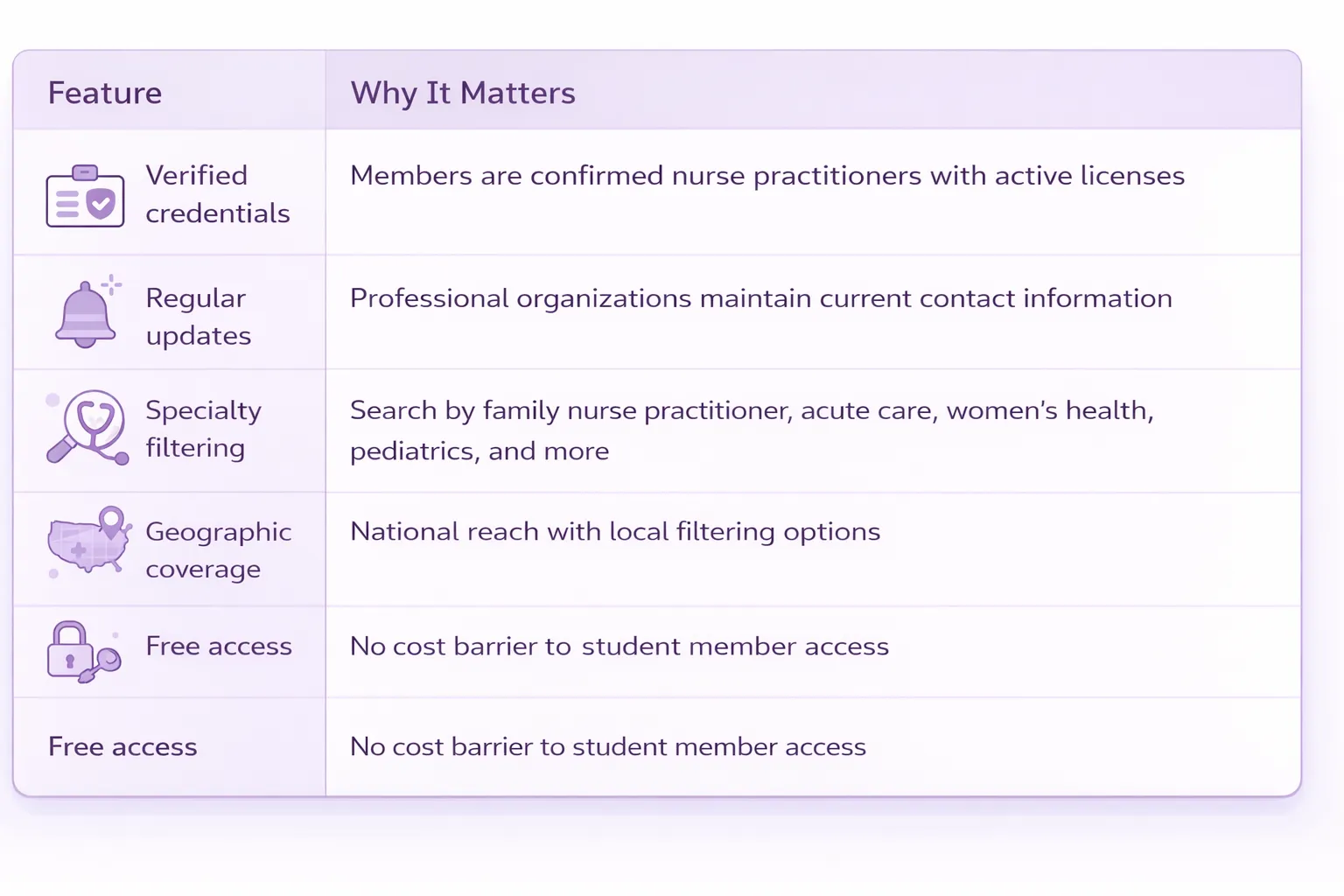
The American Nurses Credentialing Center also maintains preceptor resources through their professional network, connecting students with practitioners who hold advanced practice certification. These resources carry weight because both organizations have skin in the game—they need well-trained graduates to maintain nursing practice standards.
Limitations to consider:
Professional directories aren’t perfect. Geographic coverage can be spotty in rural areas, and popular preceptors in metropolitan regions book up months in advance. You’ll also find that simply being listed doesn’t guarantee a preceptor will respond—many practitioners receive dozens of requests and can’t accommodate everyone.
State and Regional Nursing Organizations
Your state NP association may be your secret weapon. These organizations often maintain local preceptor lists specifically for nursing programs within their region.
State associations offer advantages national directories can’t match:
- Local knowledge: They understand which healthcare systems are preceptor-friendly
- Established relationships: Many have formal agreements with clinical sites
- Community connections: Networking events connect students with practitioners face-to-face
- Updated requirements: They know state-specific program requirements and eligibility standards
Academic partnerships between nursing schools and local healthcare systems also create pipelines for clinical placement opportunities. Your school’s clinical coordinator likely has relationships with specific practices—these connections often prove more valuable than any directory.
Red Flags: Identifying Preceptor Directory Scams
The preceptor shortage has created a perfect storm for scammers. According to the American Association of Colleges of Nursing, nursing schools are turning away qualified candidates because they lack sufficient preceptors. Where there’s desperation, there are people ready to exploit it.
Warning Signs of Fraudulent Services
Before you pay anyone a dime, look for these red flags:
Large upfront payments before showing any preceptors
Legitimate services let you see what you’re getting before you pay. If someone demands $1,500 or more before they’ll even show you their preceptor database, walk away. Trustworthy preceptor matching services offer transparent pricing and allow you to assess their network first.
Guarantees that seem too good to be true
“Guarantee placement in 48 hours for any specialty!” Sound familiar? These promises ignore the reality that finding preceptors—especially for specialties like psychiatric mental health or acute care—takes time and depends on preceptor availability, not just payment.
Lack of transparent contact information
No physical business address? No phone number? Only a contact form? These are signs of a fly-by-night operation. Legitimate services aren’t afraid to be found.
No verifiable reviews or testimonials
Anyone can write fake testimonials. Look for reviews on independent platforms, not just the company’s website. Check nursing student forums and social media groups for honest feedback from real students who have used the service.
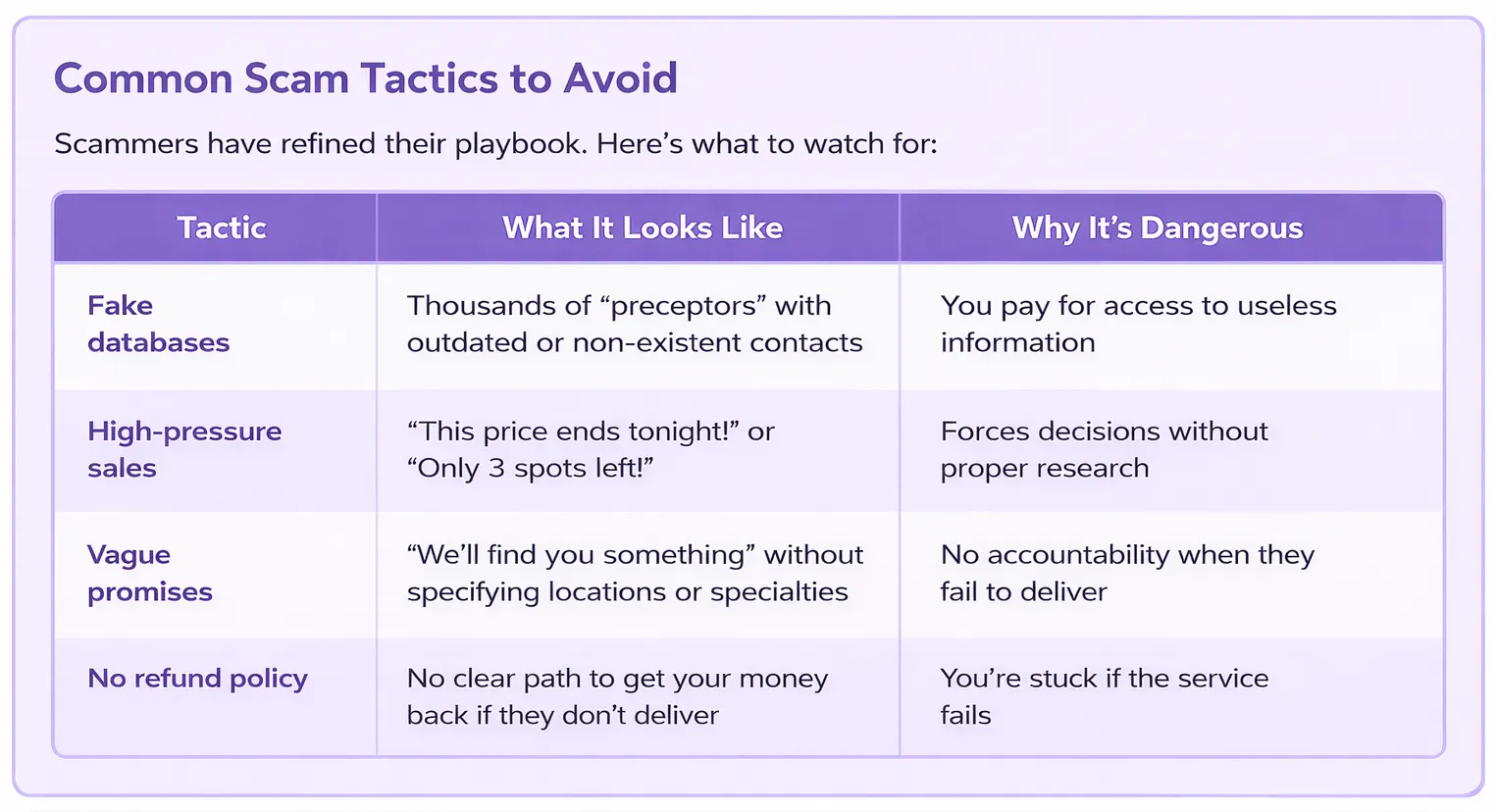
The stress of needing a preceptor makes students vulnerable. Scammers know this and use tight graduation timelines against you. Take a breath before making any payment.
Legitimate vs. Questionable Preceptor Resources
Not every paid service is a scam, and not every free resource is useful. Here’s how to sort the wheat from the chaff.
Trusted Professional Resources
AANP NPFinder
The NPFinder directory offers a comprehensive database with verified practitioner information. Filter by specialty—whether you need family practice, primary care, or acute care—and by location. It’s free and maintained by the largest professional organization for nurse practitioners in the country.
NAPNAP Student Resources
For those pursuing pediatric specialties, the National Association of Pediatric Nurse Practitioners offers preceptor connections specifically for pediatrics-focused students. Specialty organizations often have tighter networks with higher response rates.
State Nursing Boards
Many state boards maintain approved preceptor lists or can direct you to resources within your state. These lists often include practitioners who have completed required training on supervising students and handling required paperwork. Ej.Vermont Access Pass
University Clinical Placement Coordinators
Your school’s clinical coordinator should be your first call, not your last resort. They have established relationships with clinical sites and understand the specific program requirements for your dnp program or master’s degree track.
For residents in Atlanta, Georgia, more information is available through the United Advanced Practice Registered Nurses of Georgia.
Questionable or Unverified Services
Generic “preceptor finder” websites
Sites that pop up overnight, offer no information about who runs them, and provide minimal practitioner verification should raise immediate concerns. If you can’t find out who owns the business or how they vet their preceptors, your money is at risk.
Social media groups claiming guaranteed placements
Facebook groups and Instagram accounts promising preceptor connections for fees operate in a gray area. Some are run by well-meaning students or graduates sharing contacts; others are scams. Verify any claims before sending payment.
Don't miss out! Join the NPHub Official Facebook groups NOW to get the support and insider info you need on your NP Journey
Third-party brokers without nursing education credentials
If someone is selling preceptor connections but has no background in collegiate nursing education or healthcare, question their ability to understand what you need. Legitimate services employ people who understand clinical hours requirements, school approval processes, and specialty-specific needs.
Services that don’t require school approval
Any legitimate clinical placement must be approved by your nursing school. Services that claim you don’t need school involvement are setting you up for clinical hours that won’t count toward your nursing degree requirements.
When Professional Services Are Worth It
Free resources aren’t always enough. Consider professional np preceptor matching when:
- You’re in a rural area with limited local options for your specialty
- Time-pressed situations where your graduation timeline is at risk and you’ve already exhausted free resources
- Complex specialty requirements need expert matching—some specialties like women’s health or psychiatric care have fewer available preceptors
- You’ve done the homework but haven’t had success despite months of searching
The key difference between legitimate paid services and scams? Legitimate services offer a streamlined process, transparent pricing, verified preceptor networks, and clear refund policies. They also understand your program requirements and work within your school’s approval process.
Step-by-Step Directory Research Strategy
Finding preceptors requires a systematic approach. Here’s a proven strategy that most students find effective.
Phase 1: Free Professional Resources
Week 1-2: Start with the big directories
- Create accounts on AANP NPFinder and ANCC preceptor resources
- Filter by your location (expand to 50+ miles if needed)
- Filter by specialty: family nurse practitioner, acute care, primary care, etc.
- Export or save 30-50 potential contacts
Week 2-3: Tap state and specialty organizations
- Contact your state nursing association for local preceptor lists
- Reach out to specialty organizations relevant to your program (NAPNAP for pediatrics, AWHONN for women’s health)
- Check nursing organization directories for additional resources
Week 3-4: Leverage existing connections
- Ask your clinical coordinator for recommendations
- Network through alumni connections
- Reach out to clinical nurse specialists and nurse practitioners you’ve worked with as a registered nurse
- Contact classmates who may have leads on preceptors accepting multiple students
Phase 2: Expanded Search Methods
If Phase 1 doesn’t produce results, expand your approach:
Cold outreach to practices
Identify local practices and healthcare systems providing primary care or your specialty focus. Call or email practice managers to ask if any providers accept NP students. Many practices aren’t listed in directories but are open to precepting.
Professional networking
- Attend nursing conferences and local association events
- Use LinkedIn to connect with practitioners in your area
- Join professional Facebook groups (free networking, not paid placement services)
University resources
Your school may have partnerships with clinical sites you don’t know about. Schedule a meeting with your clinical coordinator to discuss all available options, including sites that have worked with students in the past.
Creative solutions
- Consider telehealth or hybrid clinical opportunities where your state board allows them
- Look at federally qualified health centers (FQHCs), which often have education missions
- Explore VA hospitals and community health centers that support nursing education
Your situation determines the best strategy. Here’s a decision framework.
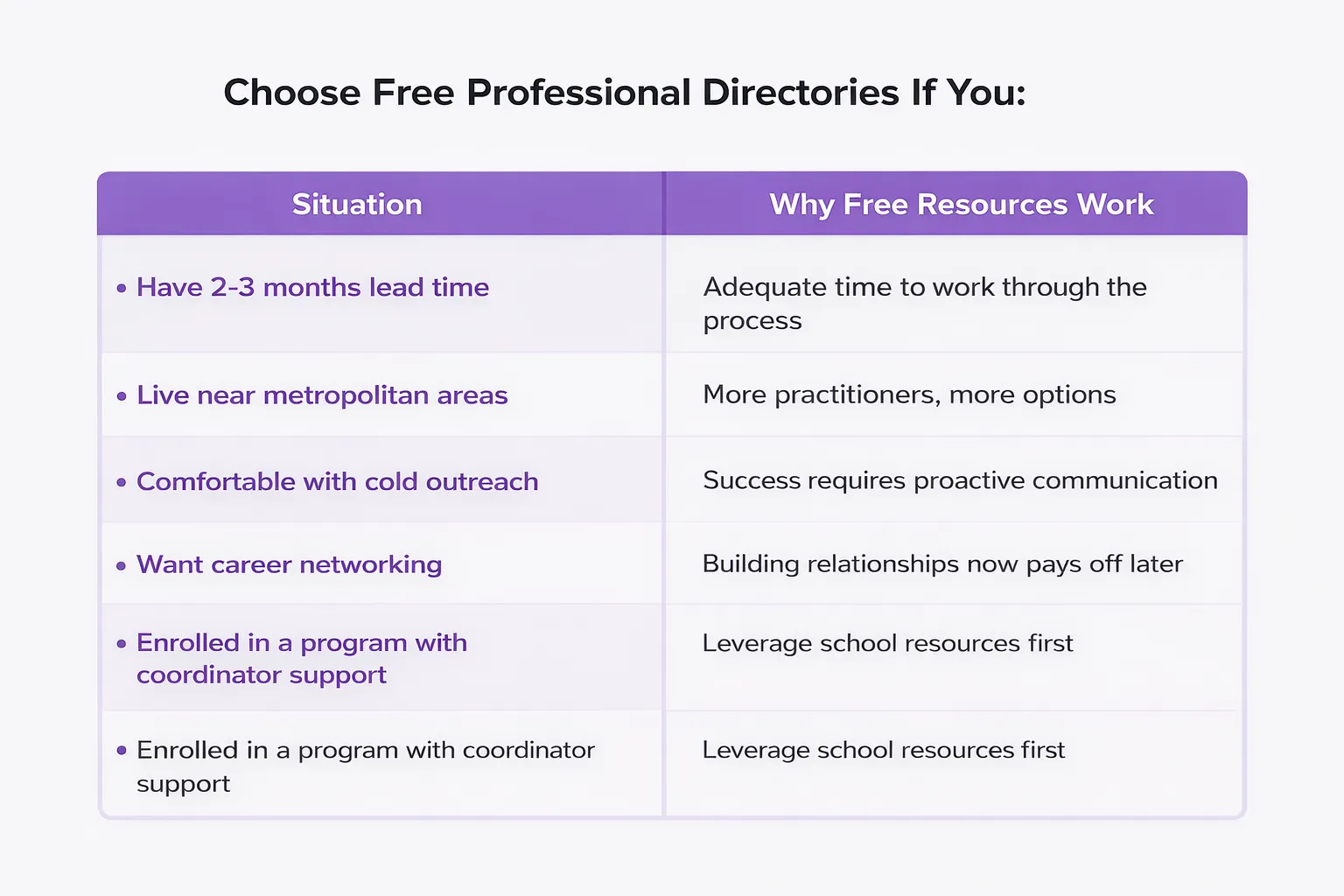
Free resources require time investment but build professional skills you’ll use throughout your career. The practitioners you contact become part of your professional network, potentially leading to job opportunities after graduation.
Consider Professional Preceptor Services If You:
Securing a clinical preceptor is often the most challenging hurdle for advanced practice registered nurse (APRN) students. While traditional search methods—such as leveraging personal connections, making cold calls, or relying on institutional lists—are the initial standard, there comes a point where professional, paid preceptor services become a necessary, strategic alternative. These services act as an essential bridge, providing vetted clinical placements when a student's self-directed efforts or institutional resources prove insufficient. Students should consider trading a financial investment for time, certainty, and access when their educational timeline is at risk.
The decision to utilize paid services often hinges on facing several common, significant challenges. For students in rural or medically underserved locations, the local pool of qualified preceptors is severely limited, making professional services with a vast, often national, network invaluable for placement. Similarly, if a student has exhausted all free options and institutional support without success, the services replace months of inefficient searching with a streamlined, targeted, and expertly vetted matching process. Furthermore, students pursuing a niche or highly specialized clinical focus can benefit from the providers' established relationships with specialty preceptors who are inaccessible through public directories.
Time-sensitive situations are a critical indicator that professional services are needed. When imminent graduation or strict program deadlines jeopardize a student's timeline, professional preceptor services guarantee speed and placement within a defined window, preventing an expensive and disruptive program delay. This focus on time also appeals to students with limited time to search due to work or family commitments. For these individuals, paying for a service is a practical, strategic way to remove a significant administrative burden and allocate their precious time to studies and personal life. Finally, services can also quickly secure "emergency" placements if a student has prior experience with failed placements or sudden preceptor cancellations.
Ultimately, while the optimal outcome is always to find a free placement, professional services offer a guaranteed solution to a systemic problem in clinical education. They convert the stress of an uncertain, time-intensive search into a predictable, reliable outcome, ensuring a concrete return on investment by protecting the student's educational timeline and minimizing the opportunity cost associated with a delayed career start.
When evaluating paid services, look for companies that:
- Offer payment plans rather than demanding full payment upfront
- Show you their preceptor network before you commit
- Handle required paperwork and clinical affiliation agreements
- Understand your specific program requirements
- Provide clear refund policies and customer support
A perfect preceptor match is worth the investment if it means graduating on time and entering the healthcare workforce prepared. But pay for quality and transparency, not promises.
Moving Forward With Confidence
The preceptor search is challenging, but it’s a challenge you can overcome. Thousands of NP students find quality clinical experiences every year, and you can too.
Start with free professional resources like AANP NPFinder and your state nursing association. Be persistent, professional, and systematic in your outreach. Treat finding a preceptor like the professional responsibility it is—because the skills you build now serve you throughout your career.
If you’ve done the homework and still struggle, legitimate professional services exist to help. Look for transparent pricing, verified preceptor networks, and companies that handle the required paperwork while respecting your school’s processes. The right service takes stress off your plate and connects you with vetted preceptors who are genuinely willing to teach.
Whether you go the DIY route or seek expert help, you’ve got this. Take action today—your future patients are counting on well-prepared nurse practitioners like you.
Key Definitions
Understanding the terminology helps you navigate conversations with schools, preceptors, and services.
NP Preceptor: A certified nurse practitioner or doctor (physician) who supervises and mentors NP students during clinical rotations. Preceptors guide students through patient assessments, provide evidence-based education on clinical practice, and co-sign documentation.
Clinical Placement: The arranged position where NP students complete required clinical hours under supervision. Each rotation typically focuses on specific patient populations or acute and chronic conditions.
Preceptor Directory: A database or listing of healthcare providers willing to supervise NP students. Quality directories verify practitioner credentials and maintain current contact information.
Clinical Affiliation Agreement: Legal contract between educational institution and clinical site allowing student placements. This document protects all parties and must be in place before clinical hours can count toward your degree.
Direct Patient Care Hours: Hands-on clinical experience time required for NP program completion and certification eligibility. Most programs require 500-1,000+ hours depending on your higher degree track. The WGU FNP program requires students to complete 650 direct patient care clinical hours in precepted settings.
Family Nurse Practitioner: A nurse practitioner specializing in family practice, providing primary care to patients of all ages. The FNP program prepares students to assess, diagnose, monitor, treat, and coordinate care for individuals across the lifespan, including women's health.
The typical duration for completing a nurse practitioner program is about two to three years, depending on the program structure and pace.
Frequently Asked Questions
How far in advance should I start looking for preceptors?
Begin your search 3-4 months before your clinical rotation start date. Popular preceptors in competitive markets book up quickly, and you need time for paperwork and school approval processes.
The rotation request and approval process alone can take 4-6 weeks at some schools. Factor in time for clinical affiliation agreements if your school doesn’t already have one with your preceptor’s practice.
Are free preceptor directories as good as paid services?
Free professional directories often have higher quality, vetted preceptors than generic paid services. The knowledge and resources available through AANP, ANCC, and specialty associations come from organizations with genuine investment in nursing education quality.
Paid services may offer more personalized matching and handle administrative burden. Your success depends more on your research effort and persistence than the directory type. Students who approach the search systematically using free resources frequently find excellent placements.
What should I do if I can’t find a preceptor through directories?
Don’t panic. You have options:
- Contact your school’s clinical coordinator for additional resources they may not have mentioned
- Expand your geographic search radius—an extra 30-minute commute beats delaying graduation
- Look into telehealth or hybrid opportunities where available and approved by your school
- Network with classmates who may have preceptors accepting multiple students
- Consider professional preceptor services with verified networks if you’ve truly exhausted free options
How can I verify if a preceptor directory service is legitimate?
Perform due diligence before paying:
- Check for business registration and physical address information
- Look for genuine student reviews on independent platforms, not just their website
- Verify they understand NP education requirements and school approval processes
- Ensure transparent pricing and clear refund policies are published
- Confirm they have an actual preceptor network, not just a database of contacts
- Ask about their process for matching and what happens if a placement falls through
Legitimate services welcome questions and provide clear answers. Scammers get vague or pushy when pressed for details.
Article details
Last updated
January 22nd, 2026
Fact-checked by
NPHub Clinical Placement Experts & Student Support Team
Sources and References
- American Association of Nurse Practitioners (AANP) - NPFinder Directory: https://npfinder.aanp.org/
- American Nurses Credentialing Center (ANCC) - Preceptor Resources: https://anpassociation.enpnetwork.com/nurse-practitioner-preceptors
- National Association of Pediatric Nurse Practitioners - NP Schools Guide: https://www.npschools.com/blog/guide-to-np-professional-associations
- Nursing License Map - Professional Organizations Directory: https://nursinglicensemap.com/resources/nursing-organizations/
- NPHub - Preceptor Matching Services:
- https://www.nphub.com
- NPHub-Searching Tool:23
- https://student.nphub.com/search
- Vermont Nurse Practitioners Association
https://vtnpa.enpnetwork.com/nurse-practitioner-preceptors - United Advanced Practice Registered Nurses of Georgia.
- https://uaprn.enpnetwork.com/
- Federally Qualified Health Centers and Rural Health Clinics
- https://www.dhcs.ca.gov/services/medi-cal/Pages/FQHC_RHC.aspx#:~:text=FQHCs%20are%20primary%20care%20clinics,and%20Policy%20for%20Requestings%20Changes.
Find a preceptor who cares with NPHub
Book a rotation.webp)
.jpeg)

.webp)
.jpeg)


%20(3)%20(2).svg)
.webp)