
.png)




.webp)
Being one preceptor short of graduation is a uniquely brutal experience. You have applications submitted, tuition paid, and family counting on you—but your inbox stays empty while classmates celebrate their secured rotations.
Finding NP preceptors in Wilmington, Delaware can be especially challenging due to limited local options. Clinical placement services can help nurse practitioner students secure clinical sites and find NP preceptors more efficiently, streamlining the process and expanding access to quality placements.
This article walks you through finding FNP and PMHNP preceptors in Wilmington and greater Delaware while keeping you in control of every decision. Wilmington may be small, but its strategic position along the I-95 corridor means you can combine local sites with nearby Pennsylvania and New Jersey options to meet your school’s requirements.
Battling Wilmington's tight preceptor market? Skip the cold calls and paperwork. Open your Free NPHub Account today. Secure your clinical placement fast and focus on planning your graduation party, not your next desperate email.
TL;DR: Key Takeaways
- Wilmington’s position as Delaware’s largest city creates a concentrated healthcare ecosystem where primary care clinics, behavioral health agencies, and major hospital systems like ChristianaCare offer accessible rotation opportunities for nurse practitioner students willing to plan ahead.
- Starting your preceptor search 9–12 months before clinicals and using a mix of direct outreach, faculty connections, and structured preceptor networks can drastically reduce last-minute panic and protect your graduation timeline.
- The emotional weight of the preceptor search is real and valid—structural issues like limited Delaware preceptors and competing student requests create the scarcity, not any failing on your part.
- Smart planning includes mapping Wilmington-area sites by commute time, preparing tailored outreach materials, and setting personal decision deadlines for when to expand your search or seek additional support.
- You will leave this guide with concrete timelines, rotation examples, and a checklist specifically tailored to Delaware NP clinicals that puts you back in the driver’s seat.
The Emotional Reality of NP Clinicals in Wilmington, Delaware
Picture this: you live twenty minutes from downtown Wilmington, your clinical start date is eight weeks away, and you are still refreshing your email for preceptor replies that never arrive. Between your current nursing shifts and helping your kids with homework, you have sent fourteen personalized emails to Delaware practices. Three responses came back—all polite rejections.
This scenario plays out across Delaware every semester. The state has approximately 2,400 licensed NPs with projected growth of 15% by 2030, yet precepting rates lag below 20% due to time constraints and competing student requests from multiple programs. More NP programs nationally means more students chasing the same limited pool of willing preceptors.
Delaware’s compact geography cuts both ways. Wilmington is the state’s largest city with roughly 71,500 residents, but it is also the only major metro area. Fewer sites than Philadelphia or Baltimore, yes—but also dense access to primary care clinics, specialty practices, and behavioral health agencies within a tight commute radius. Cross the state line and you can reach Kennett Square, PA or Salem County, NJ in under an hour.
Many NP students spend months cold-calling healthcare facilities while trying to secure clinical sites, which can be stressful and discouraging. This is why it’s crucial to have services and networks that support students throughout the clinical placement process, helping ensure timely graduation and reducing the emotional burden.
The goal of this guide is simple: walk you through what Delaware rotations actually look like, how to secure them without losing your mind, and how to feel psychologically safe and in control throughout the process. This is written from a student-first perspective, prioritizing emotional safety, transparency, and choice over speed or volume. Your graduation matters, and so does your mental health along the way.
Why Wilmington, Delaware Is a Unique Landscape for NP Clinicals
Wilmington sits along the I-95 corridor between Philadelphia and Baltimore, making it a strategic hub for NP students who need flexibility. With roughly 71,500 residents, it anchors New Castle County and serves as Delaware’s primary center for healthcare, finance, and education.
The Local Healthcare Ecosystem
The healthcare landscape in Wilmington includes:
- ChristianaCare – The state’s largest hospital system with 900+ beds, Level I trauma designation, and over 200 annual precepting slots for NP students
- Nemours Children’s Health – A major pediatric resource for FNP rotations
- Wilmington VA Medical Center – Serves veterans with primary care and mental health services
- Federally Qualified Health Centers (FQHCs) – Community health centers serving underserved populations
- Private practices and retail clinics – Scattered throughout New Castle County
Short geographic distances mean you can live in or near Wilmington while completing rotations in Newark, Dover, or even crossing state lines to Pennsylvania or New Jersey if your program permits. Delaware’s compact size is simultaneously its challenge (fewer total sites) and its advantage (everything is driveable).
Delaware’s Healthcare Needs
Delaware faces primary care shortages and growing mental health demand. The state’s suicide rate (15.5 per 100,000) exceeds the national average, driving urgent need for PMHNP graduates. One in five Delaware adults experiences mental health challenges, creating targeted opportunities for students interested in psychiatric care.
Knowing this map—understanding typical commute times, which areas have higher preceptor density, and where demand exceeds supply—helps you regain control over your clinical schedule and family life.
Finding a Preceptor in Wilmington
Let’s name what most students feel but rarely say aloud.
The embarrassment of cold calling strangers to ask for unpaid teaching time. The fear that every week without a preceptor pushes graduation further away. The isolation of watching cohort members post about their confirmed rotations while you refresh your inbox again.
Many nurse practitioner programs require students to find and organize their own clinical placements, which adds to the stress and emotional burden of securing your own clinical placements.
These feelings are valid, and they are not your fault.
Why the Search Feels So Hard
Despite the challenges related to a limited preceptor pool, competition from regional programs in Pennsylvania, Maryland, and New Jersey, constraints on clinic time due to productivity pressures, and the need to prevent burnout among experienced nurse practitioners, the Wilmington area remains a dynamic and attractive hub for NP education. With over 2,400 NPs in Delaware, there is a strong foundation of expertise, and opportunities exist to develop innovative solutions and partnerships that can expand capacity and ensure that future NP students can connect with excellent clinical training sites in this high-demand region.
When placement decisions feel like judgment on your worth as a student, remember: they are almost always about logistics, insurance, and capacity. A “no” from a Wilmington clinic is not a verdict on your potential as a provider.
Reclaiming Your Agency
You are not just a slot to be filled. You have choices about:
- How far you are willing to commute
- Which patient populations you want exposure to
- How much structured support you need versus want to handle independently
- When to expand your search versus hold firm on preferences
When you receive another rejection email, try this grounding exercise: write down one thing you learned from the interaction (even if it’s just “this clinic doesn’t take students”) and one thing you will do differently next time. Each “no” is an opportunity to learn and improve your approach, transforming rejection from a dead end into valuable data.
Types of NP Clinical Rotations Available in Wilmington and Delaware
Each school structures hours differently, but Delaware NP students typically complete 500–700+ supervised hours across two to four core settings. These nurse practitioner clinicals are required for graduation and licensure, ensuring students gain the practical experience needed to become licensed nurse practitioners in Wilmington, Delaware. Here is what you can expect to find.
Common FNP Rotations
Family nurse practitioner students in and around Wilmington often rotate through:
- Family medicine clinics serving all ages
- Internal medicine offices focusing on adults
- Pediatric practices in urban and suburban settings
- Urgent care centers handling acute presentations
- Retail clinics in pharmacy or grocery store settings
- School-based health centers
Common PMHNP Rotations
For students focused on mental health, Delaware offers:
- Outpatient psychiatry practices
- Community mental health centers serving New Castle County
- Integrated primary care–behavioral health clinics
- Inpatient psychiatric units (limited but available)
- Partial hospitalization programs
- Addiction medicine programs addressing Delaware’s opioid crisis
Specialty and Cross-Border Options
Within short drives from Wilmington, you may also access:
- Women’s health clinics
- Geriatric practices and skilled nursing facilities
- Specialty practices in nearby Kennett Square, PA
- Salem County, NJ options if your program allows out-of-state sites
Many students strategically stagger rotations—starting with primary care in Wilmington to build confidence, then adding a more specialized or rural Delaware site later. This progressive approach helps you develop clinical skills while managing commuting stress.
Tried everything and still can't find a preceptor? Have the promising ones fallen through due to paperwork or school requirements? Open a free NPHub account and find the perfect fit in Wilmington, DE, today!
Step-by-Step: How to Find an NP Preceptor in Wilmington, Delaware
Finding preceptors in Delaware requires structure, not luck. The task of identifying and securing a site for your clinical rotation that meets the needs of your nurse practitioner program is time-consuming, and the ultimate goal is to secure clinical sites that fulfill your program's requirements. This section breaks the search into clear steps: clarifying school rules, mapping local options, conducting outreach, following up, and creating backup plans.
Before you contact a single Wilmington clinic, set personal boundaries:
- Maximum commute time you can sustain for a full rotation
- Preferred patient populations (pediatrics, adults, geriatric, psychiatric)
- Your work schedule constraints and family obligations
- Non-negotiables versus preferences you could flex on
Using a mix of strategies—direct outreach, faculty and alumni networks, and structured preceptor network services—typically outperforms relying on any single approach.
Clarify Your School’s Clinical Requirements First
Your first step is not emailing clinics. It is understanding exactly what your program requires.
Review your program handbook and speak with your clinical coordinator about:
- Total required hours (typically 500–750 for FNP, 600+ for PMHNP)
- Minimum hours per population (adult, pediatrics, women’s health, psych)
- Allowable preceptor credentials (NP only? MD/DO acceptable? PA?)
- Geographic restrictions and state licensure rules
Be sure to verify your preceptor’s certification and credentials, as many university programs and clinical sites require specific certifications for approval.
Many schools leave the process of securing clinical sites up to the student, particularly with advanced practice programs.
Create a one-page summary you can reference throughout your search. If your school allows out-of-state rotations (Pennsylvania, New Jersey), confirm how this affects affiliation agreements and malpractice coverage before pursuing those sites.
After any verbal conversation with your school, send a brief confirmation email summarizing what you discussed. This creates written documentation if requirements are interpreted differently later—and it prevents the shock of a last-minute preceptor rejection after weeks of effort.
Map Wilmington and Delaware Clinical Site Options
Transform vague anxiety into a concrete, manageable list by creating a site map.
Steps to build your map:
- Identify Wilmington-area hospitals, primary care clinics, walk-in clinics, behavioral health agencies, and community health centers
- Look up each site’s website to see if they employ NPs and what specialties they cover
- Note whether sites mention student education, residency programs, or teaching missions
- Calculate realistic drive times from your home at rush hour (I-95 traffic adds unpredictability)
- Organize sites into tiers:
- High priority – Close to Wilmington, strong NP presence
- Medium priority – Slightly longer commute within Delaware
- Cross-border options – Pennsylvania or New Jersey if allowed
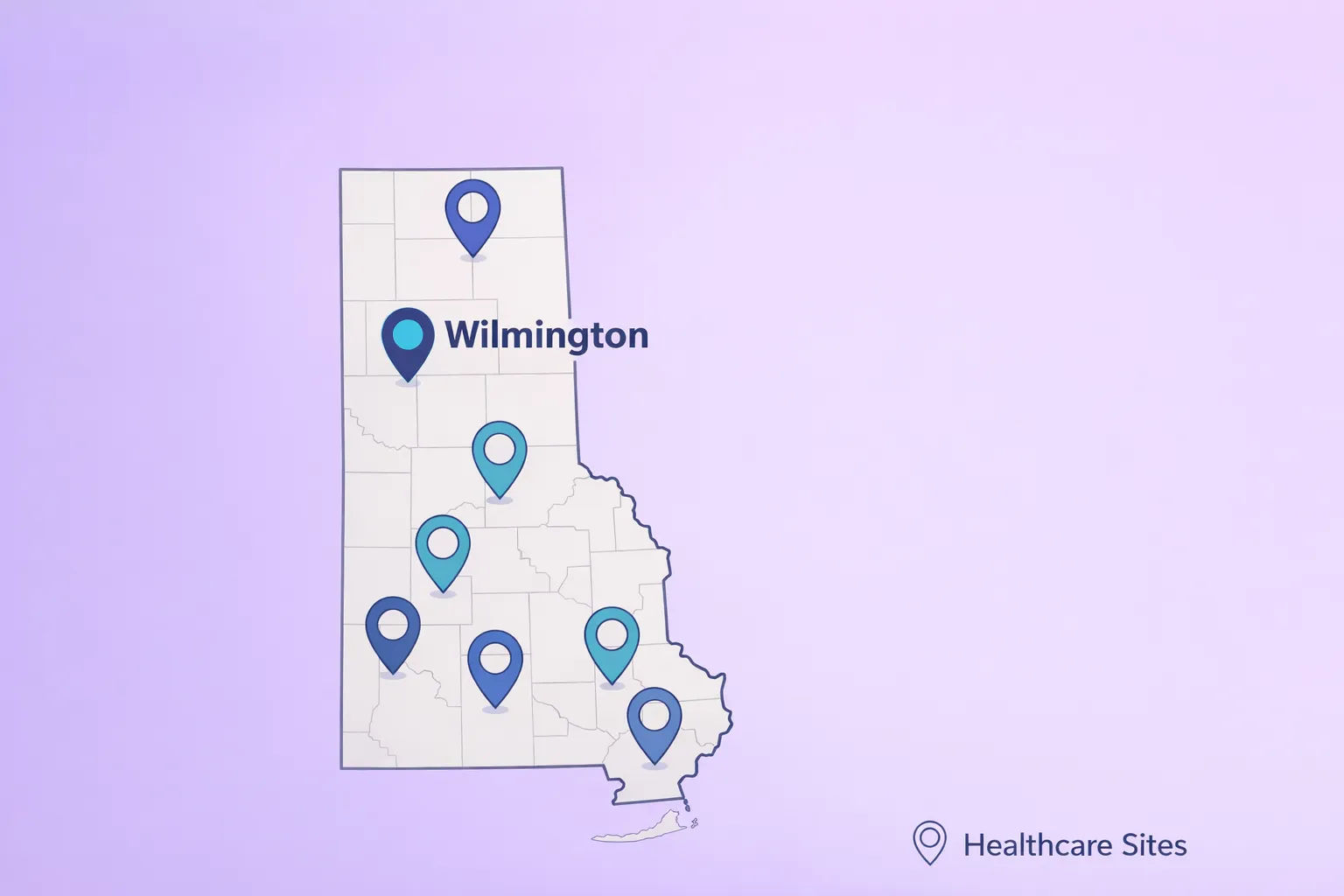
This mapping exercise makes each email or phone call feel more purposeful. You are not blindly applying everywhere—you are working through a prioritized list.
Prepare a Wilmington-Specific Outreach Script and Materials
Having prepared materials reduces the dread of each outreach attempt.
Email template components:
- Your program name and university
- Requested rotation dates
- Required hours (e.g., “I need 180 FNP hours in primary care”)
- Brief statement about why you want to serve the Wilmington community
- Clear ask (e.g., “Would you or a colleague be available to discuss precepting?”)
Keep initial emails to one or two short paragraphs. Busy Wilmington preceptors and office managers need to scan and respond quickly.
Attach a polished CV highlighting:
- Prior RN experience, especially any Delaware work (ChristianaCare, local facilities)
- Current RN license status
- Clear clinical interests (FNP primary care, PMHNP outpatient, etc.)
- Certifications and relevant training (be sure to include any certification required by your university or clinical site)
- Completed coursework or prerequisites (note which semesters or requirements you have completed to show eligibility)
Phone script basics:
- Introduce yourself concisely
- State your purpose clearly
- Ask specifically who manages student placement decisions
- Thank them for their time regardless of the answer
When you have a script, rejection feels less personal. It becomes part of a process rather than a referendum on your value.
Some placement services in Wilmington, Delaware offer payment plans to help manage rotation costs, making it easier to budget for your clinical experience.
Use Networks Intentionally (Faculty, Alumni, and Preceptor Services)
Direct outreach is not your only option. Strategic networking can dramatically shorten your search.
Faculty and alumni connections:
- Ask Delaware-based faculty if they know NPs or physicians in Wilmington who have precepted before
- Connect with program alumni working in Delaware practices
- Inquire whether your school maintains relationships with ChristianaCare or other major systems
- Associations and Coalitions
Structured preceptor networks:
Clinical placement services connect students to vetted preceptors who are already open to teaching. These networks can save 50–100+ hours of cold outreach by handling matching, paperwork, and verification.
Using a preceptor network is a choice, not an obligation. You keep control over which preceptor you accept and how far you commute. The tradeoffs are straightforward:
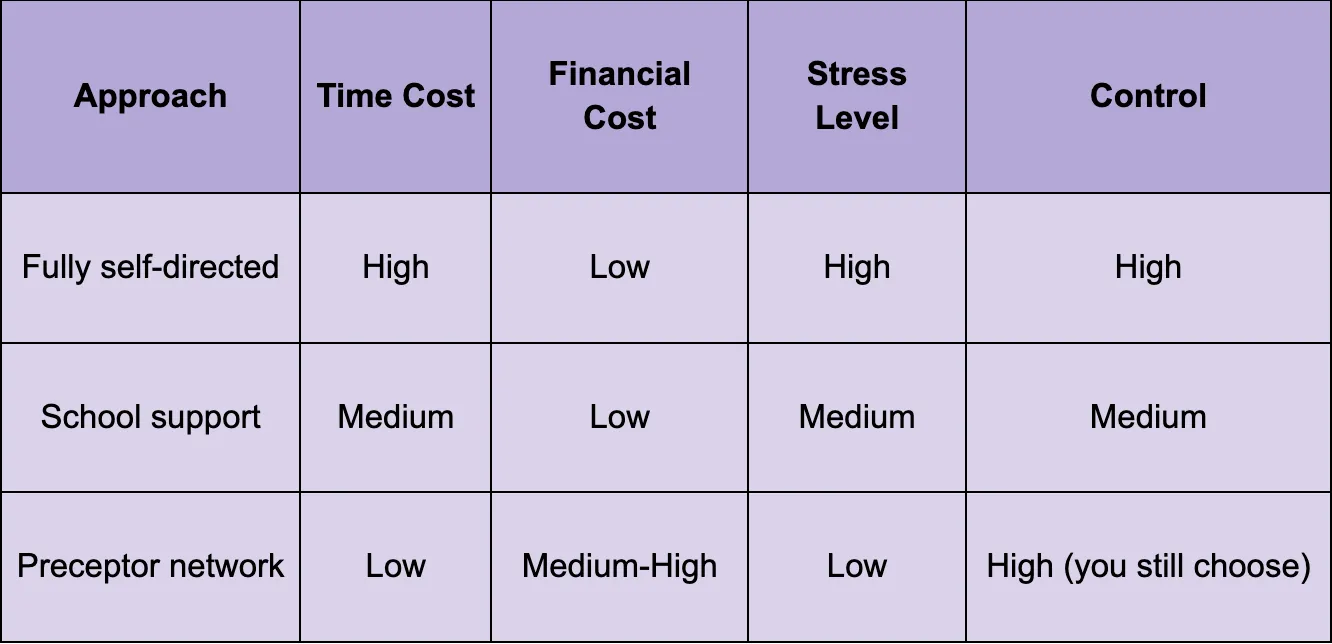
Asking for help is not failure. It is a strategic decision to protect your mental health, graduation timeline, and family responsibilities.
Follow Up, Track Responses, and Know When to Pivot
Create a tracking system to manage your search systematically.
Spreadsheet columns to include:
- Site name and location
- Contact person
- Date of initial contact
- Response status
- Next follow-up date
- Notes
Follow up once after 5–7 business days with a polite message. If you receive no response after two attempts, move the site to the bottom of your list and focus energy elsewhere.
Set a personal decision deadline—perhaps 8–10 weeks before your semester starts—after which you will strongly consider additional support from a preceptor network or expanding your search radius beyond Wilmington.
Having this timeline in writing prevents the endless feeling of being stuck. If multiple promising leads collapse simultaneously, it is a signal to widen your criteria: different clinic type, different Delaware county, or temporarily accepting a longer commute.
Stop the endless cycle of cold calls and emails to preceptors! Secure your next clinical rotation and move straight toward graduation. Create a free NPHub account and find your preceptor today!
Tradeoffs Between Different Ways to Secure a Wilmington Preceptor
There is no single “right” way to find your Wilmington preceptor. Each path has costs and benefits in terms of money, time, stress, and autonomy.
The three main approaches—self-directed search, school reliance, and preceptor networks—each serve different student situations. Choose the combination that fits your actual life constraints, not an idealized version of yourself with unlimited time.
Doing It All Yourself in Wilmington
This pathway relies on personal outreach, local contacts, and persistence with Wilmington and Delaware clinics.
Benefits:
- Lower direct financial cost
- Strong local relationships if you connect with the right preceptor
- Flexibility to pursue specific interests (e.g., a particular psychiatric practice)
Drawbacks:
- High time investment (dozens of emails, calls, follow-ups)
- High rejection rates in a competitive market
- Risk of a preceptor backing out late with no backup
This method works well for students with robust local RN networks or prior work experience in Wilmington hospitals. If you have been working at ChristianaCare for years, your colleagues may be your fastest path to securing clinical sites.
Set a clear threshold for when you will seek additional support if this path becomes overwhelming.
Relying on Your School’s Support
Some programs provide varying levels of clinical placement help, from basic site lists to formal placement coordination with Delaware hospitals.
Potential positives:
- Alignment with accreditation standards
- Familiarity with which Wilmington sites have successfully hosted students
- Streamlined compliance paperwork
Potential limitations:
- Limited number of partner sites in a small state
- Prioritization queues that may disadvantage newer students
- Popular specialties (like PMHNP) filling quickly
Ask your school early: How many Delaware preceptors do you typically work with? Are Wilmington spots competitive? What happens if your support pipeline falls through?
Even when schools help, you still have a voice in what works for your commute, childcare, and work schedule. Do not assume school placement means you lose control.
Using Structured Preceptor Networks and Placement Services
This option involves working with an organization that maintains a network of vetted preceptors and actively matches students to open rotations.
Benefits:
- Significantly reduced search time
- Support with paperwork for Delaware schools and clinical sites
- Backup options if a preceptor cannot continue a rotation
- Access to available preceptors who are already willing to teach
NPHub stands out by having secured over 10,000 placements for nurse practitioner students and placing more than 8,000 NP students nationwide since its inception. They provide full paperwork support to handle all required documentation for clinical placements, offer a 12-month payment plan to help manage costs, and have a network of over 2,000 active preceptors available for placements. Students can filter NP preceptors by location, specialty, and start date through NPHub's preceptor matching service. NPHub provides a 100% money-back guarantee and will issue a full refund if they cannot match a student with a preceptor in their area, ensuring customer satisfaction. Students using NPHub typically secure their rotation in just 2-3 weeks.
Considerations:
- Financial cost (varies by service)
- Need to verify proposed preceptors meet your program’s requirements
- Ensuring the site aligns with your career development goals
This approach is often most valuable when timelines are tight, previous outreach has stalled, or you need rotations in harder-to-place specialties like PMHNP.
You remain in control: ask questions, decline matches that do not feel right, and balance network options with your own outreach.
.webp)
Planning Your Wilmington NP Clinical Timeline (So You Don’t Panic Later)
A realistic timeline is a form of self-protection against burnout and last-minute scrambling.
Before starting clinicals in Wilmington, Delaware, make sure you have completed all required coursework and prerequisites as specified by your program. Most university and health system approval windows require 4–8 weeks for affiliation agreements with new Delaware sites. Build a small buffer for unexpected delays: preceptor illness, site policy changes, or school breaks.
Sample 9–12 Month Timeline for Wilmington / Delaware Rotations
9–12 months before rotations:
- Confirm you are officially enrolled in your program
- Clarify program requirements with your advisor
- Review your program handbook thoroughly
- Start mapping Wilmington and statewide site options
- Identify faculty or alumni who might connect you to preceptors
6–9 months before rotations:
- Begin active outreach to preferred Delaware clinics
- Request introductions from faculty and former colleagues
- Explore whether you want to engage with preceptor networks
- Track all contacts in your spreadsheet
3–6 months before rotations:
- Finalize preceptor commitments in Wilmington or surrounding Delaware towns
- Submit required paperwork to your school
- Complete onboarding requirements (background checks, vaccines, training modules)
- Confirm affiliation agreements are processing
1–3 months before rotations:
- Confirm schedule specifics with your clinical preceptor
- Verify EHR training plans and access credentials
- Plan commute logistics and parking
- Prepare your home and work schedule for the rotation start
- Review common conditions you will likely encounter
Treat this timeline as flexible scaffolding. Adjust based on when your program actually opens the clinical clearance process.
Thriving (Not Just Surviving) During Wilmington NP Clinicals
Securing a preceptor is only the first challenge. The next is walking into a new Delaware clinics, where the primary goal during clinicals is to learn practical skills and knowledge in real-world settings, without feeling overwhelmed.
Preparing for Day One
Research each site before you arrive:
- What patient population does this Wilmington clinic typically serve?
- What chronic conditions are common in this community?
- What social determinants of health affect this neighborhood?
Build a simple learning plan for each rotation with 3–5 specific goals:
- Independently managing common chronic conditions
- Strengthening psychiatric interview skills (for PMHNP)
- Developing comfort with pediatric well-visits (for FNP)
- Building critical thinking around complex presentations
Share your goals with your experienced preceptor early. Most preceptors appreciate students who arrive with clear intentions and openness to constructive feedback. Remember to meet professional expectations during your clinical rotations in Wilmington, Delaware, including punctuality, appropriate dress code, and proactive engagement with your preceptor and patients.
Communication Strategies with Busy Preceptors
How to ask for feedback:
- Be specific: “How was my assessment of that patient’s anxiety symptoms?”
- Choose appropriate moments (not during a crisis)
- Accept feedback gracefully, even when it stings
Managing uncertainty:
- Ask clarifying questions rather than freezing
- Say “I’m not sure, but here’s my thinking” instead of silence
- Debrief difficult encounters after the patient leaves
It is normal to feel clumsy at first. Experienced Wilmington-area nurse practitioner preceptors understand the steep learning curve for NP students completing their educational journey.
Navigating FNP vs PMHNP Clinicals in Delaware
FNP rotations in Wilmington typically involve:
- Higher volume of acute visits
- Chronic disease management (diabetes, hypertension, COPD)
- Broad age ranges across the lifespan
- Hands on experience with procedures (suturing, injections)
- Preparation focus: primary care guidelines, lab interpretation, common presentations
PMHNP rotations in Delaware often emphasize:
- Mood disorders, anxiety, and trauma-related conditions
- Substance use and addiction medicine (relevant given Delaware’s opioid crisis)
- Stronger interviewing and boundary-setting skills
- Mental status examinations and psychopharmacology
- Preparation focus: DSM criteria, medication interactions, safety assessments
Students who complete both FNP and PMHNP hours in Delaware notice significant overlap in core competencies: motivational interviewing, crisis de-escalation, care coordination. Building these complementary skills in a small state lets you follow patients and families across settings, deepening empathy and clinical judgment.
Clinical Rotation Evaluation: How Your Performance Is Assessed and Why It Matters
Clinical rotation evaluation is at the heart of your nurse practitioner education—and as an NP student in Wilmington and across Delaware, you know this is where the real challenge begins. You're juggling classroom learning, clinical placement planning, and hands-on experience, all while trying to prove you're ready to step into the role that will help solve America's healthcare crisis. It's not just about showing up to your rotations—you're under pressure to demonstrate your clinical skills, critical thinking, and readiness when the system already makes it harder for NP students than it should be. But here's the truth: every skill you master and every evaluation you complete brings you closer to becoming the healthcare provider your community desperately needs.
Contingency Planning: When Your Wilmington Rotation Falls Through
Even well-planned Delaware clinicals sometimes collapse.
A preceptor gets sick. A clinic changes its student policy mid-semester. Staffing shortages make training untenable. These things happen, often with little warning.
Emotional Preparation
Prepare for this possibility early so that if it happens, you see it as a systems problem, not a personal failure. The preceptor market in a small state like Delaware is genuinely tight. A rotation falling through reflects logistics, not your worth.
Practical Backup Steps
Maintain a backup list:
- 2–3 Wilmington or Delaware preceptors who expressed tentative interest
- Sites that gave positive signals even if they could not commit initially
- Cross-border options you researched but did not pursue
If a rotation is canceled:
- Notify your clinical coordinator in writing immediately
- Ask about school-supported alternatives
- Decide whether to re-open your search radius or engage preceptor networks
- Review your backup list and reach out the same day
Protect your graduation timeline and mental health with smart contingency planning—stop spiraling and start acting! Open your free NPHub account today and get the tools you need to stay on track.
Key Definitions for Delaware NP Clinicals
Let’s clarify the terms you will encounter throughout your clinical journey in Wilmington and beyond.
Term Definition
NP Clinicals
Structured, school-required hands-on rotations where Delaware NP students (FNP, PMHNP, AGNP, etc.) apply classroom knowledge with real patients under supervision. Most programs require 500–750 total hours.
Preceptor
A licensed, practicing clinician—often a nurse practitioner, sometimes a physician or PA depending on program rules—with at least 1–2 years of practice who teaches, observes, and evaluates you in a real Wilmington-area setting. Preceptors are expected to uphold professional expectations, including fostering student initiative, engagement, and proactive learning.
Clinical Placement
The combination of an approved site (e.g., a Wilmington family practice, Newark hospital-based clinic, or Dover community health center) plus a specific clinical preceptor and scheduled hours that meet your program’s criteria. Clinical placements require adherence to professional standards, including compliance with the dress code and demonstration of professional expectations such as curiosity and initiative.
Certification
Official recognition or credential required for preceptors, often necessary for university program approval and to meet clinical site requirements in Wilmington, Delaware.
Enrolled
Students must be officially enrolled in a graduate nursing program to be eligible for clinical placements in Wilmington.
Completed
Students must have completed required coursework or semesters in their graduate program before starting clinical placements.
Participate
To participate in clinicals, students must meet all eligibility requirements, including being enrolled in the program and having completed necessary prerequisites.
FNP Clinicals
Rotations focusing on family practice across the lifespan (pediatrics, adult, geriatric) often in primary care clinics, urgent care centers, and retail clinics in and around Wilmington.
PMHNP Clinicals
Mental health-focused rotations in settings such as outpatient psychiatry, community mental health centers, inpatient psychiatric units, or private psychiatric practices serving Wilmington and greater Delaware.
Understanding these definitions helps you communicate clearly with schools, sites, and potential preceptors. When everyone speaks the same language, paperwork moves faster and misunderstandings decrease.
Need assistance with your upcoming rotation's paperwork? Start your clinicals stress-free and speed up the process by opening a free NPHub account today!
FAQs About NP Clinicals and Preceptors in Wilmington, Delaware
How early should I start looking for an NP preceptor in Wilmington?
Most students should begin clarifying school requirements and mapping Wilmington and Delaware sites 9–12 months before clinicals start. Active outreach should begin 6–9 months prior.
Smaller states like Delaware have more competition for each preceptor, so earlier outreach improves your chances of finding a match that fits your commute and specialty interests. If you are already closer to your start date, structured preceptor networks and expanding your geographic search can still help recover lost time.
Can I complete all of my NP clinicals inside Wilmington city limits?
It depends on your program’s requirements and local site capacity. Some students secure enough primary care and psychiatric hours within Wilmington alone, while others combine city rotations with nearby towns like Newark, Middletown, or Dover.
Variety across settings—urban, suburban, and possibly rural Delaware—can strengthen your clinical experience and may be encouraged by some schools. Confirm with your advisor whether they expect exposure to multiple practice environments before limiting your search to Wilmington proper.
Are physician preceptors allowed for NP clinicals in Delaware?
Many NP programs do allow physicians (MD/DO) or PAs to precept for some or all rotations, but this is entirely program-specific. You must confirm with your school whether Delaware-licensed physicians in family medicine, internal medicine, pediatrics, or psychiatry can count toward your required hours.
Including physician preceptors can expand your options in a compact market like Delaware, especially when most preceptors who are NPs are already committed to multiple students.
What if my school rejects a preceptor I found in Delaware?
Common reasons for rejection include insufficient preceptor experience, credential mismatches, site failure to meet affiliation or insurance standards, or conflicts with program policies.
Request specific written feedback from your school so you understand which criteria were not met. Share that feedback with any preceptor network or other potential sites to ensure your next match aligns with the program’s standards from the start.
How do I balance work, family, and commuting to Delaware clinicals?
Start with realistic planning: calculate weekly hours including charting time and commute, then discuss schedule options with your preceptor early in the rotation.
Consider clustering clinical days when possible (two longer days instead of four short ones) to reduce total commute time, especially if your site is outside central Wilmington. Schedule specific times for rest, family, and study. Revisit your commitments if you notice signs of burnout during the semester—protecting your mental health is essential to completing your program successfully.
Article details
- Last updated
February 26, 2026
- Fact-checked by
NPHub Clinical Placement Experts & Student Support Team
- Sources and references
- https://www.bizjournals.com/philadelphia/news/2024/02/05/brandywine-residential-conversion-office.html#:~:text=In%20the%20past%2015%20years%2C%20Buccini/Pollin%20Group,71%2C569%2C%20according%20to%20the%20U.S.%20Census%20Bureau.
- https://residency.christianacare.org/em#:~:text=ChristianaCare%20is:%20*%20Delaware's%20only%20Level%20I,9th%20for%20emergency%20visits%20on%20east%20coast
- https://www.nemours.org/education/gme/nurse-practitioner-fellowship.html
- https://www.va.gov/wilmington-health-care/health-services/
- https://dhss.delaware.gov/wp-content/uploads/sites/10/dph/pdf/fqhcs.pdf
- https://pmc.ncbi.nlm.nih.gov/articles/PMC10810289/
- https://www.nami.org/wp-content/uploads/2025/05/Delaware-GRPA-Data-Sheet-8.5-x-11-wide.pdf
- https://www.nphub.com/blog/np-emotional-resilience
- https://pubmed.ncbi.nlm.nih.gov/37851338/
- https://www.yelp.com/search?find_desc=Private+Practice+Doctor&find_loc=Kennett+Square%2C+PA+19348
- https://www.actshealthservices.org/locations/delaware/wilmington/skilled-nursing/
- https://www.nphub.com/blog/the-ultimate-no-bs-guide-to-scoring-free-np-preceptors
- https://dcnpweb.enpnetwork.com/nurse-practitioner-preceptors/948191
- https://courts.delaware.gov/bbe/preceptor.aspx
- https://dpr.delaware.gov/boards/nursing/
- https://aorndelaware.nursingnetwork.com/nursing-preceptors
- https://www.nphub.com/blog/find-np-clinical-rotation-tips
Find a preceptor who cares with NPHub
Book a rotation.webp)
.jpeg)

.webp)

.jpeg)

%20(3)%20(2).svg)
.webp)