
.png)



.webp)
If you’re considering Salt Lake City, Utah, you’re looking at a healthcare-rich environment with genuine options—and with the right approach, you can build a clinical experience that supports both your learning and your well-being.
TL;DR: Main Steps to Find and Secure NP Preceptors in Salt Lake City
This section provides a quick-reference summary for students ready to take action on their preceptor search in the salt lake area.
Core Steps
- Clarify requirements: Know your program’s clinical hour requirements and review Utah’s nurse practitioner scope of practice and collaborative agreement expectations
- Map your target area: Identify neighborhoods in and around Salt Lake City that match your commute tolerance and learning interests
- Build your list: Compile 15-20 potential clinics and providers using program resources, health system directories, and professional organizations
- Start outreach early: Begin personalized emails 6-9 months before your clinical term, allowing time for follow-up and plan adjustments
- Confirm expectations: Before finalizing, discuss teaching style, patient load, prescribing exposure, and emotional safety with each potential preceptor
Looking for a preceptor for your next rotation in Salt Lake City? Our specialized team is ready to help you secure a placement today. Create your Free NPHub account now to explore all the available options.
Salt Lake City, Utah at a Glance for NP Students
Salt Lake City sits as Utah’s capital and largest city, positioned in the salt lake valley along the Wasatch front at roughly 4,300 feet elevation. The great salt lake lies just west of the city limits, creating the distinctive lake effect weather patterns that bring fresh powder to nearby slopes in winter and sunny, dry summers.
The city’s history offers context for its organized layout and community values:
- Founded on July 24, 1847, by 148 Mormon pioneers led by Brigham Young who established the settlement after fleeing persecution in the east
- The grid street system centers on temple square, with all addresses oriented along cardinal directions—making navigation surprisingly intuitive for newcomers
- Known as the crossroads of the west due to its position at the intersection of I-15, I-80, and I-215, plus connections through salt lake international airport
For NP students, what matters most is this: the metro population exceeds 1 million when you include suburbs like West Valley City, Sandy, Murray, and Bountiful. This density creates a healthcare ecosystem with hospitals, community clinics, urgent care centers, and specialty practices spread throughout the valley.
Salt Lake City’s economy rests on government, healthcare, education, technology, outdoor industry, and tourism. This diversification stabilizes healthcare employment and means you’ll find varied clinical exposure—from academic medicine at the University of Utah to community health centers serving underserved populations in west valley neighborhoods. The city functions as a major employer of nurse practitioners, physicians, and other healthcare professionals, giving you a realistic preview of your future job market.
Nurse Practitioner Practice in Utah and Salt Lake City
Understanding Utah’s practice environment before you start your preceptor search gives you a foundation for asking the right questions and setting appropriate expectations. The state’s regulatory framework shapes everything from what you’ll observe during clinicals to how you might practice after graduation.
Utah Nurse Practitioner Scope of Practice
Utah is recognized as a state with relatively broad practice authority for nurse practitioners, though it’s classified as a restricted practice state rather than a full practice authority state. This means NPs can diagnose, manage treatments, interpret diagnostic tests, and prescribe medications—including many controlled substances—after meeting specific state requirements.
The key distinction: Utah requires completion of approximately 2,000 collaborative practice hours before NPs can prescribe Schedule II through V controlled substances with reduced supervision. During your clinical rotations and early career, you’ll likely work within a collaborative framework.
For current, detailed requirements, verify information through the Utah Division of Occupational and Professional Licensing (DOPL) and the Utah Nurse Practice Act. Regulations shift, and what applies during your clinicals may evolve by the time you enter practice.
Utah Nurse Practitioner Collaborative Agreement
A Utah nurse practitioner collaborative agreement is a formal arrangement—when required—between an NP and a collaborating physician or health system. This document typically outlines:
- Prescribing parameters, especially for controlled substances
- Consultation expectations and referral protocols
- Chart review and quality assurance processes
- Communication methods and availability
For NP students, this matters because your preceptor’s relationship with their collaborating physician can influence your clinical experience. Some preceptors work in settings with highly structured collaboration; others practice with significant independence. Neither is inherently better—what matters is finding a match that supports your learning style.
The Emotional Impact for Students
Clearer state practice rules can actually reduce anxiety during clinicals. When you understand what NPs in Utah are allowed to do—and what requires collaboration—you spend less mental energy worrying about legal boundaries and more energy learning patient care.
Hospital-based systems, community health centers, and private practices in the salt lake area each interpret NP roles somewhat differently. During your preceptor interviews, ask specific questions:
- What assessments and procedures will I observe and participate in?
- How does prescribing work in this practice?
- What’s the typical patient load, and how much teaching time is built into the day?
Asking these questions isn't about being overly demanding—it's about making sure the clinical placement offers a valuable learning experience. If you are still searching for a placement in Salt Lake City, sign up for a free NPHub account to explore all the available options.
Finding and Securing NP Preceptors in Salt Lake City
If you’re an NP student in or near Salt Lake City feeling stressed about securing clinical placements, take a breath. This is manageable. With a methodical plan, you can build a list of options, conduct targeted outreach, and secure a preceptor who respects both your learning needs and your boundaries.
Identifying Potential Sites
Start by mapping out where NP preceptors practice within Salt Lake City and surrounding communities. Your realistic radius includes:
- Downtown/University District (0-10 minutes from Downtown SLC): Academic centers, specialty clinics, TRAX access
- Murray, Midvale, West Valley City (15-25 minutes): Community hospitals, primary care, urgent care
- Sandy, Draper, South Jordan (20-35 minutes): Suburban family practice, pediatrics, women’s health
- Bountiful, Layton (20-40 minutes north): Mix of community clinics and health systems
- Ogden (40-50 minutes north): Urban healthcare options, FQHCs
- Provo (45-60 minutes south): University town, varied clinical settings
Use these resources to build your initial list:
- Your NP program’s clinical placement office and existing preceptor lists
- Health system career and provider directories (University of Utah Health, Intermountain Healthcare)
- Professional association membership directories (Utah Nurse Practitioners organization)
- Federally Qualified Health Center locators for underserved population experience
- Simple Google searches for “family practice NP Salt Lake City” or similar
Connect Strategy to Emotional Benefits
Every step of this process should serve both practical and emotional goals. For example:
- Mapping options along TRAX and bus lines helps you avoid exhausting commutes that lead to burnout during intensive clinical semesters
- Building a longer list of possibilities means you’re never desperate or forced to accept a placement that feels unsafe
- Starting early gives you negotiating power and time to course correct if your first choices don’t work out
Typical Preceptor Settings in Salt Lake City
NP students in the salt lake area typically rotate through:
- Primary care and family practice clinics in suburban neighborhoods
- Internal medicine practices near downtown hospitals
- Pediatric and women’s health clinics throughout the valley
- Emergency departments and urgent care centers
- Mental health and behavioral health practices
- Community health centers serving underserved populations along the west side of the valley
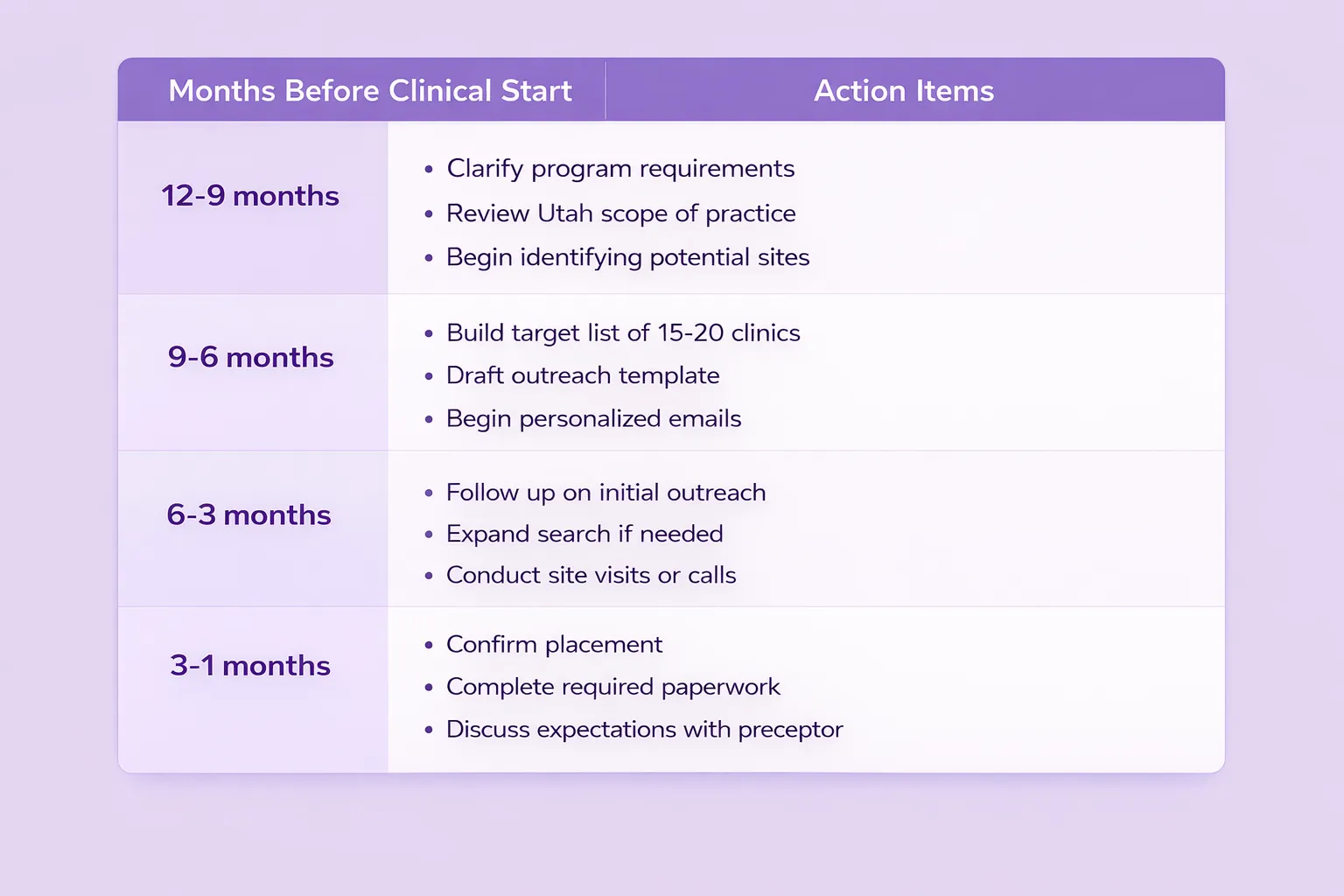
Start your outreach 6 to 9 months before your clinical term begins. Keep a simple tracking spreadsheet with clinic names, contact information, dates of outreach, and responses. This structure transforms an overwhelming task into a visible, manageable project.
Struggling to secure a preceptor for your next rotation through tedious cold calls and emails? Stop searching! Open a Free NPHub account now and secure your preceptor placement, starting with Salt Lake City.
Best Clinical Areas and Neighborhoods for NP Students in SLC
Salt Lake City’s neighborhoods each offer different clinical experiences, commute patterns, and levels of intensity. Choosing where to focus your preceptor search is partly about learning goals and partly about what you can sustain emotionally during a demanding semester.
Downtown Salt Lake City and the University District
The area around the University of Utah and University of Utah Hospital offers exposure to academic medicine, complex cases, and subspecialty consultation. The main street corridor and areas near city creek center provide urban density with restaurants, lodging options for visiting students, and cultural amenities.
Pros:
- High acuity, diverse patient populations
- Strong teaching culture in academic settings
- TRAX Red Line provides easy access without a car
Cons:
- Faster pace may feel overwhelming early in training
- Competition for placements can be intense
Central Valley: Murray, Midvale, West Valley City
These communities house large community hospitals, urgent care centers, and primary care clinics. You’ll see a mix of acute and outpatient experience with more moderate commute options.
Intermountain Healthcare operates major facilities throughout this area, handling approximately 70% of Utah births and employing thousands of advanced practice providers. This makes the central valley a practical target for students seeking primary care and women’s health rotations.
East Side: Sugar House, Millcreek, Holladay
These neighborhoods offer a blend of family practice, pediatrics, and specialty clinics serving diverse ages and socioeconomic groups. Located east of downtown toward the mountains, they provide easy access to a big cottonwood canyon and other mountain recreation for stress relief between shifts.
The balance of clinical variety and quality of life makes these areas attractive for students who want to explore hiking, climbing, or skiing during their free time.
Beyond the City Limits
Don’t forget that widening your radius to include Sandy, Draper, Bountiful, Layton, Ogden, or even Provo can significantly increase preceptor choices and reduce competition. A 45-minute commute may be worth it for a preceptor who genuinely invests in your education.
Building a Salt Lake City Preceptor Search Plan
A clear, student-directed plan transforms a stressful scramble into a manageable project. When you can see the steps laid out and track your progress, the emotional weight of uncertainty decreases.
Suggested Timeline
Prioritizing Your Outreach
Start with settings that directly fulfill your required clinical hours—whether that’s family practice, adult-gerontology, pediatrics, women’s health, or mental health. Then expand to:
- Urgent care and emergency settings for acute care experience
- Specialty clinics aligned with your interests
- Rural or suburban sites if urban placements are full
- Community health centers for underserved population hours
Crafting Your Outreach Email
Keep it concise and professional. Include:
- Brief introduction (your name, NP track, program name)
- Specific clinical term dates and hours needed
- What you hope to learn and contribute
- Any Utah or Salt Lake City connections (local residence, prior nursing experience, volunteer history)
- Clear statement that you respect their time and clinic workflow
Mention if you have prior CNA or RN experience in the area, or if you’ve volunteered with local organizations. These details help you stand out and suggest you understand the local healthcare community.
Track Everything
Create a simple spreadsheet with columns for:
- Clinic/preceptor name
- Contact information
- Date of initial outreach
- Response received
- Follow-up dates
- Notes on fit and feel
Documenting your progress eliminates the emotional turmoil of a disorganized search, providing a clear, real-time status of your efforts. Open a Free NPHub account and allow us to support you throughout this process.
Safety, Ethics, and the “Salt Lake City Nurse Arrested” Headlines
If you’ve searched for nursing news in Utah, you may have encountered headlines like “Salt Lake City Utah nurse arrested” and felt a flash of concern about your own future practice. This is worth addressing directly.
Understanding the Context
Over recent years, a small number of Utah nurses and other clinicians have faced legal scrutiny related to patient rights, law enforcement interactions, controlled substance handling, and documentation practices. In 2023, at least one NP in the region faced consequences for improper controlled substance prescribing connected to collaborative agreement lapses.
Utah DOPL reported approximately 12 NP disciplinary actions in 2024, with around 40% related to prescribing issues. These numbers are small relative to the thousands of NPs practicing safely in the state, but they serve as a reminder that compliance matters.
Protecting Yourself During Clinicals
As an NP student in Salt Lake City, you can take concrete steps to practice ethically and reduce risk:
- Know your clinical site’s policies before you begin—ask for orientation materials and policy handbooks
- Understand patient consent requirements and how your site handles sensitive situations
- Document carefully and ask questions before participating in anything that feels unclear
- If law enforcement personnel request patient information or access, know that you should defer to supervising staff and established facility protocols
Your Right to Speak Up
You retain the right to raise concerns, seek guidance from faculty, and request a preceptor or site change if a placement exposes you to repeated ethical distress. Staying in a situation that compromises your professional values or emotional safety is not required—and doing so can damage your long-term confidence in practice.
Before starting a rotation, discuss common ethical scenarios with your preceptor. Topics might include:
- Informed consent processes
- Mandatory reporting requirements
- How the site handles requests from law enforcement
- Boundaries around prescribing and documentation
These conversations aren’t signs of distrust—they’re signs of a thoughtful, prepared student.
Life Outside Clinicals: Living, Commuting, and Recharging in SLC
Sustainable success as an NP student in Salt Lake City requires planning for housing, transportation, and genuine downtime. Clinical hours and coursework will consume significant energy, but neglecting the rest of your life leads to burnout.
Housing Patterns for NP Students
Common approaches include:
- Living near the University of Utah for easy access to academic resources and TRAX
- Settling in mid-valley suburbs like Murray or Midvale for lower rent and central location
- Choosing Bountiful, Sandy, or other suburban areas for more space and quiet, accepting a longer commute
Median rent in Salt Lake City runs around $1,400 per month, somewhat higher than the state average of approximately $1,200. Factor this into your budget planning.
Public Transportation
Utah Transit Authority (UTA) operates the TRAX light rail system with three lines (Red, Blue, Green) connecting downtown, the university, medical centers, and suburban areas. FrontRunner commuter rail extends north to Ogden and south to Provo, making car-free living feasible for some students.
Key connections for NP students:
- Red Line: University of Utah, downtown, Murray
- Blue Line: Downtown, west valley, Draper
- FrontRunner: Ogden, Salt Lake Central, Provo
Outdoor and Cultural Outlets
The location of Salt Lake City at the base of the Wasatch Mountains provides exceptional access to adventure and stress relief:
- Mountain trails for hiking range from 15 minutes to an hour from downtown
- Four ski resorts sit within about 45 minutes for winter snow sports
- The Great Salt Lake and Antelope Island offer nature days with unique scenery
- Downtown hosts museums, performing arts venues, and restaurants for urban exploration
- Community festivals and free events run throughout spring, summer, and fall
Intentional time in nature, arts, and community spaces can buffer compassion fatigue and help you process difficult clinical experiences. Don’t treat self-care as optional—plan it into your schedule.

Final Thoughts: Quick Action Items
- Be willing to decline a preceptor who doesn’t respect your learning needs or safety concerns
- Track every contact in a spreadsheet so you can see progress and stay organized
- Expand your radius to include surrounding cities if your initial targets don’t respond
- Prioritize sites where you feel comfortable asking questions and making mistakes as part of learning
- Connect with Utah NP professional organizations for networking and mentorship leads
To find a preceptor in your desired specialty and location, consider opening a Free NPHub account today. Also, remember to refer back to earlier sections for comprehensive guidance on ethical considerations, selecting the right neighborhood, and effective stress management strategies throughout your clinical rotations.
Key Definitions for NP Students in Utah
Clear definitions help you interpret program and legal language related to NP practice in Salt Lake City and throughout Utah.
Nurse Practitioner (NP): An advanced practice registered nurse with graduate-level preparation (master’s or doctoral degree) who assesses, diagnoses, and treats patients. NPs can prescribe medications in all 50 states, though specific authority varies by state law.
Utah Nurse Practitioner Scope of Practice: The set of state laws and regulations describing what NPs in Utah are authorized to do independently and what requires collaboration or supervision. Utah is classified as a restricted practice state, meaning full independence requires meeting specific experience requirements.
Utah Nurse Practitioner Collaborative Agreement: A formal or informal written understanding between an NP and a physician or health system. When applicable, this document outlines roles, prescribing parameters (especially for controlled substances), and consultation expectations.
Preceptor: An experienced clinician—often an NP, MD, DO, or PA—who supervises, teaches, and evaluates NP students in a real-world clinical setting. Good preceptors attend to both clinical competence and professional identity formation.
Full Practice Authority: A regulatory designation indicating that NPs can evaluate patients, diagnose conditions, interpret diagnostic tests, and initiate treatment plans—including prescribing medications—without physician oversight. Utah does not currently grant full practice authority without meeting specific collaborative requirements first.
FAQ: NP Students and Salt Lake City
This section addresses common but often unspoken questions NP students have about training and living in Salt Lake City.
Is Salt Lake City a good place for NP students who are not from Utah or not religiously affiliated?
Yes. While approximately 48-55% of Utah’s population identifies as LDS (Latter-day Saints), Salt Lake City itself is notably more diverse than the state overall. Downtown salt lake city and surrounding urban neighborhoods include secular communities, diverse religious traditions, and strong LGBTQ+ presence compared to more rural parts of Utah.
NP students from varied backgrounds report finding supportive peer networks through their academic programs, professional associations, and interest-based communities. Clinical sites range from those with strong LDS cultural influence to entirely secular healthcare environments. You can find your people here.
How far outside Salt Lake City should I be willing to travel for a strong preceptor?
A realistic travel range is 30 to 60 minutes from your home base. Within this radius, you can access sites in Ogden to the north, Provo to the south, and communities throughout the valley.
Consider the tradeoffs:
- Longer commutes consume time and energy but may offer less competitive placements and more one-on-one teaching
- Closer sites save energy but may have higher demand and less flexibility
- Your emotional bandwidth matters—a 90-minute round-trip commute may be sustainable for a few weeks but exhausting over a full semester
Match your commute tolerance to your current life circumstances (family, work, housing flexibility).
What can I do if my assigned or chosen preceptor in SLC doesn’t feel like a good fit?
First, document specific concerns—what’s happening, when, and how it affects your learning or safety. Then approach your faculty advisor or clinical coordinator with concrete examples rather than general complaints.
Most programs have processes for addressing placement problems. You may be able to request a site change mid-rotation if circumstances warrant it. Staying in a harmful environment is not required and can damage your confidence and professional development.
Prioritize psychological safety and learning quality. A preceptor who doesn’t teach, demeans students, or creates an unsafe environment isn’t worth preserving a “smooth” record.
How do Utah’s NP laws affect my job prospects after graduation if I want to stay in Salt Lake City?
Utah’s relatively supportive practice environment and strong healthcare sector provide solid job options for new NPs. While the state doesn’t offer full practice authority without meeting collaborative requirements, legislative efforts continue to push toward expanded scope—some experts predict gradual movement toward greater autonomy by 2030.
Salt Lake City’s 15% projected job growth for NPs through 2030, combined with an aging population and post-COVID demand, creates favorable conditions. Average NP salaries in Utah run approximately $118,000, about 10% above the national average.
For current law and employer-specific policies, consult DOPL and discuss practice arrangements during job interviews.
What should I do if I’m struggling emotionally during my clinical rotations in Salt Lake City?
Reach out early rather than waiting until you’re in crisis. Resources include:
- Your program’s academic advisor or student services office
- University counseling centers (if affiliated with University of Utah or other local programs)
- Peer support through classmates and NP student organizations
- Intentional use of Salt Lake City’s outdoor and cultural resources for stress relief
Clinical training is demanding, and struggling doesn’t mean you’re failing. Taking proactive steps to address emotional distress protects your learning and your future practice.
Your preceptor search in Salt Lake City is a project you control. Start early, stay organized, and trust your instincts about fit. The right clinical experience is out there—and with deliberate effort, you’ll find it.
Creating a free NPHub account lets you explore vetted preceptors and approved clinical sites that align with your program requirements and help you stay on schedule for graduation. Our team manages the paperwork and approvals, which means less stress and fewer delays for you.
Article details
Last updated
February 11, 2026
Fact-checked by
NPHub Clinical Placement Experts & Student Support Team
Sources and references
- Utah Division of Occupational and Professional Licensing (DOPL): dopl.utah.gov — Current Utah Nurse Practice Act, NP licensure requirements, and collaborative agreement information
- University of Utah College of Nursing Clinical Placements: nursing.utah.edu — Program-specific clinical resources and partnerships
- Utah Nurse Practitioners (UNP): utahnps.org — Professional association events, mentorship programs, and networking opportunities
- American Association of Nurse Practitioners (AANP) Scope of Practice Map: aanp.org — National overview of state practice environments
- Utah Transit Authority (UTA): rideuta.com — TRAX, FrontRunner, and bus route planning for commutes
- Visit Salt Lake: visitsaltlake.com — Neighborhood guides, events, and cultural activities for work-life balance
- Bureau of Labor Statistics Utah NP Data: bls.gov — Employment projections and salary information
- https://nurse.org/articles/utah-nurse-practitioner-full-practice-authority/
- https://le.utah.gov/xcode/Title58/Chapter31B/58-31b-S803.html?v=C58-31b-S803_2020051220200512
- https://commerce.utah.gov/dopl/
- https://adminrules.utah.gov/public/rule/R156-31b/Current%20Rules
- https://nurse.org/articles/utah-nurse-practitioner-full-practice-authority/#:~:text=According%20to%20the%20AANP%2C%20giving,med%20spas%20on%20their%20own.
- https://www.nphub.com/blog/utah-np-preceptors-student-rotations-career-success
- https://intermountainhealthcare.org/locations/mckay-dee-hospital?utm_campaign=gmb&utm_medium=organic&utm_source=local
- https://schools.utah.gov/superintendentannualreport/dataandstatistics/fy2024/2024DisciplinaryLawEnforcementReport.pdf
- https://www.nphub.com/blog/np-practice-challenges
- https://www.nphub.com/blog/np-students-burnout-prevention
- https://www.rideuta.com/Rider-Tools/Schedules-and-Maps
- https://www.apartments.com/rent-market-trends/salt-lake-city-ut/#:~:text=Cost%20of%20Living%20in%20Salt,could%20pay%20$2%2C218%20or%20more.
- https://stateparks.utah.gov/parks/wasatch-mountain/#:~:text=Enjoy%20Wasatch%20Mountain%20State%20Park%20year%2Dround.%20Camp,of%20the%20four%20popular%2018%2Dhole%20golf%20courses.
Find a preceptor who cares with NPHub
Book a rotation.webp)
.jpeg)

.webp)
.jpeg)
.jpeg)

%20(3)%20(2).svg)
.webp)