
.png)




.webp)
If you’re a nurse practitioner student considering Delaware for your clinical rotation or first practice role, you’re exploring a state where a close-knit healthcare community meets diverse patient populations. Whether you’re drawn to urban hospitals in Wilmington, rural clinics in Kent and Sussex counties, or seasonal care near the beaches, understanding Delaware’s licensure process, preceptor landscape, and professional environment will help you make confident, informed choices.
Key Takeaways
- Start planning your Delaware RN and APRN licensure path during your final year of your NP program to avoid any practice gaps after graduation.
- All nursing licenses in Delaware, including APRN, are managed through the DELPROS online system; your APRN license will usually renew on the same cycle as your Delaware RN license.
- Delaware offers a mix of urban, suburban, and coastal practice settings, with strong demand in primary care, behavioral health, and rural Sussex and Kent counties.
- Building your own network—faculty, local NPs, and professional groups—is the safest, lowest-stress way to find a reliable Delaware preceptor and future job opportunities.
- Understanding Delaware’s history, demographics, and healthcare policy landscape helps you choose a practice environment that fits both your clinical interests and emotional well-being.
- Looking to secure a preceptor in Delaware? Explore all the available options by opening a Free NPHub account today.
Overview of Delaware for Nurse Practitioner Students
Delaware earned its nickname as the first state when it became the first to ratify the United States Constitution on December 7, 1787. This small but influential state offers NP students something unique: a healthcare community where your reputation, relationships, and clinical skills can create lasting professional connections across the entire state of Delaware.
Key locations for NP students:
- Wilmington: The state’s economic hub and largest city, home to major hospital systems, specialty clinics, and corporate headquarters. Many students complete urban rotations here.
- Dover: The state capital, located in Kent County, featuring health systems serving central Delaware and state government employment opportunities.
- Newark: University town near Wilmington with academic health resources and research connections.
- Beach communities (Rehoboth, Lewes, Milford): These Sussex County towns serve seasonal populations that swell during summer months, creating unique urgent care and primary care demands.
Delaware’s corporate-friendly environment—it’s famously home to more registered corporations than residents—creates unexpected NP opportunities in occupational health, employee wellness clinics, and corporate health services. The state’s high population density relative to its small size means you’ll encounter diverse patient populations without extensive travel between clinical sites.
Delaware Healthcare Landscape and NP Demand
Delaware’s mix of urban, suburban, and rural areas creates distinctly different learning and practice experiences for NP students. Understanding these differences helps you choose rotations and job settings that match your clinical interests and personal preferences.
New Castle County: Urban and Suburban Practice
Northern Delaware centers around Wilmington and its suburbs. Here you’ll find:
- Higher patient volumes with complex chronic disease management
- Behavioral health services addressing substance use, anxiety, and depression
- Hospital-based services including emergency departments and specialty care
- Diverse patient demographics reflecting urban migration patterns
The trade-off: Fast-paced environments accelerate clinical learning but require stronger personal boundaries to prevent burnout. Students who thrive on variety and intensity often prefer these settings.
Kent and Sussex Counties: Rural and Coastal Practice
Moving south, the healthcare landscape shifts dramatically:
- Primary care shortages create strong demand for nurse practitioners
- Aging populations need disease prevention, wellness visits, and chronic disease management
- Seasonal tourism at the Delaware beaches brings waves of visitors needing urgent care, particularly during summer months
- Family practice and community health centers serve agricultural workers and long-term residents
The trade-off: Smaller practices offer more personalized mentoring and continuity with patients, but you may see fewer rare conditions. Students who value relationship-building and community connection often find these settings emotionally rewarding.
- Large hospital systems in Wilmington and Dover offer student experiences focused on high acuity cases, specialty exposure, and team-based care environments.
- FQHCs (Federally Qualified Health Centers), typically located in rural and underserved communities, provide students with mission-driven primary care experience working with diverse populations.
- School-based clinics are found throughout all counties, emphasizing pediatric focus, preventive services, and an educational role for students.
- Behavioral health practices have a growing demand statewide, particularly concentrated in New Castle, offering exposure to integrated care models.
- Urgent care and retail clinics, especially in beach areas and suburban corridors, give students experience in episodic care, high-volume environments, and developing efficiency skills.
When evaluating clinical sites, consider how each environment affects your emotional well-being. A high-intensity urban rotation might accelerate your learning but leave you depleted if you don’t build in recovery time. A slower-paced rural site might frustrate you if you crave constant stimulation. Neither is better—what matters is knowing yourself.
Explore the available nurse practitioner positions in Delaware's rural areas. Register for a free NPHub account today to begin your search.
.webp)
Pathway to RN and APRN Licensure in Delaware
Knowing the licensure process early reduces last-minute stress and prevents gaps in your ability to practice after graduation. The sequence may seem straightforward, but timing each step correctly makes the difference between a smooth transition and months of frustration.
Typical sequence:
- Obtain initial RN license (or verify your compact RN license is valid in Delaware)
- Complete an accredited NP program with required clinical hours in your chosen population focus
- Pass national certification in your specialty area
- Apply for APRN licensure through the Delaware state board of nursing
- Obtain prescriptive authority (typically part of the APRN application process)
Critical timing considerations:
- Schedule your national certification exam close to graduation so results are available when you apply for APRN licensure
- Coordinate your prescriptive authority approval with your first job start date—some employers cannot credential you until this is complete
- Build buffer time into your timeline for unexpected processing delays
Special situations:
- Compact RN license from another state: You can practice as an RN in Delaware under your compact privilege, but you still need a separate Delaware APRN license to practice as an NP
- Relocating into Delaware: Begin the APRN application process before your move if possible
- Changing population focus: If you’re adding a new certification (e.g., moving from FNP to AGNP), verify Delaware’s requirements for dual certification
Always verify current Delaware Board of Nursing rules directly. Regulations, fees, and continuing education requirements can change, and official sources give you the most accurate information for your specific situation.
When to Apply for Licensure as a Nurse Practitioner in Delaware
You should apply for APRN licensure only after meeting all RN practice and educational requirements for advanced practice. Applying prematurely creates unnecessary complications; waiting too long creates income gaps and employment delays.
Recommended timeline:
- 12 months before graduation: Confirm program alignment with Delaware requirements.
- 6-9 months before graduation: Research DELPROS system and gather transcript requests.
- 3-6 months before graduation: Schedule your national certification exam.
- Final semester: Create a DELPROS account and begin application preparation.
- Upon passing certification: Submit the complete APRN application.
- Before job start date: Verify prescriptive authority approval.
For students already holding a Delaware RN license: Your APRN application process connects to your existing license record, potentially simplifying documentation.
For students with an RN license from another compact state: You’ll establish a Delaware APRN license that may have a different renewal cycle than your multistate RN privilege. Pay attention to expiration dates to avoid lapses.
Build emotional buffer time into your planning. Processing delays happen, background checks take time, and document requests can arrive unexpectedly. When you plan for these possibilities, you stay in control rather than feeling pressured by external timelines.
How to Use DELPROS for Delaware APRN Licensure
DELPROS (Delaware Professional Regulation Online Services) is your central portal for all licensure activities. Understanding how to navigate it saves time and reduces anxiety.
Key student actions in DELPROS:
- Create an account using your legal name and contact information
- Start an application and save your progress—you don’t have to complete everything in one session
- Upload required documents including transcripts, certification verification, and background check results
- Track application status through your e-License dashboard in real time
- Return as needed over up to six months to add missing items
What the dashboard tells you:
- Current application status (received, under review, pending documents, approved)
- Any deficiencies or additional documentation requested
- License expiration dates once issued
- Renewal deadlines and continuing education tracking
Renewal patterns to understand:
- Your APRN license typically aligns with your Delaware RN license renewal date
- If your RN license is from another compact state, your Delaware APRN often renews on September 30 of odd-numbered years
- Renewal requirements include continuing education hours—verify current pharmacology and controlled substance content requirements
Pro tip: Keep a personal checklist of all required documents (certification proof, official transcripts, background check confirmation, collaborative agreement if required) so you submit a complete application the first time. Incomplete applications create delays that feel stressful and outside your control.
Practice Environment, Policy, and Professional Support in Delaware
Policy and professional networks shape how safe, respected, and autonomous you’ll feel as an NP student and new graduate in Delaware. Understanding the professional landscape helps you make informed choices about where to train and practice.
Delaware participates in regional NP collaborations, sharing education, advocacy, and compensation data with neighboring states in the Mid-Atlantic region. This means resources developed in Philadelphia, Baltimore, or Washington DC often apply to Delaware practice, and professional connections extend beyond state borders.
What regional collaboration offers students:
- Compensation reports helping you set realistic salary expectations
- State fact sheets comparing regulations, benefits, and practice patterns
- Continuing education events accessible from Delaware’s central location
- Advocacy networks working to reduce unnecessary practice barriers
Delaware nurse practitioners are actively involved in efforts to improve quality care and expand access to services. Coalitions focused on high-quality, equitable care work on issues like telehealth expansion, scope of practice updates, and insurance coverage improvements.
Joining state and regional NP groups before graduation offers emotional benefits beyond career advancement: feeling less isolated during the transition from student to provider, having mentors who understand your challenges, and gaining a sense of belonging in the profession.
Staying Informed About Delaware Legislation and Policy
Students and new NPs can access state policy tracking tools through professional organizations to monitor changes affecting licensure, scope of practice, telehealth regulations, and prescribing rules.
Practical approach:
- Set aside time once per month to review policy updates
- Subscribe to newsletters from Delaware nursing organizations
- Follow relevant committees or boards on social media
- Attend occasional advocacy webinars to understand ongoing debates
Why this matters for your career:
Awareness of policy trends helps you make intentional choices. If telehealth regulations are expanding, you might seek rotations that build those skills. If rural access initiatives are gaining support, you might position yourself for emerging job opportunities in Sussex or Kent counties.
Staying informed reduces surprise and anxiety. When rules or documentation expectations change, you feel prepared rather than reactive. You can ask informed questions during job interviews and advocate for yourself more effectively.
NP students: Secure your clinical placement in Delaware with NPHub! We offer convenient payment options. Create your free NPHub account and claim your spot now!
Professional Community and Leadership Opportunities
Delaware NP coalitions and associations support practice, education, advocacy, research, and leadership across the state. These organizations offer more than networking—they provide professional identity and community during a vulnerable career transition.
What involvement offers:
- Access to members who can answer licensure questions from personal experience
- Leads on preceptor opportunities and job openings
- Recognition programs honoring outstanding NP contributions in practice, education, advocacy, research, and leadership
- Reduced emotional strain during job search through trusted connections
How to engage as a student:
- Attend webinars or local meetings in Wilmington or Dover as an observer
- Volunteer at statewide conferences to meet practicing NPs informally
- Follow organizational news and events calendars
- Consider student membership options if available
Early engagement creates long-term benefits. When you need a reference for a licensure question or want an introduction to a potential employer, you’ll already have relationships to draw on.
Delaware Nurse Practitioner Education, CE, and Early Career Growth
Ongoing education and continuing education (CE) connect to both clinical competence and professional confidence. In a small state where reputations travel quickly, demonstrating commitment to excellence through continuous learning matters.
Program considerations for students:
- Confirm your graduate program meets Delaware state requirements for APRN licensure
- Verify specialty alignment (your program’s population focus should match your intended certification)
- Ensure clinical hours meet or exceed state minimums
Continuing education patterns:
Delaware NPs must complete ongoing CE to maintain licensure. Requirements typically include:
- General CE hours across relevant clinical topics
- Pharmacology content, often with specific hour requirements
- Controlled substance prescribing content in some renewal cycles
Always verify current requirements through the Delaware Board of Nursing, as these specifications can change between renewal periods.
Building your personal CE plan:
Rather than randomly accumulating hours, consider focusing CE on areas where you feel less confident:
If you feel uncertain about…
Consider CE in…
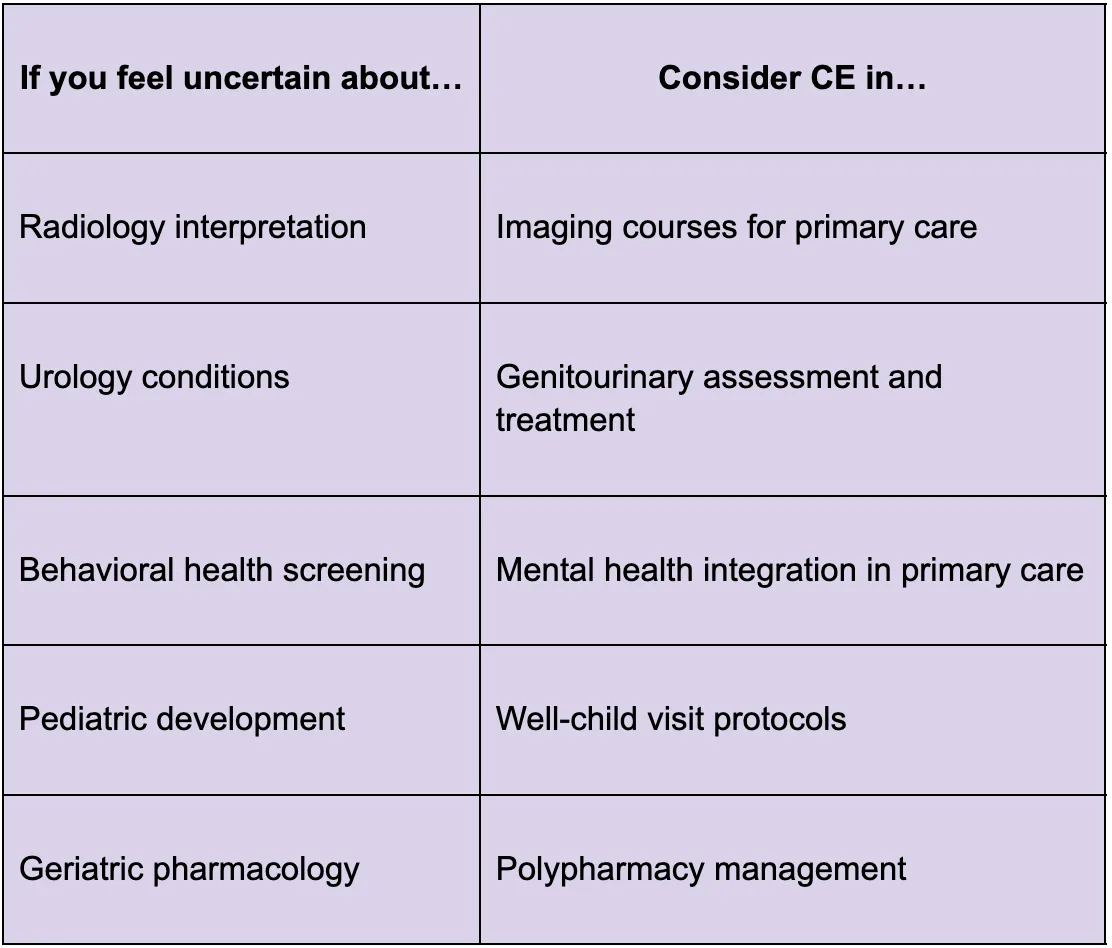
This intentional approach builds genuine competence rather than just checking boxes.
Events, Webinars, and On-Demand CE Relevant to Delaware NPs
Delaware’s central location provides access to diverse CE formats serving the Mid-Atlantic region.
Common event formats:
- Evening webinars (often at 6:00 pm ET) allowing participation after clinical hours
- Saturday morning sessions for intensive topic coverage
- In-person networking events in Wilmington or Dover combining CE with community building
- Multi-day conferences in Philadelphia or Baltimore accessible by train or short drive
On-demand CE advantages:
- Multi-credit bundles (sometimes 20+ hours on respiratory, critical care, or other topics) let you work at your own pace
- Long availability windows (some courses approved through 2026-2028) accommodate unpredictable student schedules
- Self-paced completion fits around clinicals, exams, and personal obligations
Emotional benefits of CE engagement:
Mastering complex content reduces imposter syndrome; connecting with peers normalizes struggles. Completing challenging courses proves capability, even during overwhelming clinical rotations. Ready to control your Delaware NP journey? Open your free NPHub account now to secure your preceptor and build mastery!
Find NP Preceptors in Major Delaware Cities
- Dover, Delaware Clinical Rotations
- Wilmington, Delaware NP Clinicals
- Rehoboth Beach, Delaware NP Clinicals
Finding and Working With a Nurse Practitioner Preceptor in Delaware
Finding a Delaware NP preceptor can feel stressful and vulnerable, especially in a small state where professional circles overlap. It’s normal to feel anxious about this process. What matters is approaching it as something you lead, not something done to you.
Frame preceptor selection as your choice:
You’re not begging for a favor—you’re seeking a professional learning relationship that benefits both parties. A good preceptor gains a motivated learner who contributes to their practice while developing skills. You gain clinical training and mentorship that shapes your entire career.
Delaware offers a variety of common preceptor settings. Hospital-based teams, primarily located in Wilmington and Dover, provide experience in acute care, managing complex patients, and interdisciplinary collaboration.
Community health centers, found in Kent and Sussex counties, focus on primary care across the lifespan and serving underserved populations. For a faster-paced environment, coastal urgent care centers in the beach communities offer exposure to episodic care, efficiency, and a diverse range of patient presentations.
Students can also gain specialized knowledge in private specialty clinics located throughout the state, learning depth in specific conditions and outpatient management. Finally, behavioral health practices, concentrated in New Castle, are available for those interested in mental health assessment and psychopharmacology.
Trade-offs to consider:
Some students prefer formal matching systems offered by their programs, which reduce uncertainty but may limit choice. Others prefer self-initiated networking, which requires more effort but offers more control over site selection and scheduling. Neither approach is inherently better—consider which feels safer and more aligned with your learning style.
A good preceptor relationship balances clinical rigor with psychological safety. You need someone who challenges you to grow while creating space to ask questions, process mistakes, and build confidence without shame.

Step-by-Step Approach to Finding a Delaware NP Preceptor
Timeline recommendation: Start outreach at least 6-9 months before your desired clinical term. This buffer reduces last-minute pressure and gives you options if your first choices don’t work out.
Step 1: Mine your existing network
Before cold-calling strangers, consider who already knows your work:
- Current or former RN managers in Delaware hospitals
- NPs you’ve worked alongside in your RN role
- Faculty members with connections to local clinics
- Classmates who’ve already completed rotations
Step 2: Expand through professional engagement
- Join Delaware-focused NP groups (many have student membership options)
- Attend events in person or online to meet potential preceptors informally
- Introduce yourself before making formal requests—relationships matter
Step 3: Create a preceptor packet
When you’re ready to reach out, have these materials prepared:
- Short professional bio (2-3 paragraphs)
- Current resume highlighting relevant RN experience
- Your program’s clinical requirements and documentation expectations
- Your preferred schedule and any flexibility you can offer
- Brief statement on how you’ll add value to their practice
Step 4: Make thoughtful requests
- Personalize each outreach based on what you know about the preceptor’s practice
- Be specific about what you’re asking (hours, specialty, timeline)
- Offer to visit the site or have a phone conversation before committing
Step 5: Honor your own limits
Choose a site and schedule that allows rest, family responsibilities, and reflection—not just maximum hours. Burnout during clinical rotations affects your learning, your patients, and your long-term relationship with nursing.
Setting Expectations and Protecting Your Emotional Safety
Before committing to a preceptor, ask questions that reveal whether the relationship will support your growth:
Questions to ask potential preceptors:
- “How do you prefer to give feedback—in the moment or at the end of the day?”
- “What’s your teaching style when I make a mistake or miss something?”
- “How do you handle situations where we disagree about patient care?”
- “What patient load should I expect to carry by the end of the rotation?”
Logistics to clarify early:
- Typical daily schedule and patient volume
- Documentation expectations and EHR access
- On-call responsibilities (if any) and how emergencies are handled
- Policy for sick days or family emergencies
- Parking, dress code, and other practical details
Communication norms to establish:
Consider requesting weekly debriefs—even 15 minutes—to keep the learning relationship predictable. This creates space to ask questions you didn’t want to raise in front of patients and to receive feedback you can actually integrate.
If something feels wrong:
You have permission to speak up early if a site feels unsafe, unethical, or misaligned with your program’s requirements. Work with your faculty to explore alternatives. Needing a change of site is a sign of self-advocacy, not failure.
In a small state like Delaware, you might worry about burning bridges. But protecting your education and well-being matters more than any single preceptor relationship. Professional communities respect students who handle difficult situations with integrity.
Need assistance with securing and managing your rotation requirements? Open a free NPHub account for specialized NP support to help you stay on track for graduation.
Nurse Practitioner Jobs and Early Practice in Delaware
Delaware offers diverse NP roles across settings, specialties, and patient populations. Understanding what’s available helps you make intentional job choices that support long-term career satisfaction.
Common NP roles in Delaware:
- Primary care NP: Handles diagnosis, treatment, wellness, disease prevention, and chronic disease management, with high demand in Kent and Sussex counties.
- Hospitalist NP: Focuses on inpatient care, admissions, discharges, and care coordination in Wilmington and Dover hospital systems.
- Specialty clinic NP: Provides focused assessment and treatment for specific conditions, primarily concentrated in New Castle County.
- Behavioral health NP: Manages mental health assessment, psychopharmacology, and therapy integration, with growing demand statewide.
- Urgent care NP: Offers episodic care for minor injuries and acute illness in beach areas and suburban corridors.
Core NP responsibilities across settings:
- Performing patient assessment and diagnosis
- Ordering and interpreting diagnostic tests
- Prescribing medications (requires prescriptive authority)
- Developing treatment plans
- Coordinating care with specialists and community resources
- Providing patient education and counseling
- Documenting care according to practice and regulatory standards
Evaluating job offers:
Salary matters, but it’s not everything. Consider:
- Quality of mentoring and orientation for new graduates
- Length and structure of onboarding period
- Schedule flexibility and on-call expectations
- Alignment with your long-term career goals
- Support for continuing education and professional development
- Work culture and team dynamics
Deliberate job choice connects to emotional outcomes. A well-supported first job reduces burnout risk, enables sustainable work-life integration, and builds a stronger sense of purpose in your Delaware community.
Delaware’s History, Demographics, and What They Mean for NP Practice
Understanding Delaware’s historical context helps you provide more culturally responsive care and build trust with patients who carry complex histories.
Key historical moments shaping Delaware:
- June 15, 1776: Delaware declared independence as “The Delaware State”
- December 7, 1787: First state to ratify the U.S. Constitution, earning “The First State” nickname
- 1804: Éleuthère Irénée du Pont established what became the largest gunpowder factory in the country on the Brandywine River, launching industrial development
- 1865: Delaware initially rejected the Thirteenth Amendment (later ratified nationally), reflecting complex racial history
- Mid-20th century: School desegregation efforts and urban unrest in Wilmington shaped contemporary equity concerns
Why this matters clinically:
The legacy of segregation, desegregation struggles, and economic inequality affects how some patients experience healthcare. Historical trauma may appear as:
- Distrust of healthcare institutions and providers
- Reluctance to share personal information
- Delayed care-seeking due to past negative experiences
- Health disparities in chronic disease prevalence and outcomes
Today’s demographic mix:
Delaware reflects both Northern and Southern U.S. cultural influences. The population includes:
- Significant Puerto Rican and Guatemalan communities
- Growing Asian American populations
- Historical Native American presence, particularly in Kent and Sussex counties
- Long-established African American communities throughout the state
- Seasonal and permanent residents from across the Mid-Atlantic region
Implications for NP practice:
- Cultural humility matters more than cultural “competence”
- Language access strategies (interpreters, translated materials) improve care quality
- Awareness of historical context helps you understand patient responses
- Building trust takes time, especially with patients who’ve experienced discrimination
Your path to becoming a Delaware NP is one you actively choose at every step. From selecting the right clinical sites to building your licensure timeline to evaluating job offers, each decision shapes a career that can fit both your clinical interests and your personal well-being.
Start building your Delaware network and secure your preceptor today! Open your free NPHub account to connect with local NP organizations and faculty with Delaware ties. The professional community you build now will support you throughout your career in the First State.
.webp)
Key Definitions for Nurse Practitioner Students in Delaware
Before diving into the specifics, here are essential terms you’ll encounter throughout your Delaware NP journey:
- Advanced Practice Registered Nurse (APRN): The legal category under Delaware law that includes nurse practitioners, certified nurse midwives, clinical nurse specialists, and certified registered nurse anesthetists. This is the license type you’ll pursue after completing your NP program.
- DELPROS: Delaware’s online professional licensure system where RN and APRN applicants submit, track, and renew their licenses. Think of it as your central dashboard for all licensure activities in the state.
- Compact RN License: A multistate RN license issued under the Nurse Licensure Compact that allows you to practice as a registered nurse across member states. Important note: this does not replace or substitute for an APRN license, which must be obtained separately in Delaware.
- Preceptor: A licensed NP or physician in Delaware who supervises your clinical hours during your program and supports your transition toward independent practice. This relationship significantly shapes your clinical education.
- Full Practice Authority vs. Restricted Practice: Different states grant NPs varying levels of autonomy. Some allow independent practice without physician oversight, while others require collaborative agreements or supervision. Understanding where Delaware falls on this spectrum helps you plan your career trajectory.
FAQs About Nurse Practitioner Education and Licensure in Delaware
How early should I start preparing for my Delaware APRN license while I’m still a student?
Most successful students begin serious preparation 6-12 months before graduation. This timeline allows you to confirm your program aligns with Delaware requirements, plan your national certification exam date, and familiarize yourself with the DELPROS system.
Create a simple month-by-month checklist covering exam registration, transcript requests, background check initiation, and application document gathering. This approach reduces last-minute pressure and creates room for unexpected delays—background checks can take longer than expected, transcripts sometimes require multiple requests, and certification exam results have processing periods.
Starting early lets you choose when to submit applications rather than feeling rushed by employer start dates or external timelines. You stay in control of the process.
Can I complete my NP program out of state and still get licensed and practice in Delaware?
Yes, many Delaware NPs complete their programs in other states. The key requirements are that your program must be properly accredited and aligned with national certification standards recognized by Delaware.
Before enrolling—or during your first semester—verify that your out-of-state coursework and clinical hours will meet Delaware’s APRN requirements. Some programs have specific state approvals that affect licensure portability.
If you have any uncertainty, contact the Delaware Board of Nursing directly with detailed information about your program. Getting clarity early prevents discovering problems late in your education when changing programs would be difficult or costly.
What if I start my career with an RN license in another compact state and then want to move to Delaware as an NP?
An RN multistate license allows you to practice as a registered nurse across all compact member states, including Delaware. However, every state—including Delaware—has its own separate APRN license process.
Moving into Delaware as an NP involves:
- Applying for Delaware APRN licensure through DELPROS
- Providing verification of your national certification
- Understanding how your compact RN renewal cycle interacts with Delaware APRN renewal dates
Build extra processing time into your relocation plans. Rushing a move while simultaneously navigating licensure creates unnecessary stress. Many graduates give themselves at least 2-3 months of buffer between their last day at a previous job and their first day in a new Delaware position.
How competitive are NP jobs in Delaware, and will I be able to find work after graduation?
Demand varies by county, specialty, and setting. Primary care and behavioral health roles in rural and coastal areas (Kent and Sussex counties) may be less saturated than some urban subspecialties in Wilmington. Seasonal urgent care near the beaches creates predictable hiring cycles.
What significantly improves your job opportunities:
- Strong clinical references from preceptors who know your work
- Active networking in Delaware NP communities before graduation
- Earlier engagement with local practices during your clinical rotations
- Flexibility about geographic location within the state
Focus on fit and support in your first job, not just speed of hiring. A position with strong mentoring, reasonable hours, and aligned values supports long-term career satisfaction more than rushing into an ill-fitting role that leads to early burnout.
What if my preceptor site in Delaware isn’t a good fit once I start?
Discovering a misalignment is more common than many students realize, and noticing it early is a sign of clinical insight, not personal failure.
When something feels wrong, document specific concerns:
- Lack of appropriate supervision for your skill level
- Patient ratios that compromise safety
- Repeated policy or ethical violations
- Teaching approach that shames rather than supports learning
- Scope of practice concerns
Bring these concerns to a trusted faculty member promptly. Most programs have processes for evaluating site concerns and supporting transitions when necessary.
Changing sites, when warranted, is about protecting patient safety and your emotional well-being. In Delaware’s small professional community, handling difficult situations with integrity—clear communication, appropriate documentation, respectful transitions—actually builds your reputation rather than damaging it.
Article details
- Last updated
February 13, 2026 - Fact-checked by
NPHub Clinical Placement Experts & Student Support Team - Sources and references
- https://www.csg.org/2026/01/26/delaware-the-first-state/
- https://share.google/I9oI2t4xuz83frYuK
- https://share.google/UfZaOs8YKq6kq3d2u
- https://dhss.delaware.gov/wp-content/uploads/sites/10/dph/pdf/fqhcs.pdf
- https://news.delaware.gov/2026/02/09/state-of-delaware-opens-initial-rfps-to-transform-rural-health-care/#:~:text=The%20proposal%20also%20includes%20funding,results%20efficiently%20and%20cost%2Deffectively.
- https://dpr.delaware.gov/boards/nursing/apnlicense/
- https://dpr.delaware.gov/boards/nursing/apnlicense/#:~:text=Already%20hold%2C%20or%20concurrently%20apply,within%20the%20past%20two%20years.
- https://delpros.delaware.gov/OH_CommunitiesLogin
- https://www.aanp.org/advocacy/delaware
- https://www.facebook.com/groups/delawarepreceptorsfornpstudents
- https://dpr.delaware.gov/boards/controlledsubstances/continuing-education-and-audit-information/
- https://dcnpweb.enpnetwork.com/#:~:text=Enduring%202025%20DCNP%20Fall%20CE,2026%20at%206:00pm%20ET
- https://www.nphub.com/blog/preceptor-search-tips
- https://www.nphub.com/blog/springfield-np-preceptors
- https://www.nphub.com/blog/np-emotional-resilience
- https://research.com/careers/how-to-become-a-nurse-practitioner-in-delaware#:~:text=According%20to%20projections%2C%20the%20employment,Community%20health%20organizations
- https://www.hospitalrecruiting.com/blog/9474/how-to-evaluate-your-nurse-practitioner-job-offer/
- https://archivesfiles.delaware.gov/ebooks/Delaware_-_A_Guide_to_the_First_State.pdf
Find a preceptor who cares with NPHub
Book a rotation.webp)
.jpeg)

.webp)

.jpeg)

%20(3)%20(2).svg)
.webp)