
.png)



.webp)
TL;DR: How to Scale NP Programs Without Increasing Faculty Burnout
- NP enrollment is growing faster than clinical placement infrastructure can support it, and in most programs, the operational burden of sourcing preceptors, managing contracts, and maintaining compliance documentation still falls on a small team of nursing faculty members already stretched across teaching, research, and advising.
- Faculty burnout is a systems issue. AACN data shows 85.2% of nursing faculty report moderate to high burnout, with the highest rates among early to mid-career tenure-track faculty who absorb disproportionate placement coordination work on top of their core responsibilities.
- NPHub's recruiter-led model shifts clinical placement operations off faculty desks entirely. Our Preceptor Recruiting team, staffed by board-certified nurse practitioners, handles sourcing, vetting, contracting, site approval, and ongoing re-verification every 45 days, producing accreditation-ready documentation as a built-in output of the process.
- Programs that have made this shift are seeing measurable results. Graceland University eliminated student stop-outs completely. USC removed the unsustainable burden of nationwide placement coordination from faculty. In both cases, clinical capacity compounds with every term rather than resetting.
- If your program is navigating growing enrollment, accreditation pressure, or faculty workload concerns, our university team would welcome the conversation about what a partnership looks like for your institution. Get in touch today.
Nurse practitioner programs are growing fast. DNP enrollment has expanded for over two decades, master's-level nursing programs saw a 4.8% increase in 2024, and applications continue climbing. The demand for advanced practice registered nurses across primary care and specialty settings isn't slowing down.
But enrollment is scaling faster than the clinical infrastructure behind it.
Every new student needs a qualified preceptor, an approved clinical site, executed contracts, and ongoing oversight. That work multiplies with each cohort, and in most nursing schools, it still falls on the same small team of nursing faculty members who manage placements at half the volume.
The pressure is compounding across every level:
- Faculty workload and well-being
- Accreditation documentation and compliance
- Placement timelines and student outcomes
- The program's ability to graduate nurse practitioners on time
This isn't new, but it's intensifying. AACN data confirms the nursing faculty shortage has reached a decade-high vacancy rate, and the primary barriers to accepting qualified nursing students remain insufficient clinical sites, faculty, and preceptors. Programs are being asked to produce more nurses with fewer resources to support clinical education.
We built our model around this exact challenge. At NPHub, we work alongside nursing programs as a dedicated NP clinical placements partner, absorbing the operational weight of preceptor sourcing, vetting, and coordination so programs can grow without burning out the people who make them run. Our team is led by board-certified nurse practitioners who understand clinical education from the inside.
This blog is for deans, directors, and clinical coordinators trying to scale responsibly without sacrificing quality or their team's well-being.
If that sounds like your program right now, our university team would welcome the conversation. Get in touch today.
.webp)
How Nurse Practitioner Clinical Placement Demands Are Stretching Faculty Teams
As NP enrollment grows, so does the operational weight behind every student's clinical rotations. Each placement requires a vetted preceptor, an approved site, contracts, compliant documentation, and ongoing oversight from start to finish.
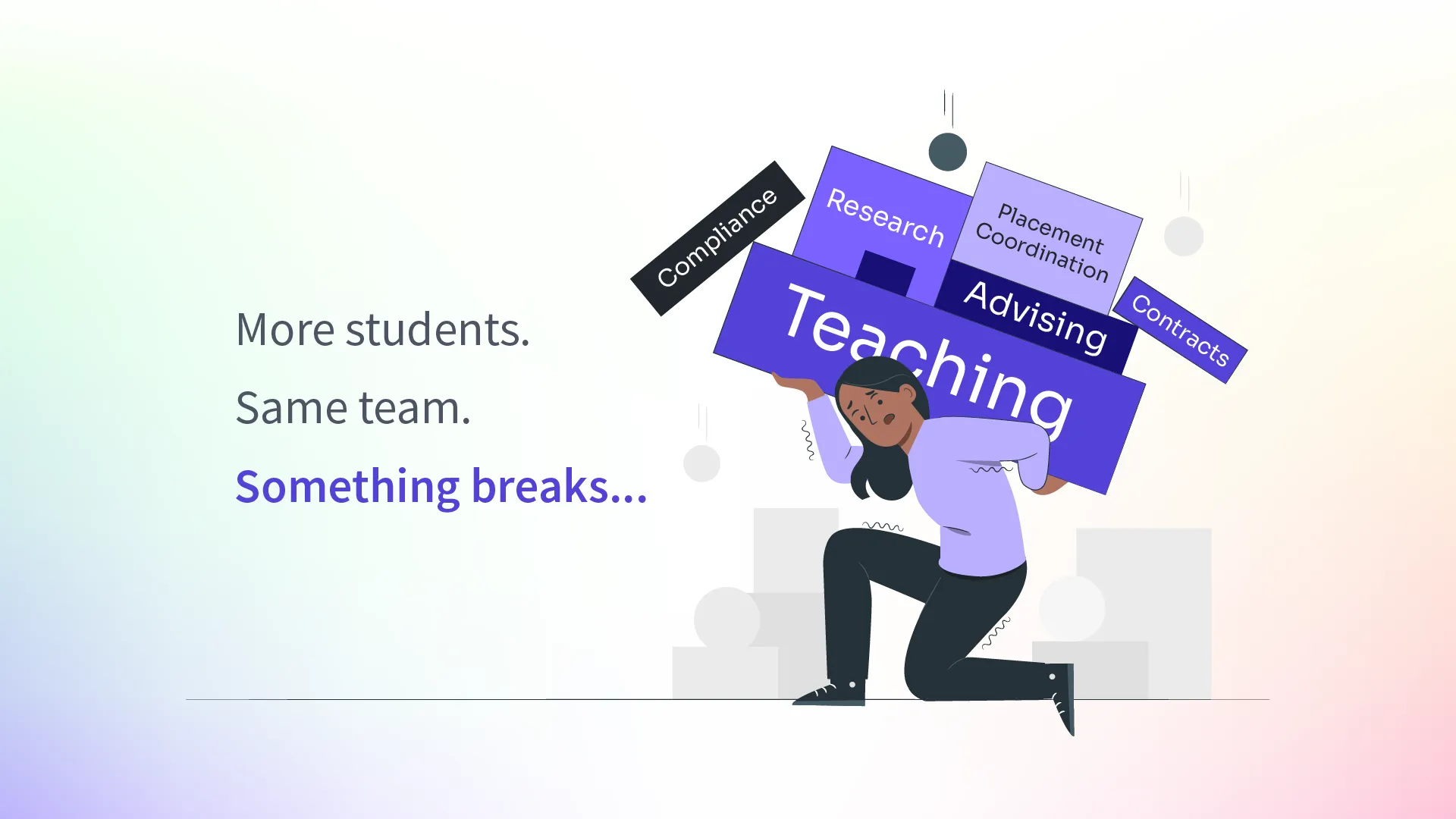
In most nursing programs, that entire workload falls on a handful of nursing faculty members and clinical coordinators, the same people responsible for teaching, advising, mentoring, and research.
The scope of placement coordination alone includes:
- Sourcing and vetting preceptors by specialty and location
- Tracking credentials, licensure, and site approvals
- Managing contracts and affiliation agreements
- Communicating with students, preceptors, and clinical sites throughout each rotation
- Resolving issues when placements fall through or conditions change mid-cycle
This isn't a workload spike. It's a structural pattern that intensifies with every new cohort.
Research from AACN found that 85.2% of nursing faculty reported moderate to high levels of burnout, with the highest rates among tenure-track faculty and doctorally prepared nursing faculty in early to mid-career, the very people programs can least afford to lose. Faculty burnout isn't a resilience problem. It's a systems issue, where too much operational work is routed through too few people.
The downstream effects are serious. When placements stall or documentation gaps emerge, programs face accreditation risk, delayed graduations, lower student satisfaction, and threats to faculty retention and job satisfaction.
The pattern is clear: without structural support for clinical placements, growth doesn't just stretch faculty teams, it quietly destabilizes the program from the inside.
Why Nursing Faculty Burnout Is a Systems Issue, Not an Individual One
When faculty burnout comes up in nursing education, the response often defaults to self-care strategies — wellness initiatives, mindfulness programs, better time management. These aren't harmful, but they treat burnout as something individuals should manage rather than something the system is producing.
The research tells a different story. A systematic review of burnout among nursing faculty members found that the factors most strongly associated with burnout weren't personal, they were structural: hours of work, number of students taught, job pressure, and perceived stress. Job satisfaction and workplace empowerment, on the other hand, had a significant inverse relationship with burnout. In other words, when the system supports faculty, burnout decreases. When it overloads them, burnout is the predictable result.
AACN's national study reinforced this pattern. Among 3,556 nursing faculty surveyed, 85.2% reported moderate to high burnout levels, with the highest rates among early to mid-career faculty aged 35 to 54, many of them tenure-track assistant and associate professors still establishing their careers. These younger faculty often absorb disproportionate operational tasks, including clinical placement coordination, without adequate institutional support.
The faculty role was never scoped to carry what it now carries. Teaching, advising, scholarship, research, and service are already a demanding portfolio. When placement sourcing, preceptor vetting, compliance documentation, and site communication are layered on top, the workload exceeds what any individual can sustain, regardless of resilience or work engagement.
This is a structural design problem that requires a structural solution, removing operational placement work from the faculty role entirely and shifting it to dedicated infrastructure built for that purpose.
That's the model we built at NPHub. If your program is exploring how to make that shift, our university team would welcome the conversation. Get in touch here.
What Our Recruiter-Led Model Does and Why It Works Differently
Most NP programs treat clinical placement as a task that resets every semester: find a preceptor, complete the paperwork, and move on. Our model treats it as infrastructure. The goal isn't to fill a slot. It's to build a growing, compounding network of vetted nurse practitioner preceptors and approved clinical sites that becomes more reliable with every term.
How Our Placement Team Operates
Our Preceptor Recruiting team functions as an embedded extension of your program's clinical education infrastructure. These are dedicated, board-certified nurse practitioners who handle preceptor sourcing by specialty and location, outreach and relationship management, contract execution, onboarding coordination, and ongoing communication with clinical sites throughout every rotation.
This isn't a referral list or matching algorithm. It's a hands-on, clinician-led recruitment operation that absorbs the operational work currently falling on clinical faculty and coordinators, freeing your team to focus on teaching, mentorship, and student development.
How Every Nurse Practitioner Preceptor Is Vetted
Every clinical preceptor in our network goes through a structured verification process before being matched with a student:
- Clinician-led oversight: Each preceptor is sourced and evaluated by board-certified NPs who assess clinical fit, scope of practice, and alignment with your program's specific requirements.
- NP-to-NP vetting interviews: A focused 20-minute peer-level conversation evaluates patient population, daily clinical workflow, teaching readiness, and whether the environment supports meaningful hands-on experience rather than observation alone.
- Credential and license verification: Board certification, active unrestricted licensure, and license integrity screening with zero-tolerance disqualification for any unresolved issues.
- Clinical site approval: Confirmation that each site has administrative readiness, documentation compliance, and alignment with university expectations to host nursing students.
- Ongoing re-verification every 45 days: Because clinical settings change, schedules shift, patient populations evolve, operations adjust. A one-time check isn't enough to protect a rotation or your program's standards.
This process directly supports accreditation readiness. Every step generates standardized documentation, verified credentials, scope confirmations, site approvals, and re-verification logs that map to CCNE and ACEN standards without requiring additional cleanup from your team.
Supporting Accreditation With Built-In Documentation
Placement-related documentation is one of the most time-consuming aspects of accreditation reviews. Our process produces ready-to-use credential profiles and compliance records that programs can pull directly into self-studies or site visit preparation. Every clinical placement carries a centralized audit trail: who was placed, where, under whose supervision, with what credentials, and when re-verification occurred.
This reduces both faculty workload and institutional risk simultaneously — your coordinators aren't stitching together records from dozens of sources before a review.
Burnout Prevention: Building Capacity Around Your Academic Year
The highest-value shift happens when placement moves from reactive to proactive. We work with programs to forecast clinical capacity by specialty and academic term, plan cohort-based placements rather than handling individual requests ad hoc, and establish placement SLAs — agreed-upon timelines for sourcing, vetting, and confirming preceptors so your team can plan enrollment with confidence.
We also build contingency plans for delayed or disrupted placements, so a single preceptor change doesn't cascade into a student's delayed graduation.
Programs like Graceland University went from ten student stop-outs per semester to zero after partnering with us. USC eliminated the unsustainable faculty burden of coordinating nationwide placements across time zones. In both cases, capacity didn't just stabilize, it compounded, growing stronger every term.
That's the difference between filling placements and building infrastructure your program can rely on.
If your program is ready to explore what that shift looks like, our university team would welcome the conversation.
.webp)
Protecting Faculty, Program Reputation, and What a Partnership Looks Like
Everything we've outlined — the recruiting, the vetting, the documentation, the capacity planning — exists to protect the people who make NP education possible. Faculty well-being isn't a side benefit of this model. It's the point.
Reducing Workload Without Reducing Quality
Our partnership model assigns a single point of contact who manages placement communication, status updates, and escalation, so coordinators aren't constantly chasing information. When a placement is at risk, proactive alerts reach your team before problems cascade.
This preserves faculty time for what they were hired to do: teach, mentor, conduct research, and advance nursing practice. Research consistently shows that job satisfaction and work engagement improve when operational burdens are manageable, and that faculty retention follows. When programs stop losing early and mid-career educators to unsustainable workloads, they protect institutional knowledge, program continuity, and the life balance that keeps experienced faculty engaged long-term.
How Placement Reliability Protects Your Program's Reputation
Placement quality and program reputation are directly linked. When nursing students have consistent, well-supported clinical experiences, satisfaction scores rise and complaints drop. That matters for accreditation and for enrollment.
Prospective students pursuing a nursing career, whether they hold a bachelor's degree or are advancing toward a master's degree or doctoral degree, evaluate programs partly on clinical support strength. Reliable placements become a recruitment differentiator, especially as data from the American Association of Colleges of Nursing continues to show that clinical site shortages are a primary barrier to accepting qualified applicants. Programs that can demonstrate a strong clinical infrastructure gain a competitive advantage that compounds with every cohort.
Scaling Responsibly Starts With the Right Infrastructure
NP programs across the country are being asked to do more, admit more students, place more cohorts, and document more outcomes without proportional increases in the faculty, systems, or clinical infrastructure needed to support that growth. The result is a cycle that stretches the same people thinner every semester, and the data confirms it: the vast majority of nursing faculty are already operating at moderate to high burnout levels.
It doesn't have to work this way.
The programs seeing the strongest outcomes are making a structural shift, moving clinical placement coordination off faculty desks and into a dedicated, clinician-led infrastructure that compounds in value with every term. Not outsourcing education. Building the operational foundation that lets faculty return to the work that actually requires their expertise: teaching, mentoring, guiding the next generation of nurse practitioners through the clinical experiences that shape their careers.
That's what we built NPHub to do. Our Preceptor Recruiting team operates as an extension of your program, sourcing, vetting, and managing preceptor relationships through a process designed to support accreditation readiness, protect faculty well-being, and deliver the kind of consistent clinical placements that students and programs can rely on.
Whether your program is managing growing enrollment, navigating accreditation cycles, or simply seeking a sustainable way to support your faculty and students, we'd welcome the chance to explore what a partnership would look like for your institution.
Our university team is ready when you are. Get in touch today!
Frequently Asked Questions
1. How severe is the nursing faculty shortage, and how does it affect NP programs?
The shortage is significant and growing. AACN reported a national nursing faculty vacancy rate of 8.8% in the 2022–2023 academic year — the highest in over a decade — translating to 2,166 unfilled positions across baccalaureate and higher-degree programs.
2. How widespread is burnout among nursing faculty?
It's pervasive. In AACN's national study of 3,556 nursing faculty, 68.3% reported moderate burnout, 16.9% reported high burnout, and 85.5% experienced moderate to high exhaustion. Burnout was also a significant predictor of intent to leave, with roughly a quarter of participants planning to leave their position within two years. These numbers reflect a systemic pattern driven by heavy workloads, limited support, and operational demands like clinical placement coordination that fall outside the core faculty role.
3. How does NPHub's model directly reduce faculty burnout?
By removing clinical placement coordination from the faculty role entirely. Our Preceptor Recruiting team handles preceptor sourcing, vetting, contracting, onboarding, site communication, and ongoing monitoring — the operational tasks that compound on top of teaching, advising, and research. Programs that partner with us report faculty reclaiming time for the work they were hired to do, which research shows is directly linked to improved job satisfaction and lower turnover intentions.
4. What makes NPHub's preceptor vetting process different from other placement services?
Most services verify that a preceptor has an active license and move on. Our process is clinician-led and multi-layered: every preceptor completes a structured NP-to-NP vetting interview with a board-certified nurse practitioner, undergoes credential and license verification with zero-tolerance disqualification for any integrity issues, and is matched to a clinical site that's been confirmed for administrative readiness. Active preceptors are then re-verified every 45 days. This isn't a one-time screening; it's an ongoing quality system that produces accreditation-ready documentation as a natural output.
5. How does NPHub support accreditation compliance for NP programs?
Every step of our recruitment and vetting process generates standardized documentation mapped to CCNE and ACEN standards, verified credentials, scope-of-practice confirmations, site approval records, and re-verification logs. Programs can pull these directly into self-studies or site visit preparation without additional reformatting or compilation. This centralized audit trail reduces the compliance burden on coordinators and helps programs demonstrate consistent oversight across placements.
6. Can NPHub support programs that are scaling enrollment or expanding into new states?
Yes. Our model is built to scale. Whether your program is growing cohort sizes, adding new specialties, or expanding clinical placements across state lines, our recruiters follow the same structured process regardless of geography. We also handle state-specific compliance requirements as part of the placement process, so programs get consistent quality and documentation whether they're placing students locally or nationwide.
Ready to explore what this could look like for your program? Get in touch with our university team.
Find a preceptor who cares with NPHub
Book a rotation.webp)


.webp)
.jpeg)
.jpeg)

%20(3)%20(2).svg)
.webp)