
.png)



.webp)
TL;DR
- NP clinical placement models are evolving because two pressures arrived at the same time. Faculty burnout and tightened accreditation expectations (CCNE, ACEN, the Sawyer Initiative) are exposing the limits of faculty-driven sourcing, alumni networks, student self-placement, and coordinator-led outreach, the four models most NP programs run in some hybrid combination.
- Placement bottlenecks aren't a logistics problem. They're a structural one. A single delayed clinical rotation ripples through faculty workload, accreditation documentation, enrollment growth, tuition cycles, and program reputation. 30% of administrators name clinical placements as their single biggest operational inefficiency.
- A sustainable NP clinical placement model treats placement as ongoing infrastructure. Five elements distinguish a structured approach: a continuous sourcing pipeline, separation of recruiting from coordination, clinician-led vetting, audit-ready documentation by default, and relationship continuity across cohorts.
- Preceptor recruiters are the role most programs underestimate. They operate upstream from clinical coordinators, sourcing qualified preceptors across various specialties (FNP, PMHNP, women's health, primary care, acute care, pediatrics), running credential and license integrity screening, and maintaining preceptor relationships across cohorts. The role requires clinical judgment, not just administrative outreach.
- NPHub's preceptor recruiting function is built around five operational pillars: clinician-led oversight, NP-to-NP vetting interviews, credential and license integrity screening, clinical site approval, and 45-day re-verification. Partner programs like USC and Graceland University have seen faculty time reclaimed and student stop-outs eliminated as a result. If your program is working through what a structured recruiting function would look like in practice, get in touch with the NPHub university partnerships team.
Inside deans' offices and program director meetings, the conversation about clinical placement sounds different than it did five years ago. The focus has moved away from how to fill the next rotation and toward whether the underlying model still holds up under the weight of current enrollment, accreditation expectations, and faculty capacity.
There is no universal blueprint for how an NP program should manage its clinical placement process, and the leaders making real progress are the first to acknowledge it. Different programs are testing different combinations:
- Faculty-driven sourcing
- Alumni and professional networks
- Student self-placement
- Dedicated clinical coordinators
- Third-party preceptor matching services
- Or some hybrid of all of the above
Each model has its strengths. Each has a point where it strains.
What's prompting a rethink is that two pressures arrived at the same time:
- Faculty burnout has deepened as sourcing work continues to flow to people whose actual job is teaching, curriculum, and student support.
- Accreditation expectations have tightened, with CCNE and ACEN reviewers now scrutinizing documentation in ways most programs weren't built to defend.
When those two pressures compound, the cost of an improvised placement process gets harder to absorb.
This piece walks through the NP clinical placement models programs use today, where each one breaks under load, and what changes when preceptor recruiting is treated as a dedicated function rather than a shared responsibility. It also covers how NPHub structures its own recruiting and vetting process as one working example of what a structured approach looks like in practice, including how it has played out for partner programs like USC and Graceland University.
If your program is already working through these questions, the NPHub university partnerships team has these conversations regularly with NP and PA programs.
The shift starts with a more honest look at the models programs are actually running today.
What are the common NP clinical placement models?
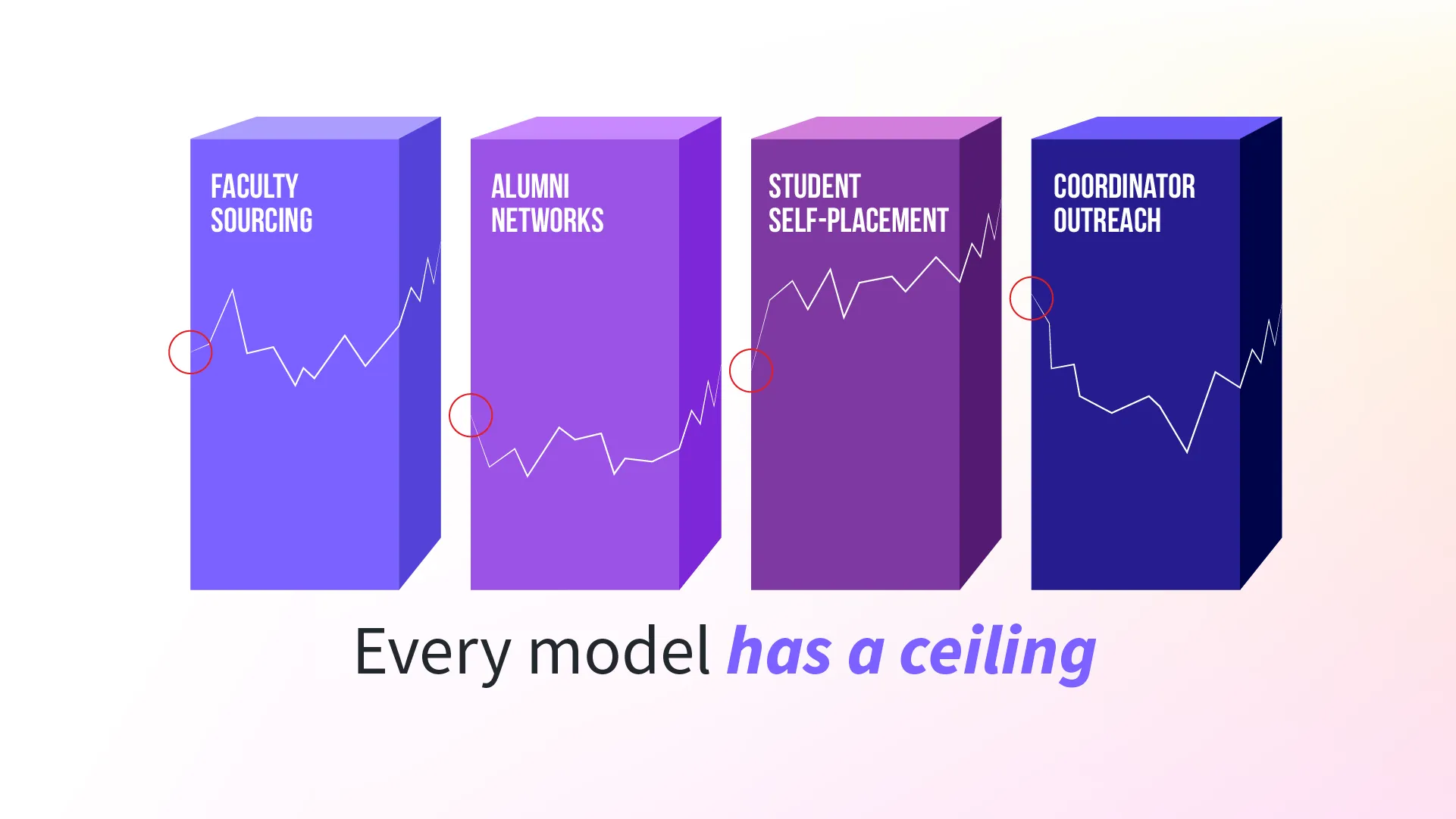
NP programs typically rely on one of four placement models (faculty-driven sourcing, alumni networks, student self-placement, or coordinator-led outreach). Most programs blend two or three in practice, and each combination produces different tradeoffs across capacity, compliance, and faculty workload.
A closer look at how each behaves under real-world conditions:
- Faculty-driven sourcing: Faculty use their own clinical practice networks to recruit nurse practitioner preceptors.
- Strengths: High clinical quality and strong alignment with program requirements.
- Strains: Doesn't scale. Pipelines contract when faculty retire or change institutions, and sourcing pulls time from curriculum, research, and student guidance.
- Alumni networks: Programs tap former graduates now in clinical practice to host new NP students.
- Strengths: Trust, continuity, and familiarity with program details.
- Strains: Geographically concentrated; slow to mature; thin across various specialties like PMHNP, women's health, and pediatrics.
- Student self-placement: NP students secure their own preceptors through an application process that the program approves.
- Strengths: Low direct cost; works well for students with strong existing networks.
- Strains: Creates equity gaps, thins documentation, and shifts a structural responsibility onto students, many of whom now pay for preceptor matching services on top of tuition to complete the rotations their degree program requires.
- Coordinator-led outreach: A clinical placement coordinator manages preceptor outreach alongside scheduling and paperwork.
- Strengths: Dedicated effort and consistent guidance for students through the clinical placement process.
- Strains: Sourcing competes against active rotation logistics and loses to whatever is most urgent that week.
Most NP programs run a hybrid: faculty contributing relationships, coordinators chasing leads, alumni filling gaps across primary care and urgent care centers, and students covering the rest. The hybrid is pragmatic, and for years, it has been working.
The strain shows up when enrollment grows, faculty leave, accreditation reviewers ask for documentation no one owned, or the pool of qualified nurse practitioner preceptors shrinks against rising demand.
Why are NP programs rethinking their clinical placement process now?
Enrollment growth, accreditation tightening, and faculty burnout are compounding at the same time. Individually, each pressure has been on program leaders' radar for years. What's changed is that all three are now arriving at full force in the same window, making the limits of legacy clinical placement models visible in ways they weren't before.
The pressures showing up most often in strategic conversations inside NP programs:
- Placement is now named as the #1 operational inefficiency: A 2026 benchmark report from Cisive found that 30% of program administrators identify clinical placements as the least efficient part of their program, more than any other operational area, including academic delivery. More than 90% of programs report that difficulty securing enough clinical sites impacts their operations.
- Qualified applicants are being turned away at scale: AACN's most recent enrollment survey reports that 93,176 qualified applications were not accepted at U.S. nursing schools last year, with insufficient clinical placement sites, faculty, and preceptors named as the primary barriers. Nearly 17,000 of those turned-away applications came from graduate programs, the pipeline that feeds future nurse practitioners and nurse educators.
- Enrollment is climbing while clinical capacity isn't: Master 's-level nursing enrollment grew 6.8% last year, and DNP enrollment grew 5.9%, the 22nd consecutive year of expansion. Each new cohort needs clinical hours, qualified nurse practitioner preceptors, and approved clinical sites, which the existing infrastructure wasn't built to absorb.
- Accreditation expectations have moved underneath programs: The Sawyer Initiative pushed CCNE to strengthen expectations around preceptor qualifications, clinical site preparation, and the quality of clinical rotations. Reviewers now scrutinize not just whether NP students completed required clinical hours, but whether the program can defend how those decisions were made and documented.
This isn't a single-cause event. It's three structural pressures (demand, compliance, and people) arriving in the same window, against placement infrastructure designed for other times. Programs that build their clinical placement process around faculty networks and ad hoc sourcing aren't doing anything wrong. They're running a model that worked under different conditions and is now being asked to absorb pressures it wasn't designed for.
How does a clinical rotation bottleneck affect the whole program?
Placement delays don't affect only one student. A single rotation that isn't secured on time ripples through faculty workload, accreditation documentation, enrollment planning, tuition cycles, and the program's reputation with future cohorts. What looks like a logistics problem on the surface is almost always a structural one underneath.
The five ripple areas that show up most clearly in program operations:
- Faculty time pulled from teaching, research, and curriculum: Every hour a faculty member spends chasing a preceptor is an hour not spent on course design, mentorship, or scholarship. Sourcing work is also invisible in faculty evaluation, so the cost accumulates quietly until it shows up as burnout, departures, or a quiet decline in the quality of clinical training oversight.
- CCNE and ACEN documentation gaps surface during review: Accreditation reviewers expect documented, repeatable processes for preceptor qualification, clinical site approval, and ongoing oversight. When sourcing is improvised, the records are too, and one missing affiliation agreement or unverified license per cohort isn't a finding, but a pattern of missing records across cohorts is.
- Enrollment growth is capped by clinical site capacity: No NP program can responsibly admit a larger cohort without proportional clinical site capacity to support it. Growth without capacity becomes a placement crisis one or two semesters later, and the institutional pressure to raise enrollment runs directly into the operational ceiling of how many clinical sites the program can actually staff.
- Delayed graduations delay tuition cycles and workforce entry: When NP students can't complete required clinical hours on schedule, graduation is delayed. That delay has downstream effects: tuition cycles stretch, financial aid timelines slip, and the workforce waits longer for practitioners who were ready to start working. Industry analysis has identified clinical placement bottlenecks as one of the clearest pressure points limiting advanced practice nursing growth at the workforce level.
- Student experience shapes future cohort recruiting: Nurse practitioner students share their clinical placement experiences with peers, on social platforms, with prospective applicants. A stress free experience reinforces the program's reputation; a chaotic one damages recruiting for the next cohort and weakens relationships with the clinical sites that absorbed the disruption. Recent research on nursing student attrition consistently identifies negative clinical placement experiences and lack of institutional support as significant contributors to students leaving their programs.
The pattern across all five areas is the same: the cost of an improvised placement process is rarely paid by the part of the program that owns the process. It's paid by faculty, by accreditation posture, by enrollment planning, by future students, and ultimately by the workforce waiting on the other side of graduation.
What does a sustainable NP clinical placement model look like and where do clinical preceptor recruiters fit in?
A sustainable NP clinical placement model treats placement as ongoing program infrastructure, not a per-cohort task. The leaders making real progress are converging on five elements that distinguish a structured approach from an improvised one:
- A continuous sourcing pipeline: New preceptors are recruited ahead of demand, not in response to it, so capacity doesn't reset every term.
- Separation of recruiting from coordination: Sourcing and scheduling are distinct disciplines. When one person owns both, recruiting consistently loses to whatever rotation is most urgent that week.
- Clinician-led vetting: Evaluating whether a clinical setting fits a given rotation, scope, acuity, patient population, and teaching readiness is a clinical judgment, not an administrative one.
- Audit-ready documentation by default: Affiliation agreements, credential records, and clinical site approvals exist before an accreditation review asks for them, not assembled retroactively.
- Relationship continuity across cohorts: Preceptors are retained as long-term partners, so capacity compounds rather than rebuilds each semester.
Most NP programs are operating somewhere short of this. The placement process at most nursing schools was built for an era when cohort sizes were smaller, accreditation expectations were softer, and competition for qualified nurse practitioner preceptors across various specialties was less intense.
The role that makes a sustainable model work is the preceptor recruiter. A preceptor recruiter is a dedicated professional who sources, vets, and onboards qualified preceptors at scale. They operate upstream at the supply layer (building the pipeline), while clinical coordinators operate downstream at the execution layer, managing scheduling, paperwork, and student support. Both roles are necessary, and most programs are short-staffed on the recruiting side.
Core responsibilities of the role include:
- Sourcing across various specialties — FNP, PMHNP, women's health, primary care, acute care, and pediatrics.
- Structured outreach with measurable cadence and conversion tracking.
- Credential verification and license integrity screening for every potential preceptor.
- Site-level approval, vetting the clinical sites themselves separately from the individual preceptor.
- Compliance documentation that supports program requirements and accreditation review.
- Relationship continuity, keeping preceptors engaged across cohorts rather than treating each placement as transactional.
The reason most programs underestimate this role is that they frame it as administrative outreach. In practice, preceptor recruiting requires the same clinical literacy and judgment as clinical onboarding. A coordinator without a clinical background can verify a license. They can't reliably assess whether the scope of clinical practice, treatment plans, and patient mix at a given site will support a meaningful FNP or PMHNP rotation. That judgment is what separates available preceptors from genuinely qualified preceptors and it's the layer most ad-hoc models don't address systematically.
How does NPHub approach preceptor vetting, and what does it look like in practice?
NPHub's preceptor recruiting function is built around five operational pillars: clinician-led oversight, structured NP-to-NP vetting interviews, credential and license integrity screening, clinical site approval, and continuous 45-day re-verification. The framework treats recruiting as ongoing program infrastructure, not a one-time placement activity.
- Clinician-led oversight: Board-certified nurse practitioners source and vet every NP preceptor, applying clinical judgment to fit, scope, and teaching readiness.
- NP-to-NP vetting interview: Every potential preceptor completes a 20-minute conversation evaluating their clinical practice setting, specialty alignment, patient care population, and acuity.
- Credential and license integrity screening: Active licensure, board certification, and disciplinary review, with zero-tolerance disqualification for any restriction on a qualified preceptor's record.
- Clinical site approval: Potential clinical sites are vetted separately from individual preceptors, confirming the site can administratively support NP students through the full clinical placement process.
- 45-day re-verification: Active preceptors and clinical sites are re-checked continuously, because real-world clinical settings change.
Two partner programs show how this plays out across different program details.
The University of Southern California's small clinical team was setting 3 AM alarms to coordinate clinical rotations across multiple states and internationally. After partnering with NPHub, USC's two-person team effectively expanded into a 90+ person preceptor-recruiting workforce, freeing faculty to focus on teaching and guidance.
"It's been great. We had a lot more students who were placed that we didn't have to come up with alternative schedules for," said Dr. Cynthia Sanchez, USC's Clinical Placement Coordinator.
Graceland University's two-person team could only source preceptors within their existing network in-state, and 10 np students per semester were stopping out because they couldn't find clinical placements. After partnering with NPHub, which gave Graceland access to over 2,000 qualified preceptors across 45 states, that number dropped to zero.
"Having NPHub actually go out there and essentially take my 2-man team and make it a 51-man team is HUGE," said Graduate Practicum Coordinator Lisa Winch.
Both cases share the same structural insight: the gain wasn't more effort. It was a different function.
How should NP programs evaluate a clinical placement partner?
Programs evaluating a clinical placement partner should look for clinician-led vetting, transparent credential and license integrity screening, separate approval of clinical sites and individual preceptors, and ongoing re-verification rather than one-time onboarding. The distinction between a vendor and a partner usually comes down to whether their process is built to support program requirements and accreditation review, or simply to fill a placement slot.
Five questions cut through most of the noise:
- Who conducts the vetting? Clinicians can evaluate whether a clinical setting fits a given rotation. Administrative reviewers can verify a license, but they can't reliably assess scope, acuity, or teaching readiness.
- Are clinical sites approved separately from individual preceptors? A qualified preceptor in an unprepared site still creates a placement problem. Both layers need to be vetted.
- Is verification continuous or one-time? Clinical practice settings change. A partner that re-checks active preceptors on a defined cadence catches issues before they disrupt a student's clinical rotation.
- Is documentation audit-ready by default? Records of preceptor qualifications, affiliation agreements, and clinical site approvals should exist as a byproduct of how the partner already works, not assembled retroactively before a CCNE or ACEN review.
- How are preceptor relationships maintained across cohorts? Capacity that resets every term isn't capacity. Look for evidence that preceptors are retained as long-term partners.
The questions in this piece — what does a sustainable clinical placement model look like, what is the role of preceptor recruiters, what does evaluation actually require — don't have universal answers yet. They're being worked out program by program, in real time, by leaders who recognized that the old model is straining and the new one hasn't fully arrived.
If any of these questions are showing up in your own planning, the NPHub university partnerships team works through them with NP and PA programs regularly.
Frequently Asked Questions
What is a preceptor recruiter, and why do NP programs need one?
A preceptor recruiter is a dedicated professional who sources, vets, and onboards qualified nurse practitioner preceptors at scale, operating upstream from clinical coordinators. NP programs need this role because faculty networks and ad-hoc outreach don't scale with enrollment growth or hold up under accreditation scrutiny. Without a dedicated recruiting function, sourcing work flows to faculty or coordinators who weren't hired for it, and capacity caps itself before the program can graduate the next cohort of confident nurse practitioners.
How do NP programs increase clinical placement capacity without adding faculty?
Programs can expand clinical placement capacity by separating recruiting from coordination and assigning sourcing to a dedicated function, internal or partnered. This frees faculty for curriculum, research, and student support while a recruiting team builds a continuous pipeline of qualified preceptors across various specialties. The result is more clinical experiences per cohort without expanding faculty headcount.
What credentials should an NP preceptor have?
An NP preceptor should hold an active, unrestricted state nursing license, current board certification in their specialty, and demonstrated clinical experience appropriate for the rotation. Many programs also require an advanced degree relevant to the patient population served, whether families, children, adults, or specialty groups. Verification should include a license integrity screen for any disciplinary history before the preceptor is approved to work with NP students.
How long does it take to secure an NP clinical placement?
Securing an NP clinical placement typically takes anywhere from a few weeks to several months, depending on NP specialty, geography, and how the program manages the clinical placement process. Programs relying on faculty networks or student self-placement often see longer timelines and missed start dates. A structured preceptor matching service can shorten the timeline by maintaining an active pipeline of potential preceptors rather than starting outreach from scratch each term.
Can preceptor matching services support CCNE or ACEN compliance?
Yes, when the service applies consistent vetting and documentation standards across every placement. Preceptor matching services that verify licensure, document clinical site approval separately from the individual preceptor, and maintain audit-ready records help programs strengthen their accreditation posture and protect program reputation. Services that rely on open listings or basic credential checks generally do not meet that bar.
What specialties are hardest to find preceptors for?
The hardest specialties to staff are typically psychiatric mental health, pediatrics, women's health, and primary care, particularly in rural areas and high-demand metro markets. Demand consistently outpaces supply in these various specialties, and experienced preceptors are often approached by multiple programs each semester. Specialty mismatches between an np student's degree program requirements and available preceptors are one of the most common causes of delayed placements.
How does ongoing preceptor verification protect students mid-rotation?
Ongoing verification catches changes in a preceptor's license status, scope of clinical practice, patient care population, or treatment plans before those changes disrupt a student's rotation. When verification is continuous rather than one-time, issues can be identified and addressed without forcing the nurse practitioner student to start over. This protects completed clinical hours and supports a more stress free experience throughout the rotation.
How can NP students find NP preceptors when their program doesn't have a clinical placement service?
NP students without program-provided placement support typically rely on a mix of their existing network, alumni connections, and preceptor matching platforms to find NP preceptors. The application process varies by school, but most degree programs require the student to submit a placement request with preceptor credentials and a signed affiliation agreement. An np preceptor finder service can reduce the time spent finding clinical sites by maintaining a vetted pool of qualified preceptors across various specialties.
Find a preceptor who cares with NPHub
Book a rotation.webp)
.jpeg)

.webp)
.jpeg)


%20(3)%20(2).svg)
.webp)