
.png)



.webp)
TL;DR
- Most NP programs rely on transactional placement models, passive databases, and one-off matches that reset to zero every term, leaving faculty and coordinators to carry the full burden of securing clinical sites.
- Transactional approaches typically lack ongoing preceptor relationships, meaningful vetting beyond credentials, and any infrastructure for forecasting clinical capacity across cohorts.
- Relationship-driven recruitment, in which dedicated teams continuously engage, vet, and support preceptors over time, yields more reliable, higher-quality placements that programs can plan around.
- NPHub's model is clinician-led, built on NP-to-NP vetting interviews, 45-day re-verification cycles, and specialty expertise that compounds with every term rather than disappearing between them.
- For NP programs looking to reduce faculty workload, strengthen accreditation compliance, and improve on-time graduation rates, the shift from transactional placement to relationship-driven recruitment is not incremental, it is structural. Connect with NPHub's university team →
For most NP programs, clinical placement is where operational pressure hits hardest. Enrollment is climbing, clinical sites are harder to secure, and faculty are absorbing more coordination work than their roles were designed for. The result is: inconsistent preceptor quality, fragmented oversight across rotation sites, and documentation that requires hours of cleanup before it's ready for an accreditation review.
These aren't new problems. But they're getting worse, and most placement services aren't built to solve them.
The standard model treats preceptor recruitment as a matching exercise: find an available clinician, confirm a license, and move on. That approach fills seats. It doesn't address the deeper concerns university leaders and clinical coordinators are managing, whether clinical preceptors meet specific program requirements, whether sites are genuinely prepared to support NP students, and whether the documentation trail will hold up when it matters.
NPHub approaches recruitment differently. Every preceptor in the network is sourced, vetted, and monitored by board-certified Nurse Practitioners through a structured, clinician-led process aligned with the standards NP programs are held to. That means credential verification, clinical site accountability, and consistent documentation aren't afterthoughts, they're built into how recruitment works from day one.
When recruitment is done with this level of rigor, the outcomes programs care about, fewer rejected placements, stronger clinical rotations, and cleaner compliance records, follow naturally.
In this blog, we'll walk through three areas where NPHub's recruiter-led model directly supports program quality: preceptor vetting and credential alignment, communication and expectation-setting with clinical sites, and consistent documentation across placements.
If your program is navigating these challenges and exploring how a university partnership with NPHub could reduce your administrative burden, our university team would welcome the conversation.
Preceptor Vetting and Credential Alignment for Clinical Rotations
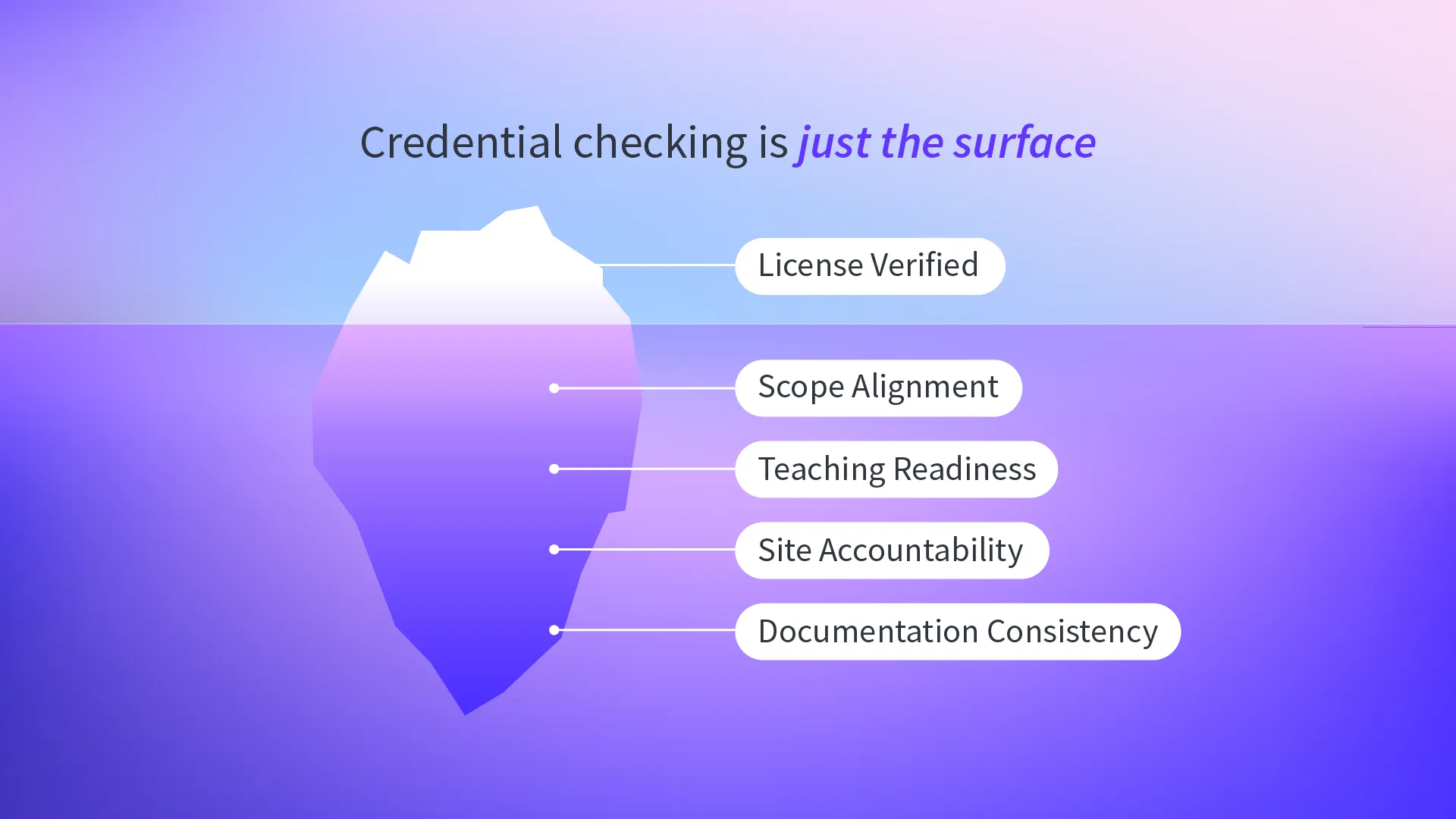
Most placement services verify that a preceptor has an active license. That's a starting point, but for NP programs managing accreditation expectations and diverse rotation requirements, it's not nearly enough.
A nurse practitioner preceptor can hold a valid license, maintain board certification, and still be a poor fit for a specific student's rotation. Maybe their scope of practice doesn't align with the program's primary care requirements. Maybe their patient population skews toward a demographic that won't satisfy the clinical experience a family nurse practitioner student needs. Maybe the clinical site looks good on paper, but it doesn't offer the hands-on patient care exposure that builds real competence.
These mismatches are where placement rejections happen, and they cost programs time, credibility, and coordinator hours that are already stretched thin.
Why Credential Alignment Matters More Than Credential Checking
This is why NPHub's Preceptor Recruiters don't stop at credential checking. They assess for credential alignment: the fit between a preceptor's clinical practice and the specific rotation, specialty, and program requirements a student needs to fulfill.
Every preceptor considered for NPHub's network completes a structured NP-to-NP vetting interview, a focused, 20-minute conversation with a board-certified Nurse Practitioner from NPHub's internal clinical team. This isn't a screening call. It's a clinician-led evaluation that confirms:
- Scope of practice and specialty alignment with program requirements
- Patient population and daily clinical workflow
- Whether the environment supports meaningful clinical teaching, not just observation
- The preceptor's readiness and commitment to mentorship and hands-on student involvement
Research supports why this depth matters. A systematic review of preceptor competencies across health professions found that effective preceptorship depends on measurable competencies — communication skills, the ability to adapt to learner needs, commitment to teaching excellence, and facilitation of clinical reasoning. These aren't qualities you can verify through a license lookup. They require assessment by clinicians who understand what advanced practice education demands.
That's exactly what NPHub's recruiters are trained to evaluate. Because the vetting team is made up of experienced nurse practitioners, not administrative staff or third-party reviewers, they can assess whether a provider's expertise, clinical setting, and approach to mentorship align with what NP and APRN students actually need in a rotation.
Zero-Tolerance Credential and License Verification
Beyond clinical fit, every preceptor undergoes formal license and credential verification. This includes:
- Confirmation of board certification and an active, unrestricted state nursing license
- License integrity screening for any disciplinary actions or restrictions
- Validation of professional background and clinical experience
NPHub maintains a zero-tolerance standard: any preceptor with unresolved issues is automatically disqualified. This protects patient safety, program credibility, and students' completed clinical hours.
Supporting Accreditation-Ready Documentation
For programs navigating CCNE or ACEN expectations, this process also generates preceptor qualification documentation that maps directly to accreditation standards, verified credentials, scope confirmations, and clinical site approvals that are ready for review without additional cleanup from your team.
The result is fewer rejected placements, stronger alignment between preceptors and program requirements, and a level of vetting rigor that most programs simply cannot replicate at scale with internal resources alone.
Clear Expectations and Communication With Nurse Practitioner Preceptors & Clinical Sites
Placing a student with a qualified preceptor is only half the equation. What happens after that placement is confirmed, the communication, the expectation-setting, and the ongoing check-ins, are what determine whether a rotation runs smoothly or becomes a problem your faculty has to solve mid-semester.
Clinical coordinators know this: a preceptor's schedule changes without notice. A site adjusts its patient care workflows in ways that limit student involvement. A teaching dynamic that looked strong on paper doesn't translate into meaningful hands-on experience once the rotation begins. This is part of the operational reality of managing clinical placements across a growing number of enrolled students and sites.
Most programs absorb this burden internally, and the cost is high: faculty time spent chasing updates, coordinators fielding student concerns, and program leaders managing the downstream fallout when a rotation goes sideways.
Ongoing Monitoring that Catches Issues Early
Communication doesn't stop once a rotation is underway. NPHub maintains a structured outreach cadence, including re-verification every 45 days to confirm that conditions on the ground haven't shifted. Recruiters proactively monitor for scope changes, scheduling conflicts, and operational shifts at clinical sites so that problems are identified early, not after they've already affected a student's progress.
Research on effective clinical communication reinforces why this matters: structured, proactive communication builds trust, reduces misunderstandings, and creates the conditions for better outcomes across every stakeholder involved. The same principles apply when managing the relationship between a clinical site, a student, and a program.
Relieving Faculty of the Coordination Burden
For programs, the value here is direct: NPHub's recruiters serve as a dedicated communication layer between clinical sites and your institution, reducing the back-and-forth that faculty and coordinators currently manage on their own. That means fewer escalations landing on your team, more confidence that rotations are progressing as expected, and more time for faculty to focus on the guidance and educational oversight that actually requires their expertise.
When communication with clinical sites is consistent and proactive, it doesn't just prevent logistical problems, it protects the quality of the clinical experience itself. Students get the mentorship and hands-on learning that their rotations are designed to provide. Programs get the operational stability they need to maintain strong outcomes across every cohort.
If your team is spending more time managing site communication challenges than focusing on student success, a conversation with NPHub's university team could help identify where that burden can shift.
Consistent Documentation Across Placements
Ask any clinical coordinator what consumes their time beyond what's reasonable, and documentation will be near the top of the list. Not because the work is complex but because it's fragmented. Every clinical site has its own format. Every preceptor submits credentials differently. And when it's time for a CCNE or ACEN review, the program is left stitching together records from dozens of sources into something that looks consistent enough to pass scrutiny.
This problem scales with enrollment. The more NP students a program places, the more clinical sites it works with, and the wider the documentation gap becomes. What starts as a manageable administrative task quietly becomes a compliance risk that consumes coordinator hours, delays approvals, and introduces uncertainty into the accreditation process.
Why Documentation Consistency Matters More Than Documentation Volume
Research consistently shows that inconsistent documentation creates real downstream problems. A study examining documentation across care settings found that over a third of transitions had inconsistent records — driven by vague reporting, insufficient detail, and a lack of standardized language across providers and facilities. Separately, a clinical audit at a teaching hospital demonstrated that introducing structured templates and standardized processes improved documentation compliance from 38% to 87%, with the most dramatic gains in areas that had been previously unstructured.
The parallel to NP clinical placement documentation is direct. When every preceptor and site is documented through a different process or no formal process at all, programs inherit the same risks: gaps in records, inconsistent formatting, and credential files that require significant cleanup before they're accreditation-ready.
What NPHub's Recruiter-Led Process Produces
Because NPHub's Preceptor Recruiters follow the same structured process for every preceptor and every clinical site, the documentation that results is standardized across the entire network. This includes:
- Verified credential and license files for every nurse practitioner preceptor
- Scope-of-practice confirmations aligned with specific program requirements
- Clinical site approval records confirming administrative readiness to host students
- Re-verification logs from the 45-day monitoring cycle, documenting ongoing compliance
This isn't documentation created after the fact to satisfy a review. It's generated as a natural output of the recruitment and vetting process, meaning it's complete, current, and consistent without requiring additional work from your team.
Supporting Program Credibility and Long-Term Success
Programs that can point to a clean, auditable trail of preceptor qualifications, site approvals, and ongoing monitoring are better positioned to protect their reputation, support enrollment confidence, and demonstrate to prospective students and nursing graduates alike that their clinical education infrastructure is built on verified standards.
When your documentation process is as rigorous as your clinical placement process, the job of proving quality to accreditors, institutional leadership, and prospective students becomes substantially easier. That's what a recruiter-led model is designed to enhance, not just the placement itself, but the evidence trail that proves it was done right.
What This Means for NP Programs
The throughline across vetting, communication, and documentation is straightforward: how preceptors are recruited determines the quality of outcomes programs can deliver to their students.
Programs that rely on ad-hoc placement methods, informal networks, reactive site searches, and coordinator-driven outreach absorb the full weight of that process themselves. Every credential gap, every miscommunication with a clinical site, every inconsistent record that needs reformatting before an accreditation review lands on faculty and coordinators who are already managing more than their roles were designed to carry.
NPHub's recruiter-led model is built to shift that burden. Not by replacing the program's role in clinical education, but by functioning as an extension of its infrastructure, delivering the predictability, accountability, and documentation consistency that programs need to operate at scale without compromising the standards their students depend on.
This distinction matters more as the landscape evolves. NP programs are growing. Accreditation expectations are tightening. The next generation of nurse practitioners needs clinical experiences that develop real knowledge and practice-ready competence, not rotations that simply check a box. Programs preparing students to succeed in advanced practice need partners whose approach to recruitment reflects that same level of rigor.
Having a structured recruitment partner isn't a convenience. It's a competitive advantage, one that supports professional growth for students, protects program credibility, and helps institutions focus their resources on what they do best: educating clinicians who are ready to learn, lead, and deliver quality patient care from day one.
Vetted preceptors, consistent documentation, and ongoing oversight shouldn't be the exception in NP clinical education, they should be the standard. If your program is ready to make that shift, connect with our university team to explore what a partnership with NPHub looks like in practice.
.webp)
Frequently Asked Questions
1. How is NPHub different from other clinical placement services our program might work with?
Most placement services operate as matching platforms; they connect students with available preceptors based on basic criteria like location and license status. NPHub's model is recruiter-led and clinician-driven. Every preceptor is sourced, vetted through a structured NP-to-NP interview, and continuously monitored by board-certified Nurse Practitioners. That means your program receives preceptors who have been evaluated for clinical fit, teaching readiness, and specialty alignment, not just availability. The process also produces standardized documentation that maps directly to accreditation expectations, reducing the compliance burden your coordinators typically carry.
2. What documentation does NPHub provide, and how does it support CCNE or ACEN accreditation reviews?
NPHub's recruiter-led process generates standardized documentation for every preceptor and clinical site in the network. This includes verified credentials and license files, scope-of-practice confirmations, site approval records, and re-verification logs from the ongoing 45-day monitoring cycle. Because this documentation is produced through a consistent, structured process, it's ready for accreditation review without requiring your team to reformat, compile, or verify records from individual sites.
3. Can NPHub support programs that are scaling enrollment or expanding into new states?
Yes. NPHub's recruiter-led model is designed to support programs at scale, including those managing growing cohorts, adding new specialties, or expanding clinical placements across state lines. Because recruiters follow a standardized process for sourcing, vetting, and monitoring preceptors regardless of geography, programs get the same level of quality and documentation consistency whether they're placing students locally or across multiple regions. NPHub also handles state-specific compliance requirements as part of the placement process.
4. Does NPHub guarantee placement for every student?
NPHub's Perfect Preceptor Promise guarantees that every placement is safe, supportive, and aligned with student learning needs. The goal is to ensure that every placement your program approves is one that supports meaningful clinical education and protects your students' progress toward graduation.
5. How does ongoing monitoring work, and what happens if something changes during a rotation?
NPHub's clinical team conducts proactive outreach to active preceptors and clinical sites every 45 days. During these check-ins, recruiters confirm that practice locations, scope of care, patient populations, and scheduling remain accurate and aligned with program requirements. If something changes mid-rotation, a preceptor's availability shifts, a site adjusts operations, or a scope concern arises, NPHub's team identifies the issue early and works with the program and student to determine next steps, rather than leaving the student to navigate the disruption alone.
Find a preceptor who cares with NPHub
Book a rotation.webp)
.jpeg)

.webp)



%20(3)%20(2).svg)
.webp)