
.png)



.webp)
TL;DR: Key Takeaways
- Dover, Delaware serves as a strategic hub for NP and PMHNP students seeking clinical placements, offering a mix of primary care, behavioral health, and specialty opportunities within a smaller, more navigable city environment. To secure your spot, it's crucial to plan in advance and start your search early, as clinical sites can be booked months in advance.
- Most NP programs require 500–1,000+ supervised clinical hours, and understanding Delaware’s licensure expectations early helps you choose preceptors and sites with confidence.
- You remain in control of your placement journey—school resources, local networking, cold outreach, and paid matching services are all available options, each with clear tradeoffs in cost, time, and stress. Competition for clinical learning opportunities is intense due to the growing number of graduate nursing programs.
- PMHNP students face unique challenges in finding psychiatric placements due to high demand, but Dover offers community mental health clinics, integrated behavioral health, and state-funded programs worth exploring.
- This guide prioritizes your emotional safety and informed choice, giving you practical strategies without pressure to commit to any single approach. Finding a qualified preceptor can feel like an impossible task for NP students, but services exist to help you find NP preceptors quickly and efficiently.
- Struggling to find the perfect preceptor in Dover, Delaware? Create your FREE NPHub account now to instantly access qualified preceptors and get matched fast for your clinical rotations!
Why Dover, Delaware Matters for NP and PMHNP Students
Dover might not be the first city that comes to mind when you think about clinical rotations, but for nurse practitioner students in Delaware, it offers something valuable: a manageable, well-connected healthcare landscape where you can build genuine relationships with preceptors and access diverse patient populations across various specialties.
Dover is the capital of Delaware, founded in 1683 by William Penn. It became the state capital in 1777 due to its central, safer inland location during the Revolutionary War. Dover is where the nickname 'The First State' originated, as Delaware became the first state to ratify the U.S. Constitution at the Golden Fleece Tavern in 1787. The Delaware Regiment was organized on The Green in Dover, which also served as a crucial intelligence-gathering spot during the Revolutionary War. Caesar Rodney made his famous midnight ride from Dover to Philadelphia in 1776 to cast a tie-breaking vote for Delaware's independence. In the 1800s, Dover was home to active conductors on the Underground Railroad. The International Latex Corporation in Dover produced the spacesuits used by NASA during the Apollo moon missions. The Air Mobility Command Museum features over 30 vintage aircraft, including cargo planes and a presidential plane. Dover International Speedway, known as the 'Monster Mile,' hosts major NASCAR events. The city is also known for its connection to agriculture and houses the Delaware Agricultural Museum and Village. The John Dickinson Plantation is the preserved 18th-century boyhood home of the 'Penman of the Revolution.' First State Heritage Park links historic sites including the Old State House and the Biggs Museum of American Art. Notably, Dover is one of only four U.S. state capitals not served by an interstate highway and is a major production site for Jell-O and Kraft products.
As the state capital, Dover serves as the administrative center for state agencies, including the Delaware Board of Nursing. This proximity means streamlined access to licensure resources—a practical advantage that reduces bureaucratic stress when you need answers about your clinical hours or certification requirements.
Key healthcare anchors in Dover include:
- Bayhealth Hospital, Kent Campus —a regional medical center with inpatient and outpatient services
- Federally qualified health centers serving underserved populations
- Community mental health programs and state-funded behavioral health services
- Outpatient primary care, internal medicine, and urgent care clinics
- Specialty practices including women’s health and pediatrics
Dover’s central location between Wilmington (about 60 miles north) and Delaware’s coastal communities makes it practical for students commuting from across the state, eastern Maryland, or southern New Jersey. The city’s population of approximately 34,120 supports a healthcare infrastructure with roughly 12 primary care NPs per 10,000 residents—enough density to offer clinical sites without the overwhelming competition you might face in larger metro areas.
The emotional benefits matter too. A smaller city means a more personal experience: preceptors who remember your name, staff who invest in your learning, and opportunities for long-term mentorship that extend beyond a single rotation. Many students report that Dover’s semi-rural patient mix helps them meet competencies across family practice, adult-gero, and PMHNP tracks—all within a comfortable commute.
Understanding Delaware NP Licensure and Clinical Hour Requirements
Knowing Delaware’s licensing expectations before you start your preceptor search helps you make informed decisions about where to rotate and whom to approach. This clarity reduces anxiety and supports on-time graduation by ensuring you meet both your school and university requirements, as well as state standards for clinical rotations.
Many NP programs require students to find their own preceptors, which can add stress to their education.
Hour Requirements by Program
Most NP programs require between 500 and 1,000+ supervised clinical hours, though exact numbers depend on your school and certification track:
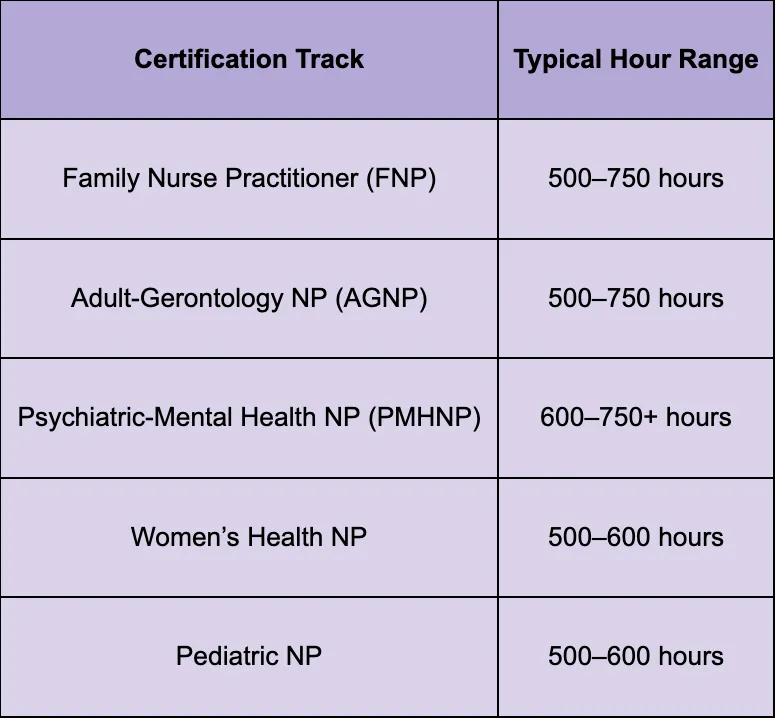
These hours must be completed under appropriate supervision in settings that align with your program’s competency requirements.
Delaware Board of Nursing Expectations
For advanced practice licensure in Delaware, you will need:
- Graduation from an accredited NP program (master’s or doctoral level)
- National certification from a recognized body (ANCC, AANP, or specialty-specific certifiers)
- Background check completion
- Verified clinical hours that meet both your university’s and the Board’s standards
Delaware operates under a “modified independence” model, meaning full practice authority requires 2,000 supervised hours post-licensure or a transitional period. However, as a student, your focus is on completing the clinical hours required for graduation and initial certification.
Alignment Between School and State Standards
Rotations completed in Dover and elsewhere in Delaware must satisfy both your university’s requirements and state regulations. This typically means:
- Your preceptor holds an active Delaware license (or appropriate multistate license)
- The preceptor practices within state scope-of-practice rules
- The clinical setting is appropriate for your specialty track
Having a clear picture of these requirements before you start reaching out to potential preceptors helps you ask the right questions and avoid wasting time on placements that won’t be approved. It also gives you confidence when discussing logistics with clinics and healthcare professionals.
Secure your Delaware Preceptor! Open a free NPHub account now to save your spot.
Clinical Sites and Specialties in Dover, Delaware
Dover offers a range of clinical settings that can support FNP, AGNP, and PMHNP students. These settings provide valuable hands-on experience, allowing students to develop practical knowledge and clinical skills under the supervision of experienced preceptors. This preceptorship period is a structured, supervised learning experience that is essential for transitioning from classroom learning to real-world patient care. While securing a specific placement is never guaranteed, understanding what’s available helps you target your search strategically. Delays in securing clinical placements can affect graduation timelines and certification eligibility.
Types of Clinical Sites
- Regional hospital campus: Inpatient and outpatient services, procedural exposure, complex patient populations
- Outpatient primary care and internal medicine clinics: Chronic disease management, preventive care, routine visits
- Urgent care centers: Acute presentations, fast-paced environments, varied chief complaints
- Community health centers: Underserved populations, sliding-scale services, often open to students
- State-run and private behavioral health programs: Psychiatric assessment, medication management, substance use treatment
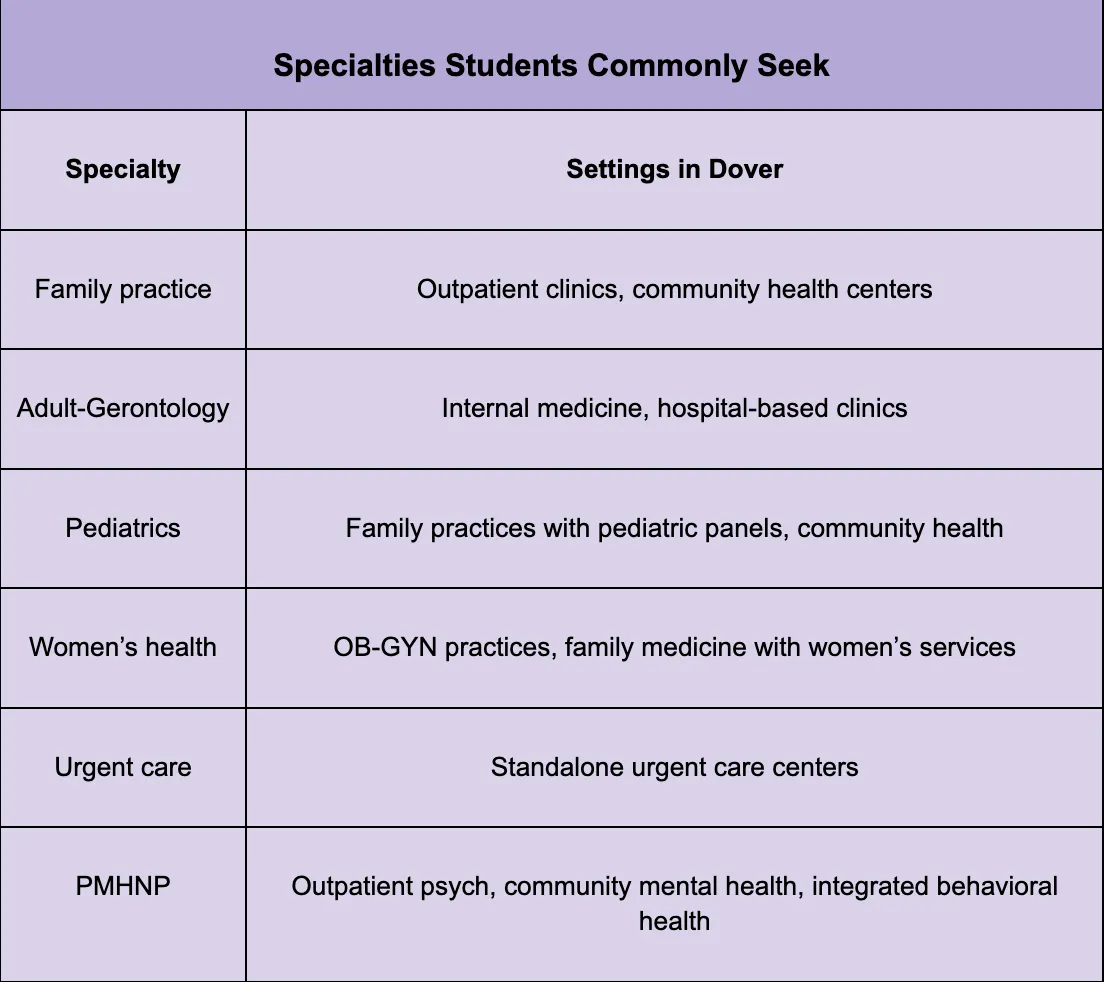
Each setting helps you meet specific competency requirements. For example, a primary care rotation builds skills in chronic disease management, while a behavioral health clinic provides exposure to diagnosis and psychopharmacology essential for PMHNP certification.
You can prioritize settings that fit both your learning goals and comfort level. Some students thrive in high-volume environments; others prefer smaller clinics with more one-on-one time. There is no single right answer—only what works for your education and well-being.
Pathways to Finding a Nurse Practitioner Preceptor in Dover
Students have multiple pathways to secure clinical placements in Dover, including various ways to find preceptors. Each approach involves tradeoffs in cost, control, and stress. The key is choosing the mix of methods that feels safest and most realistic for your circumstances. The process of finding a preceptor can be burdensome for students, especially if their program does not offer support.
Three broad approaches:
- Working with your school: Practicum coordinators, faculty contacts, existing affiliation agreements
- Building your own network: Job sites, community connections, alumni relationships
- Considering paid matching or outreach services: When timelines are tight or other paths haven’t worked
Some NP schools have practicum coordinators that help students find local preceptors, easing the placement process.
Most students find that combining methods works best. Start with school support and networking, then evaluate whether a paid option is worth the financial and emotional tradeoff if you’re running short on time.
Every pathway connects to both a practical outcome (securing a preceptor) and an emotional benefit (reduced anxiety, a clearer plan, backup options in place). Preceptors also provide guidance, mentoring, and support throughout your clinical experience.
Working With Your NP Program to Secure Dover Preceptors
Your practicum or clinical coordinator is a partner in your placement journey, not a gatekeeper. They often have insights into local opportunities and can streamline credentialing with sites that already have school affiliations.
Questions to ask your coordinator about Dover:
- Are there family practice or PMHNP preceptors in Kent County who have worked with students from our program?
- What is the typical lead time to secure rotations in Dover?
- Does the school have existing agreements with Dover-area clinics or health systems?
- What paperwork will I need to complete, and how long does approval typically take?
Pros of this approach:
- Often lower or no added cost
- Structured support and guidance
- Less cold calling required
Cons:
- Potentially limited site choices
- Competition with classmates for the same preceptors
- Stricter timelines set by the school
Even when your school provides options, you can often propose your own Dover preceptor. The school then handles vetting and paperwork, keeping you in control of your placement while reducing administrative burden.
Are you stressed about the paperwork for your upcoming rotation? It's completely normal to feel overwhelmed by the numerous requirements needed for a correct submission. To navigate this step with confidence and expedite your graduation stress-free, open a free NPHub account today.
Networking in Dover: From RN Roles to Community Connections
Networking is relationship-building, not just asking for favors. It can feel intimidating at first, but it often leads to the most meaningful preceptor matches—clinicians who want to work with you because they know you, not because you’re next on a list.
Concrete networking ideas for Dover:
- Ask charge nurses, NPs, and physicians at local hospitals and clinics about preceptor opportunities or referrals
- Attend community health events where you might meet providers
- Connect with professional associations active in Delaware (such as state NP organizations)
- If you’re a working RN in Dover or Kent County, approach clinicians you already trust—providers on your unit, occupational health NPs, or others you’ve collaborated with
Online networking strategies:
- Update your LinkedIn profile to reflect your NP student status and specialties
- Join NP and PMHNP groups focused on Delaware or the Mid-Atlantic region
- Send brief, professional messages to local NPs whose practice aligns with your desired rotation
Protecting your emotional safety:
Set boundaries around outreach. Pace yourself to avoid burnout—you don’t have to contact every clinic in a single week. Recognize that “no” responses are almost always about capacity, not about you personally. Batch your outreach, debrief with peers, and celebrate small wins like callbacks or expressions of interest.
Cold Outreach to Dover Clinics and Practices
Cold calling and emailing can still work effectively in smaller markets like Dover, especially for outpatient primary care, internal medicine, urgent care, and behavioral health settings.
A simple, student-friendly approach:
- Research 5–10 clinics at a time (family practice, mental health, urgent care)
- Call to ask who manages student placements or clinical education
- Follow up with a concise, respectful email restating your interest and submitting your placement or clinical rotation request
What to include in your outreach:
- Your program type (FNP, PMHNP, etc.)
- Required dates and clinical hours
- School expectations for preceptor credentials
- Why you’re specifically interested in Dover (commute, population, learning goals)
Prepare a preceptor packet to send when a clinic expresses interest or to formalize your rotation request:
- Your CV or resume
- Unofficial transcript
- Program overview with preceptor requirements
- Contact information for your school’s clinical coordinator
Repeated outreach is normal. Clinics are busy, and your first email might get buried. Emotional strategies that help: batch your calls into specific time blocks, debrief with classmates afterward, and celebrate progress (even a “not now, try next semester” is useful information).
Ready to start your clinicals and still need a preceptor? Open a free NPHub account today and select the perfect fit for you, whether in Dover, Delaware, or any other location.
Considering Paid Matching and Outreach Services
There are preceptor matching services that help match NP students with clinical preceptors, including in Dover and throughout Delaware. Preceptor matching services play a crucial role in helping students secure placements by connecting them with qualified preceptors across various specialties and locations. Using them is always your choice—never a requirement.
Many preceptor matching services use a personalized matching process, assessing each student's clinical goals, specialty preferences, and location needs to connect them with the most suitable preceptors. This tailored approach often involves direct communication and evaluation to ensure a good fit and enhance the clinical experience.
To initiate the process, preceptor matching services typically require students to submit a rotation request or placement request. The clinical match process may involve platforms like an NP Preceptor Finder or NP Preceptor Matching system, which use automated tools and AI outreach to quickly pair students with available preceptors. Once a preceptor accepts the placement request (preceptor accepts), paperwork and scheduling can proceed.
The matching process usually takes one to two weeks, depending on preceptor availability and specialty. Many services allow students to review preceptor information and even interview potential preceptors before making a payment. Fees are common for these services, but some offer a full refund or money-back guarantee if they cannot find a suitable preceptor or if the school rejects the preceptor. Additionally, preceptor matching services often provide support with the necessary paperwork required for university approval of the preceptor.
Potential benefits:
- Time saved on searching and outreach
- Access to broader networks of experienced preceptors
- A structured process that provides guidance
Potential drawbacks:
- Fees per rotation or per hour (can range from $500–$2,000+)
- Deposits and payment plans that vary by service
- Strict refund policies if placements don’t work out
Questions to ask before enrolling:
- What is the typical match time for Dover or Delaware placements?
- Are Delaware-licensed preceptors guaranteed, or is the geography broader?
- How are school rejections and cancellations handled?
- What happens if no Dover-area match is found before my deadline?
- What emotional support or communication is offered during setbacks?
Read contracts carefully. Look for refund conditions, guarantees, and what happens if a preceptor cancels. Frame paid services as one tool—best used when other paths have been exhausted or when timelines are especially tight and stress is high.
Finding PMHNP and Behavioral Health Preceptors in Dover
PMHNP students in Delaware often face extra challenges securing psychiatric placements. High demand across the Mid-Atlantic region, combined with limited outpatient psych capacity, means you may need to be more proactive and creative in your search.
Types of Mental Health Settings in and Near Dover
- Community mental health clinics
- State-funded behavioral health programs
- Integrated primary care with embedded behavioral health
- Outpatient psychiatry practices (solo and group)
- Crisis services and intensive outpatient programs
- Substance use treatment facilities (including MAT programs)
Evaluating Whether a Preceptor Meets PMHNP Competencies
Not every mental health setting will provide the experiences your program requires. When assessing potential preceptors, consider exposure to:
- Psychiatric assessment and diagnosis (using DSM-5 criteria)
- Psychopharmacology and medication management
- Psychotherapy models and therapeutic communication
- Interprofessional collaboration (working with social workers, LCSWs, psychologists)
- Special populations (children, older adults, veterans, those with substance use disorders)
Be clear with potential preceptors about your PMHNP curriculum, expected skills (medication management, suicide risk assessment), and documentation standards your school requires.
Emotional Safety in Psychiatric Rotations
Psych rotations can be emotionally intense. Strategies for managing this:
- Clarify supervision expectations upfront—how available will the preceptor be for debriefing?
- Ask about the practice’s approach to processing difficult cases
- Choose preceptors who model trauma-informed, patient-centered care
- Maintain boundaries between your clinical work and personal well-being
Dover-Specific Strategies for PMHNP Students
Target your outreach to Dover-area clinics that explicitly list behavioral health or psychiatry services. This includes:
- Integrated family medicine practices with behavioral health teams
- Community mental health centers serving Kent County
- State and county mental health agencies headquartered in or serving Dover
- Private outpatient psychiatry practices accepting students
Additional strategies:
- Ask about observation hours that might evolve into full preceptorships
- Attend local or virtual mental health professional meetings to network with psychiatrists, PMHNPs, and LCSWs who may precept or refer
- Contact the Delaware Psychiatric Center or similar facilities about training opportunities
The benefit of continuity: If you can complete multiple rotations with a single Dover preceptor or system, you’ll deepen your skills and establish a stable emotional home base during what can be a demanding specialty track.
Evaluating a Potential Nurse Practitioner Preceptor in Dover
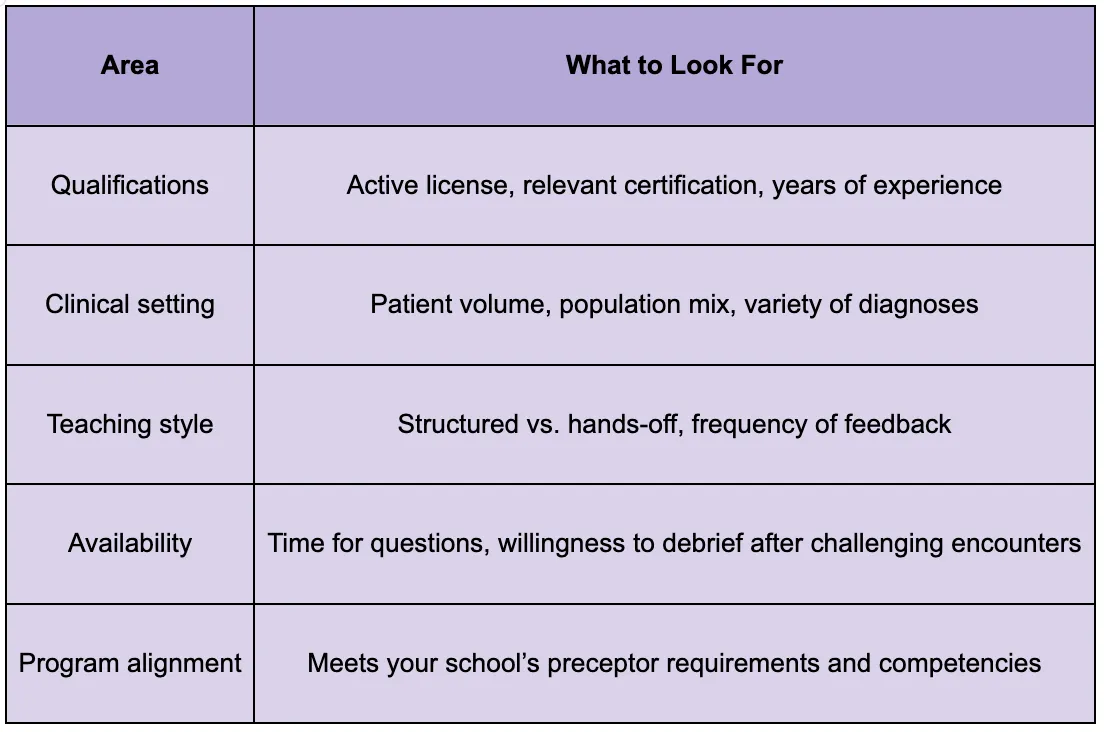
Before committing to any preceptor, take time to assess whether the site and clinician feel like a good clinical and emotional fit. This evaluation protects your learning experience and your well-being.
Core Evaluation Areas
Questions to Explore
Ask potential preceptors about:
- Prior experience supervising NP students
- Comfort level with gradually increasing your independence
- How they handle feedback, mistakes, and learning curves
- Their expectations around documentation and supervision sign-off
Professional Boundaries and Safety
Clarify expectations around:
- Direct supervision requirements (when must the preceptor be physically present?)
- How documentation is reviewed and signed
- How the preceptor responds to ethical concerns or patient safety issues
- What happens if you’re uncomfortable with a clinical situation
It’s okay to decline or seek another site if a potential preceptor doesn’t feel supportive, respectful, or psychologically safe. Your learning environment shapes your competence and confidence as a future clinician.
Questions to Ask Before Accepting a Dover Preceptor
Use this checklist when interviewing or emailing prospective preceptors:
Schedule and logistics:
- What days per week and typical hours would I work?
- What are the anticipated start and end dates?
- Is there an onsite vs. telehealth mix?
- Where should I park, and what’s the commute like?
Learning expectations:
- What types of patients will I see (age range, common diagnoses)?
- How quickly can I progress from observation to semi-independent visits?
- Are there opportunities for procedures relevant to my track?
Emotional safety:
- How do you prefer to handle difficult cases with students?
- What support is available after distressing patient encounters?
- How open are you to questions and reflection during the rotation?
Share your own learning goals and boundaries so both sides can assess fit before committing.
Managing Paperwork, School Approval, and Delaware Regulations
Paperwork is often the most time-consuming and anxiety-provoking part of securing a Dover rotation. A clear plan makes it manageable.
Typical Documents Required
- Affiliation agreement between your school and the clinical site
- Preceptor CV and license verification
- Proof of malpractice coverage (your school may provide this)
- Immunization records and TB screening
- Background check clearance
- Site-specific onboarding (HIPAA training, badge access, etc.)
The Usual Flow
- You and the preceptor agree to work together
- You submit preceptor information to your school
- School reviews credentials and approves the placement
- Site completes any additional HR requirements
- Rotation is fully cleared to begin
Delaware-Specific Considerations
Ensure your preceptor holds an active Delaware license (or appropriate multistate license if applicable) and practices within state scope-of-practice rules. If you’re unsure, gather the preceptor’s CV and license details and have your school verify approval before committing.
Practical strategies:
- Create a single folder (physical or digital) for all Dover rotation documents
- Keep deadlines visible on your calendar
- Confirm with your school how long approval typically takes (4–6 weeks is common)
What to Do if Your Dover Preceptor Falls Through
Losing a preceptor late in the process is stressful and can trigger fears about delayed graduation. If a preceptor cancels, here’s what to do:
First steps:
- Notify your practicum coordinator immediately
- Ask whether alternate Dover or Delaware sites are available
- Clarify how this might impact your timeline
Creating backup options:
- Check if any matching services you’ve used offer replacement options under certain conditions
- Maintain a “Plan B” list of potential Dover and nearby sites from the start
- Resume outreach quickly—don’t wait to process the disappointment before taking action
Self-care during transitions: Lean on peers, mentors, or counseling resources. A setback doesn’t reflect your worth or competence. It’s a logistics challenge, not a judgment of your abilities.
Time-Management Tips
- Block weekly “preceptor search” time on your calendar
- Batch emails and calls to specific days
- Track outreach in a simple spreadsheet (clinic name, contact, date, response)
- Set realistic goals: “Contact three clinics this week” is achievable; “find a preceptor today” is not
Protecting Your Well-Being During the Clinical Search
This search can feel overwhelming. Here’s a compassionate checklist for staying grounded:
- Set clear daily or weekly goals (e.g., contact three clinics, follow up with school) and celebrate progress, not just final matches
- Build a peer support circle of classmates or local NP students who can share leads, scripts, and emotional encouragement
- Practice accessible self-care that fits around clinical and work schedules: brief walks, journaling, short mindfulness exercises after outreach sessions
- Give yourself permission to pause and reassess your approach when needed
You always have the right to choose paths that balance academic needs with your mental health. Your well-being matters as much as your credentials.
Moving Forward With Confidence
Finding nurse practitioner preceptors in Dover, Delaware is a process that rewards patience, persistence, and self-awareness. Whether you’re pursuing family practice, adult-gero, women’s health, pediatrics, or PMHNP certification, Dover offers a manageable healthcare landscape where meaningful mentoring relationships are possible.
Start early. Use your school’s resources, build local connections, and consider paid services only when other options don’t fit your timeline. Evaluate every potential preceptor with both practical and emotional criteria. And remember: setbacks are logistics problems, not reflections of your worth.
Your clinical rotations are the foundation of your future practice. Approach them with the same care and intentionality you’ll bring to your patients.
Your next step: Block 30 minutes this week to map out your preceptor search timeline. Whether that means scheduling a meeting with your coordinator, drafting outreach emails, or updating your LinkedIn profile, one action today builds momentum for the placement you need tomorrow.
Tired of the endless preceptor search? Stop stressing and start learning. Create your FREE NPHub account now to instantly access qualified preceptors and get matched fast for your clinical rotations in Dover, Delaware, and beyond!
Key Definitions
Before diving into strategies, here are the core terms you will encounter throughout this guide:
- Dover, Delaware: The capital city of Delaware, located in Kent County, home to key health systems, outpatient clinics, and behavioral health centers that serve as potential clinical sites for nurse practitioner students.
- Delaware NP License: The license issued by the Delaware Board of Nursing authorizing nurse practitioners to practice in the state. Requirements include graduation from an accredited NP program, national certification, and verified clinical hours.
- Preceptor: A licensed clinician—typically an NP, physician, or PA—who supervises, teaches, and evaluates NP students during clinical rotations.
- PMHNP (Psychiatric-Mental Health Nurse Practitioner): An advanced practice nurse specializing in mental health assessment, diagnosis, and treatment across the lifespan.
- Clinical Rotation: A structured, supervised practice experience in settings such as primary care, outpatient psychiatry, community health centers, or urgent care.
FAQs About NP and PMHNP Preceptors in Dover, Delaware
How early should I start looking for a Dover, Delaware preceptor?
Begin exploring options 6–12 months before your desired rotation start date. Use the longer end of this range for PMHNP or highly specialized rotations where preceptor availability is limited. Starting early gives you time to try multiple strategies—school support, networking, cold outreach, and optional matching services—without feeling rushed. This timeline is especially helpful for students who work full time or commute to Dover and need to coordinate complex schedules.
Can I complete all my NP or PMHNP hours in Dover, or should I plan on multiple locations?
Whether you can stay in Dover for all your hours depends on your program’s requirements for diversity of settings and populations. Some programs require rotations across different site types (e.g., hospital, community health, specialty). Check with your practicum coordinator about how many rotations can occur at a single Dover site versus needing placements elsewhere in Delaware. Continuity in Dover offers emotional stability, while variety across locations builds broader clinical experience. Choose the balance that fits your learning goals.
Do my Dover preceptors need to be nurse practitioners, or can physicians and PAs precept me in Delaware?
Many NP programs and the Delaware Board of Nursing allow a mix of preceptors—NPs, physicians, and PAs. However, your program may prefer or require a certain proportion of NP preceptors, particularly for hours that count toward specialty competencies. Confirm with your school which credentials are acceptable for each rotation type. When in doubt, gather the potential preceptor’s CV and license details and have the school approve them before committing.
What if I live outside Dover—can I still do my rotations there?
Absolutely. Many students living in other parts of Delaware or neighboring states commute to Dover for rotations, especially when their home area has limited options. Plan for commute time, gas or transit costs, and potential weather delays—these factors affect both stress levels and attendance. Ask potential Dover preceptors about scheduling flexibility (e.g., stacking hours on fewer days) to make commuting more sustainable while protecting your clinical experience.
How do I know if a Dover preceptor is a good fit for my learning style?
Before interviewing potential preceptors, reflect on what you need to feel safe and supported. Do you thrive with frequent feedback or prefer more independence? Do you need clear structure, or are you comfortable with ambiguity? Ask preceptors about their teaching style, supervision preferences, and how they typically involve students in patient care. It’s okay to say “no” or keep looking if a preceptor or site doesn’t feel aligned with your needs—even if it seems like the easier option on paper. Your fulfilling clinical experience depends on finding the right preceptor, not just any preceptor.
Article details
Last updated
February 16, 2026
Fact-checked by
NPHub Clinical Placement Experts & Student Support Team
Sources and references
- https://www.ncsbn.org/bon-member-details/Delaware#:~:text=Location,Dover%2C%20DE%2019904
- https://share.google/j4thZas3U3o4ZifOh
- https://dhss.delaware.gov/wp-content/uploads/sites/10/dph/pdf/fqhcs.pdf
- https://delawaretoday.com/things-to-do/24-hour-day-trip-guide-dover/#:~:text=Nestled%20in%20the%20middle%20of,the%20U.S.%20Constitution%20in%201787.
- https://npdegrees.org/degrees/best-online-np-programs/
- https://dpr.delaware.gov/boards/nursing/apnlicense/#:~:text=Already%20hold%2C%20or%20concurrently%20apply,within%20the%20past%20two%20years.
- https://www.nphub.com/blog/find-np-clinical-placements
- https://www.facebook.com/groups/delawarepreceptorsfornpstudents
- https://www.nphub.com/blog/best-preceptor-matching-service
- https://www.nphub.com/refunds-cancellations-policy
- https://dcnpweb.enpnetwork.com/nurse-practitioner-preceptors
- https://www.nphub.com/blog/pmhnp-clinical-rotations
- https://www.nphub.com/rotation-paperwork-process
Find a preceptor who cares with NPHub
Book a rotation.webp)
.jpeg)

.webp)

.jpeg)

%20(3)%20(2).svg)
.webp)