
.png)

.avif)


.webp)
PreceptorLink and NPHub are two of the better-known preceptor matching services for nurse practitioner students, and both exist to solve the same problem: the stretch of NP school where finding a preceptor becomes your responsibility and no one seems to be answering your emails. They take noticeably different approaches, though, and a few things changed in 2025 that most comparisons have not caught up with yet.
This guide walks through how the two services actually differ on the factors that decide your rotation: cost, how much money is at risk before you have a confirmed match, refund and replacement terms, support, reviews, and specialty coverage. The goal is to help you choose the right preceptor for where you are in your program, not to talk you into anything. Where NPHub has a real advantage, you will see the numbers behind it. Where PreceptorLink may be the better fit, you will see that too.
If you would rather look at real options while you read, you can create a free NPHub account and browse available preceptors in your specialty and location. It takes a few minutes and there is no obligation to book.
.avif)
TL;DR: PreceptorLink vs NPHub
- PreceptorLink was founded in 2014 by nurse practitioner Lynn McComas, DNP, ANP-C, and in 2025 it joined AMOpportunities (AMO), a larger clinical education company. It offers a personalized matching process, a self-serve app to browse preceptor profiles, and a stated strength in last-minute placements.
- NPHub is an independent, NP-student-focused service that has helped more than 9,000 nurse practitioner students complete over 14,000 clinical rotations, backed by 4.9 out of 5 stars on Trustpilot from more than 1,600 reviews.
- Pricing works differently. NPHub publishes an hourly starting rate ($12.75 per hour) and a refundable deposit. PreceptorLink is quote-based per preceptor and starts with a $150 non-refundable application fee.
- Both offer replacement support, but the terms differ: NPHub offers a free replacement or a 100% refund, while PreceptorLink finds a new clinical site within about 60 miles or refunds your fees, with a replacement potentially costing more.
- Best for most students: NPHub, because of transparent pricing, less money at risk upfront, and a deep record of verified reviews. Best if you want to self-browse preceptor profiles or prefer a long-established, clinician-founded service: PreceptorLink is worth a look.
Want to see what your options look like before you decide? Browse preceptors near you for free.
PreceptorLink vs NPHub at a glance
The Importance of Clinical Rotations and How Preceptor Matching Platforms Can Help
Clinical rotations are where everything you have learned in class finally turns into real-world confidence. They are also one of the hardest parts of NP school to secure on your own. Between work, family, and deadlines, many students spend months emailing clinics, calling offices, and hearing the same thing again and again: “We are not taking students right now.”
That is why preceptor matching platforms exist. Services like PreceptorLink and NPHub step in to help you find qualified preceptors, meet your program requirements, and keep your graduation timeline on track. Both aim to reduce the stress around clinical placements, but they do it in different ways, and those differences can have a big impact on your experience.
If you are feeling overwhelmed, you are not alone. Whether you are just starting your search or already in full “Where am I going to find my preceptor?” panic mode, understanding how these platforms work can give you clarity and control.
Here are the key areas where PreceptorLink and NPHub differ and what they mean for you as an NP student:
- Network size
- Placements fulfilled
- Pricing structure
- Deposit requirements
- Additional services
If you already know you need help and do not want to lose more time, you can go straight to exploring your options. NPHub has helped over 10,000 NP students secure clinical placements. You can create your free NPHub account and see what rotations are available near you before spots fill up.
About PreceptorLink
PreceptorLink is a preceptor matching service for nurse practitioner and APRN students, founded in 2014 by Lynn McComas, DNP, ANP-C, a nurse practitioner whose doctoral work focused on the preceptor shortage. For most of its history, it was a boutique, NP-owned company known for a personalized matching process and hands-on coordinators.
The important update, and the piece most comparisons miss, is that in 2025 PreceptorLink joined AMOpportunities (AMO), a tech-enabled clinical education company founded in 2013 and headquartered in Chicago. AMO historically placed international and US medical students and physician assistant students into clinical experiences, and the acquisition expands PreceptorLink into additional health professions, including pre-licensure RN and RN-to-BSN placements. Lynn McComas now serves as Chief Nursing Officer at AMO, and the service brands itself "PreceptorLink/AMO." According to the companies, the goal is to combine AMO's scale with PreceptorLink's NP expertise.
For an NP student, that change is worth understanding rather than fearing. On one hand, a larger parent company can mean more resources and a wider network. On the other, some students specifically valued the smaller, NP-only feel, and the service is now part of a broader organization serving many types of learners. Neither is inherently good or bad. It is simply a factor to weigh, the same way you would weigh anything else about a service you are about to pay.
In practice, PreceptorLink offers a self-serve app where you can use search filters for dates, hours, specialty, and location, review qualified nurse practitioner preceptors, and see pricing and availability on each profile before you request a match. Every student is assigned a personal Clinical Coordinator, and the company maintains a resource center with training videos for students and preceptors. PreceptorLink also states that last-minute clinical rotations are one of its specialties and that most students receive an initial preceptor match within one to three business days.
About NPHub
NPHub is a preceptor matching platform built specifically for nurse practitioner students who are expected to secure their own clinical placements. Founded in 2017, it began when a single NP student lost her placement and needed help, and has since grown into a national database of preceptors used by students nationwide.
To date, NPHub has helped more than 9,000 NP students complete over 14,000 clinical rotations, representing roughly 1.8 million supervised clinical hours across 45 states. Its preceptor network is vetted rather than open: of more than 18,000 preceptor applicants, about 2,435 have been accepted, an acceptance rate near 13%. Students consistently rate the experience at 4.9 out of 5 on Trustpilot across more than 1,600 reviews.
Where NPHub differs day-to-day is in the support model. Rather than handing you a list of names, a coordinator works your case directly, from the initial preceptor match through the completion of your clinical hours, and the team handles school paperwork, affiliation agreements, and school approval so documentation delays do not push back your graduation timeline. You can see how that process works step by step on the how it works page, or you can create a free account and start browsing qualified nurse practitioner preceptors right away.
How PreceptorLink and NPHub actually differ
Both services will connect you with a qualified preceptor. The differences that matter show up in the details, so here is each one on its own.
Ownership and focus
NPHub is independent and focused solely on nurse practitioner students and preceptors. PreceptorLink is now part of AMOpportunities and is broadening into RN and PA placements under a parent company with roots in international medical and PA rotations. If a single-focus NP service matters to you, that favors NPHub. If you like the idea of a larger organization behind your placement, PreceptorLink's new structure may appeal to you. This is a genuine preference call, not a right-or-wrong one.
Preceptor network and specialties
Both services cover the specialties most NP students need, including family practice, primary care, psychiatric mental health (PMHNP), women's health, and pediatric NP rotations. NPHub lists a broad range, including acute care and urgent care as well.
The more useful question is not who lists more specialties but who has an available, vetted preceptor for your dates and location. This is exactly where a large national database helps, and where it can also disappoint if the listed preceptors in your area are already booked. NPHub's answer is a free waitlist: if a match is not immediately available, the team actively continues the preceptor search on your behalf. The fastest way to know what is realistic for your specialty and region is to check availability yourself rather than rely on either company's headline network number.
Pricing and what you pay upfront
This is the clearest, most concrete difference between the two.
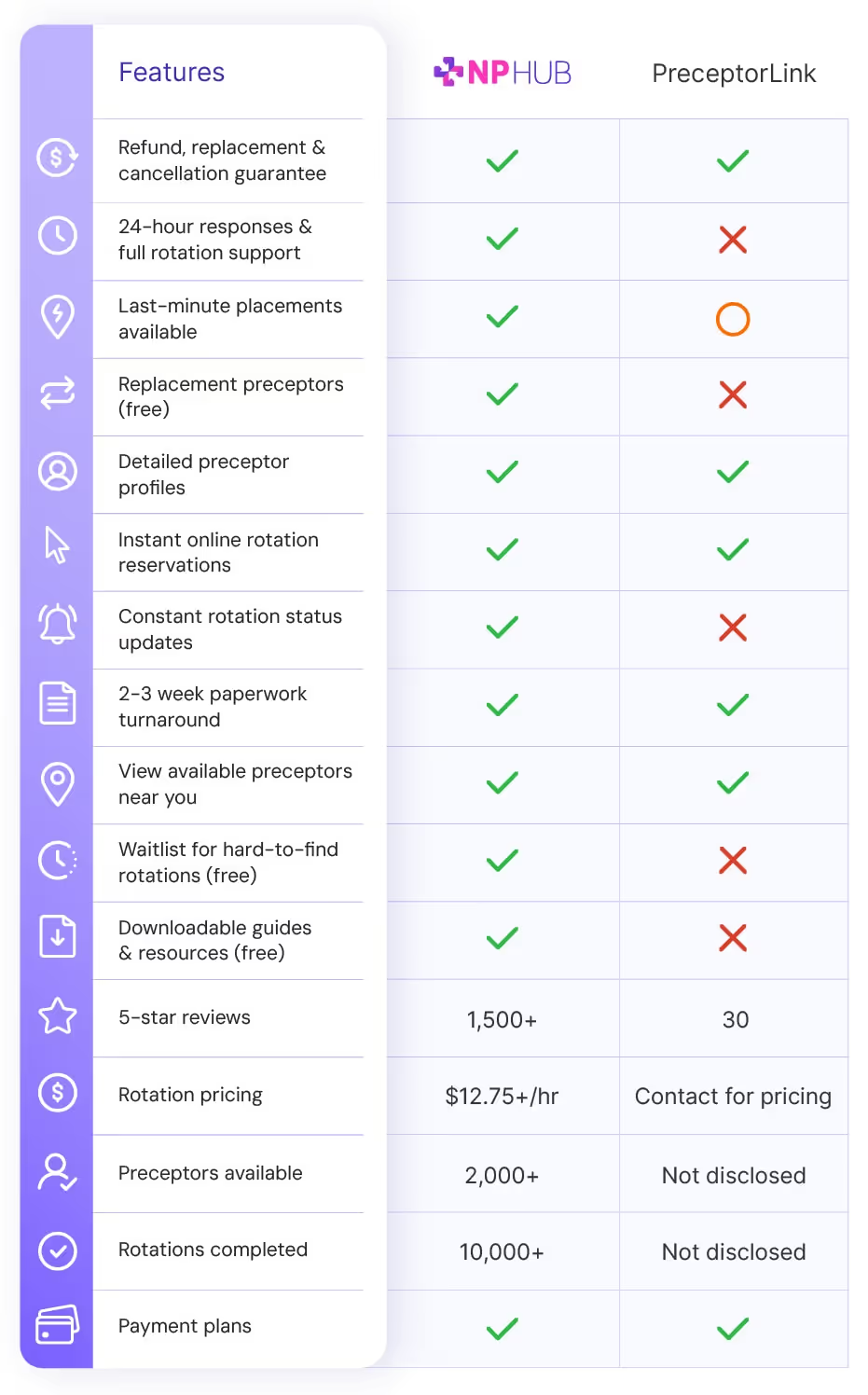
NPHub uses published, pay-as-you-go pricing starting at $12.75 per hour, so you can estimate the total for a rotation before you commit. A 5% service fee is included in that total rather than added on top of it, so the number you see is the number you pay, with no hidden fees. To get started, your 15% deposit is simply the first part of the total, not an extra charge, and the remaining balance can be paid in installments. If you pay the deposit but your preceptor has not yet accepted, you can request a full refund within 5 days.
PreceptorLink is quote-based, with the cost set by each individual preceptor's honorarium plus the company's business expenses. Per its own FAQ, the process begins with a $150 non-refundable application fee when you request a preceptor, followed by staged auto-payments as the preceptor accepts and paperwork is completed, with the full balance due before your rotation starts. If your chosen preceptor is not already in the network, an optional custom search fee (reported between $50 and $300) can apply. Publicly reported rotation totals tend to fall around $1,500 to $1,800, and higher in some markets.
The practical takeaway is not that one is always cheaper, because that depends on your specialty and total hours. It is about how much money is at risk before you have a confirmed match. With NPHub, your deposit is refundable within a short window if the preceptor has not accepted. With PreceptorLink, the $150 application fee, and any custom search fee, are non-refundable regardless of what happens next. For students on a tight budget, that difference is worth reading carefully.
Refunds, replacements, and guarantees
Preceptors sometimes back out, and how a service handles that moment is one of the most important things to understand before you pay.
NPHub's Perfect Preceptor Promise offers a free replacement or a 100% refund if a placement does not meet your program requirements or falls through, and the team handles the school coordination to keep your rotation on track. You can read the full terms on the refunds and cancellations page.
PreceptorLink also provides replacement support. Based on its stated policy, if a preceptor backs out, the service will look for a new clinical site within about 60 miles or refund your fees, and a replacement placement may cost up to 20% more than your original quote. Both approaches protect you to a degree; the difference is in the specifics, so match each policy against your own situation, especially if you live somewhere a 60-mile radius covers a lot of ground.
Support and clinical placement speed
PreceptorLink leans on a self-serve app plus a personal Clinical Coordinator, and points students to training videos to learn the platform. It advertises fast initial matches, often within one to three business days, and strong support for last-minute placements.
NPHub leans on hands-on, team-led matching, with coordinators reachable by email, SMS, and phone, and full management of school paperwork. NPHub typically moves from request to completed paperwork in about two to three weeks, which suits students planning a semester ahead. If your timeline is very tight, ask either service directly how quickly they can realistically place you in your specialty and area.
Reviews and reputation
Third-party reviews are one of the few signals you can check independently. NPHub holds 4.9 out of 5 on Trustpilot across more than 1,600 reviews, with students frequently naming their coordinators and describing help with last-minute and hard-to-place situations. PreceptorLink is smaller here, publicly reported at roughly 4.2 out of 5 from about 65 Google reviews at the time of writing. Both are positive; the difference is in volume and the breadth of independent platforms. You can read NPHub student and preceptor stories on the testimonials page.
If you want the fuller picture on trust and legitimacy specifically, we cover that in a separate guide: Is PreceptorLink a scam? What NP students should know.
How much does each service cost?
Because pricing is usually the deciding factor, here is the short version in one place.
NPHub publishes its rates. Rotations start at $12.75 per hour, and the 5% service fee and 15% deposit are part of that total rather than extra charges on top. You reserve with the deposit and can pay the balance over time. For example, a 250-hour rotation at the starting rate comes to roughly $3,190 total, though your exact number depends on specialty, location, and hours. Because the rate is published, you can estimate your cost up front by creating a free account.
PreceptorLink sets cost per preceptor, so you request a quote rather than read a rate. Expect a $150 non-refundable application fee to start, a possible custom search fee if your preceptor is not already in the network, and staged payments due in full before the rotation begins. Reported totals commonly land around $1,500 to $1,800.
Neither is automatically the cheaper choice for every student. If you value knowing the number before you commit and keeping your upfront money refundable, NPHub's model is more transparent. If you are comfortable with quote-based pricing and want to browse individual preceptor prices in an app, PreceptorLink's model may suit you.
Which One Should You Choose?
.avif)
There is no single best preceptor matching platform for everyone. The right choice depends on your specialty, your budget, how soon you need to start, and how much hands-on support you want. Here is how the two sort out.
- Choose NPHub if you want published, pay-as-you-go pricing, the smallest amount of money at risk before a confirmed match, full school paperwork handling, and a deep record of verified reviews. This fits most NP students, and especially anyone budgeting carefully or coordinating tricky school approval.
- Choose PreceptorLink if you prefer to self-browse preceptor profiles with visible pricing in an app, you value a long-established, clinician-founded service, or you are drawn to the scale of its new AMO parent company.
- For a genuinely last-minute rotation, ask both services directly how fast they can place you in your specialty and location, since availability, not marketing, decides that.
- Best overall for most students: with transparent pricing, lower upfront risk, strong guarantees, and in-depth independent review, NPHub is the stronger all-around option for the typical NP student. That is a conclusion the factors point to, not a slogan, and you can test it against your own situation in a few minutes.
Ready to see what is actually available for you? Create your free account and start your preceptor search.
Need More Info Before You Decide?
Choosing a preceptor matching service isn't one-size-fits-all. Whether you’re a new grad juggling deadlines or a working NP student trying to stay sane, it's smart to look at how different platforms stack up, especially when it comes to cost, support, and specialty coverage like PMHNP or FNP.
To help you compare and decide what actually fits your clinical goals (and your stress tolerance), we’ve put together a collection of honest, easy-to-digest comparisons:
NP Preceptor Platform Showdowns:
- Clinical Match Me vs NPHub: Complete Comparison for Nurse Practitioner Students
- Precept Me NP vs. NPHub: Which NP preceptor matching service gives you the edge?
- Preceptor Point vs NPHub
- NPHub vs MatchNP
- Clinical Preceptor Rescue vs NPHub: Which Service Should NP Students Choose?
- Preceptor Tree vs NPHub
- Best Nurse Practitioner Placement Agencies
Frequently Asked Questions (FAQ): PreceptorLink vs NPHub
Is PreceptorLink still nurse practitioner owned?
PreceptorLink was founded by nurse practitioner Lynn McComas, DNP, ANP-C, and remains clinician-led, but in 2025 it joined AMOpportunities, a larger clinical education company. McComas is now Chief Nursing Officer at AMO. So it is founder-led within a bigger parent organization rather than an independent NP-only company.
Does PreceptorLink charge an upfront fee?
Yes. PreceptorLink's process begins with a $150 non-refundable application fee when you request a preceptor, and an optional custom search fee can apply if your preceptor is not already in the network. NPHub does not charge a non-refundable application fee; it uses a 15% deposit that is refundable within 5 days if your preceptor has not yet accepted.
Is NPHub more expensive than PreceptorLink?
It depends on your specialty and total hours. NPHub publishes an hourly starting rate ($12.75 per hour) so you can estimate your total in advance, while PreceptorLink is quote-based per preceptor, with reported rotation totals commonly around $1,500 to $1,800. The clearer difference is that NPHub keeps more of your upfront money refundable.
What happens if my preceptor cancels?
With NPHub, the Perfect Preceptor Promise provides a free replacement or a 100% refund, and the team handles school coordination. With PreceptorLink, the stated policy is to find a new clinical site within about 60 miles or refund your fees, though a replacement placement may cost up to 20% more than your original quote. Confirm the current terms with either service before you commit.
Can I find a PMHNP or women's health preceptor through these platforms?
Yes. Both services support high-demand specialties, including PMHNP, women's health, family practice, and pediatric NP rotations. Availability varies by location and timing, so it is worth checking what is open for your specific dates rather than assuming the listed network reflects your area.
How long does it take for NP students to get matched?
PreceptorLink says most students receive an initial match within one to three business days. NPHub typically moves from request to completed school paperwork in about two to three weeks and works well for students planning ahead. For urgent timelines, ask each service what is realistic for your specialty and region.
Do these services work with my NP program?
Most NP programs allow students to use third-party preceptor matching services as long as the clinical site and preceptor meet program requirements. Always confirm with your school's clinical coordinator before committing, and ask the service how they handle affiliation agreements and school approval.
Is using a preceptor matching service worth it?
If your program expects you to find your own preceptor and independent outreach has stalled, a reputable service can save weeks of cold calling clinics and help protect your graduation timeline. Whether it is worth the cost depends on your location, specialty, and how much runway you have. The lowest-pressure way to decide is to create a free NPHub account and see what real, available options look like before you spend anything.
Key Definitions
- Preceptor
A licensed healthcare professional (e.g., NP, MD, PA) who supervises and mentors nurse practitioner students during clinical rotations. - Clinical Rotations
Supervised, hands-on training experiences in real healthcare settings required for NP program completion and licensure. - Preceptor Matching
The process of connecting NP students with qualified preceptors in their required specialties and locations. - PMHNP
Psychiatric-Mental Health Nurse Practitioner; an NP specialty focused on diagnosing and treating mental health conditions. - Preceptor Honorarium
A payment made to a preceptor as compensation for their time and teaching during a student's clinical rotation. - Paid vs. Unpaid Preceptors
Some preceptors volunteer their time, but due to demand, many now require honorariums. Most matching services focus on paid placements. - Placement Guarantee
A policy offered by some services (like NPHub) that promises a full refund or replacement if a placement falls through. - Preceptor Matching Platform
A third-party service like NPHub or PreceptorLink that helps NP students find and secure clinical rotations. - APRNs
Advanced Practice Registered Nurses, which include NPs, CRNAs, CNMs, and CNSs. - Preceptor App/Portal
A digital tool provided by some platforms (like the PreceptorLink app) to streamline communication, document sharing, and training videos.
Article details
- Last updated
August 17, 2026 - Fact-checked by
NPHub Clinical Placement Experts & Student Support Team - Sources and references
- https://www.nphub.com/testimonials
- https://student.nphub.com/signup
- https://www.nphub.com/pricing
- https://www.nphub.com/refunds-cancellations-policy
- https://www.nphub.com/about-us
- https://www.nphub.com/blog/clinical-match-me-vs-nphub
- https://www.nphub.com/blog/precept-me-np-vs-nphub-which-np-preceptor-matching-service-gives-you-the-edge
- https://www.nphub.com/blog/preceptor-point-vs-nphub
- https://www.nphub.com/blog/matchnp-vs-nphub
- https://www.nphub.com/blog/clinical-preceptor-rescue-vs-nphub-which-service-should-np-students-choose
- https://www.nphub.com/blog/preceptor-tree-vs-nphub
- https://www.nphub.com/blog/best-nurse-practitioner-placement-agencies
- https://www.nphub.com/blog/best-preceptor-matching-service
- https://www.nphub.com/how-it-works
- https://www.nphub.com/blog/how-nphub-verifies-preceptors
Find a preceptor who cares with NPHub
Book a rotation.webp)
.jpeg)

.webp)



%20(3)%20(2).svg)
.webp)