
.png)



.webp)
TL;DR: Why NP Clinical Placement Capacity Can't Keep Up With Enrollment
- The capacity gap is structural, not temporary. Nurse practitioner enrollment is climbing, master's nursing programs grew 4.8% in 2024, DNP programs expanded for the twenty-first consecutive year, and NP workforce demand is projected to grow 40% by 2033. Clinical placement capacity hasn't scaled with it, and the AACN has named insufficient clinical sites and preceptors among the top reasons nursing schools turn away qualified applicants.
- The cost lands on your program, not just your students. Clinical coordinators and faculty are absorbing preceptor sourcing work that sits outside their educational preparation, driving burnout, turnover, and accreditation exposure as CCNE and ACEN reviewers scrutinize placement quality, preceptor credentialing, and ongoing site oversight more closely than ever.
- Most nurse practitioner programs are doing preceptor recruiting by accident. The work is distributed across coordinators, nurse educators, and, too often, students themselves, none of whom were hired, trained, or evaluated as recruiters. Preceptor recruiting is a discipline that requires clinical judgment, relationship-building, documentation discipline, and ongoing oversight. Treating it as administrative work is the structural reason capacity never actually grows.
- NPHub's Preceptor Recruiters operate as program infrastructure, not a marketplace. Our clinician-led methodology includes NP-to-NP vetting interviews, credential and license integrity screening, clinical site approval, and a 45-day re-verification cycle, each component translating directly into faculty time recovered and accreditation evidence assembled.
- Programs that treat preceptor recruiting as an infrastructure plan around clinical capacity instead of scrambling for it. Faculty time returns to teaching and mentorship, accreditation conversations become easier, graduation timelines become more predictable, and the network of qualified preceptors and clinical sites grows cohort after cohort. Get in touch with our university team to see what that shift would look like for your nurse practitioner program.
Nurse practitioner enrollment is climbing. According to the American Association of Colleges of Nursing, master's-level nursing programs grew by 4.8% in 2024, DNP programs expanded for the twenty-first consecutive year, and applications to graduate nursing programs continued to rise, signaling sustained interest in advanced practice across primary care, psychiatric mental health, women's health, and family practice.
However, the nurse practitioner clinical placement capacity has not kept pace. The same clinical sites are being asked to absorb more nurse practitioner students, more registered nurses returning for graduate study, and more qualified applicants than ever before. This results in:
- Competition from other healthcare disciplines, medical school rotations, PA programs, and allied health students competing for the same urgent care and specialty placements.
- Regional disparities, rural areas and distance education programs are facing sharper shortages of qualified preceptors.
- Structural barriers to enrollment, the AACN has named insufficient clinical placement sites, faculty, and preceptors among the primary reasons nursing schools can't admit all qualified applicants.
The gap isn't going to close on its own. And the nurse practitioner programs absorbing the most pressure from it are the ones still treating preceptor recruiting as an administrative task rather than a discipline.
If your program is feeling this pressure heading into the next enrollment cycle, our university team can walk you through how other nurse practitioner programs are building placement capacity they can plan around.
What the Capacity Gap in Clinical Rotations Actually Costs Programs
The clinical placement shortage is a program problem and it's quietly reshaping faculty workload, accreditation posture, and enrollment health.
The Hidden Clinical Education Cost: Faculty and Coordinator Burnout
Clinical coordinators across nurse practitioner programs are spending more hours on preceptor outreach, follow-up, contract administration, and affiliation agreements than on clinical education itself. What was once a coordination function has become a full-time sourcing operation and the people absorbing it are the same ones expected to oversee curriculum, evaluate student progress, and mentor the next generation of clinicians.
Faculty are being pulled in alongside them. The sourcing work sits entirely outside their educational preparation and erodes the time they can spend on teaching, mentorship, and professional development. The literature on the NP preceptor shortage has long acknowledged that many NP programs lack a structured network of preceptors, leaving students and, by extension, faculty to fill the gap through personal outreach.
The compounding effects are familiar to any dean who's lost a seasoned coordinator:
- Burnout among clinical faculty and coordinators already stretched thin.
- Turnover in roles where institutional knowledge about clinical sites, preceptors, and paperwork history is difficult to replace.
- Knowledge loss that forces the next coordinator to rebuild relationships and documentation from scratch.
The Compliance Cost: Accreditation Risk
CCNE and ACEN reviews have evolved. Accreditors are scrutinizing placement quality, preceptor credentialing, and ongoing site oversight, not just total clinical hours completed. The Sawyer Initiative accelerated this shift, pushing CCNE to strengthen expectations around clinical site preparation, preceptor qualifications, and quality of clinical sites across distance education programs and traditional programs alike.
When preceptor verification is inconsistent, handled one way by one coordinator, another way by another, sometimes by the student themselves, programs face real consequences:
- Gaps in documentation that accreditors notice
- Unclear audit trails when site or preceptor questions arise
- Harder, more defensive conversations during review cycles
And the reputational risk compounds. Delayed graduations and rejected placements don't stay contained to individual students. They surface in program satisfaction scores, in word-of-mouth among prospective applicants, and in the kind of enrollment softening that's difficult to reverse once it starts, particularly when nurse practitioner programs are already competing for the same pool of qualified applicants.
The Student Clinical Site Experience Cost, Which Is Also a Program Cost
Insufficient clinical sites and last-minute preceptor issues affect NP students directly. But the downstream effect lands on the program: increased complaints, lower satisfaction scores, extended graduation timelines, and enrollment health that depends on a reputation for clinical support.
Put plainly: every placement issue a student experiences is a data point future applicants will hear about before they apply.
Preceptor Recruiting Is a Discipline and Most NP Programs Are Doing It by Accident
Here's the reframe that changes how to think about the capacity gap:
Most nursing programs don't have a dedicated preceptor recruiting function. The work is distributed across clinical coordinators, faculty, program administrators, and students themselves. Each group does their best. None of them were hired, trained, or evaluated as recruiters.
When students are asked to find their own preceptor, the program has effectively outsourced a core piece of its clinical education infrastructure to its least-experienced stakeholders. It's a structural answer to a structural problem, and it produces exactly the outcomes you'd expect: inconsistent placement quality, uneven documentation, and a heavy ongoing lift for whoever catches the overflow.
Preceptor recruiting looks like administrative work. It isn't.
Done well, it requires:
- Clinical judgment: evaluating scope, acuity, patient population, and teaching readiness. This is NP-to-NP work. A coordinator without a clinical background can verify a license; they can't assess whether a practice setting will support a psychiatric mental health rotation or a family practice rotation in any meaningful way.
- Relationship-building across clinical settings and healthcare facilities: preceptor recruitment is a long game. Research on NP preceptor motivation consistently finds that clinicians are far more likely to precept when their role is clearly defined, their colleagues support the arrangement, and there's trusted ongoing communication with the academic side. None of that happens through cold outreach.
- Documentation discipline that holds up to accreditation review: every conversation, credential check, and site approval is potential audit evidence. Ad hoc sourcing produces ad hoc records.
- Ongoing oversight as practice settings and clinical rotations evolve: schedules shift, acuity changes, staffing turns over. A preceptor who was a perfect fit in January may not be in June. Someone has to notice.
This is the reframe most nurse practitioner programs haven't made yet:
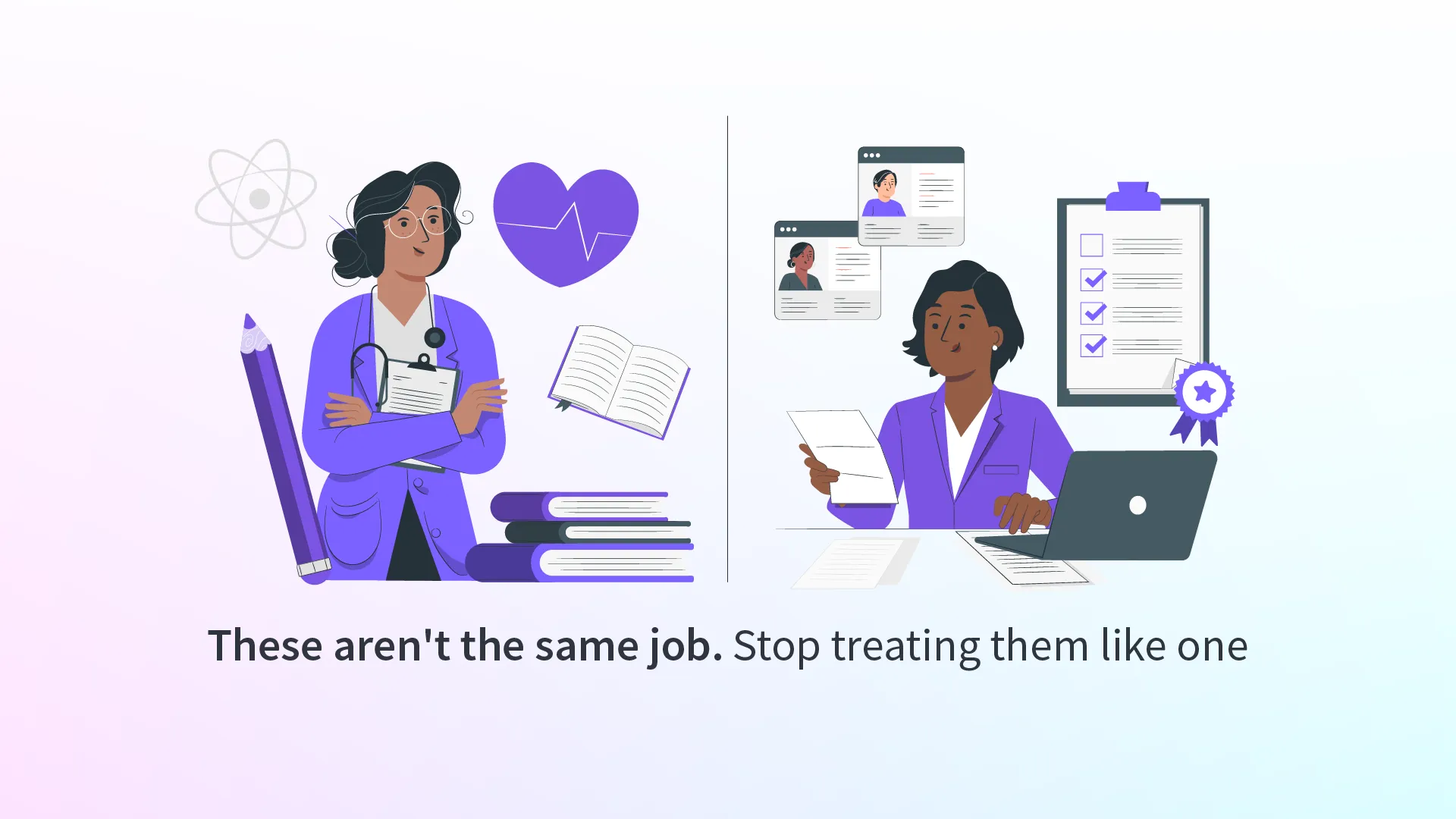
Your faculty are nurse educators. Ours are preceptor recruiters. Those are different disciplines and the gap between enrollment demand and placement capacity is the cost of conflating them.
Nurse educators are trained to teach, mentor, and develop students' clinical judgment. That's a specialized craft, and it's the work they should be doing. Preceptor recruiting is a different specialized craft, one that requires clinical credibility to evaluate sites, relational patience to build a preceptor network, and operational discipline to keep the whole system documented and current.
When programs conflate the two, the nurse educators lose. They absorb recruiting work that sits outside their educational preparation, and the recruiting itself gets done in the margins of people who have other full-time jobs. The placements get filled but the capacity never actually grows.
Treating preceptor recruiting as a discipline is what makes clinical capacity something a program can plan around, rather than something it scrambles to produce each term.
Inside NPHub's Preceptor Recruiter Methodology
This is where the discipline becomes visible. The methodology below is what a dedicated preceptor recruiting function looks like, five components our team runs on behalf of the nurse practitioner programs we partner with. Each one translates directly into faculty time recovered or accreditation evidence assembled.
Clinician-Led, Not Algorithm-Led
NPHub's Preceptor Recruiting function is led by board-certified Nurse Practitioners, not marketplaces, not algorithms, not third-party reviewers. Preceptor evaluation requires clinical judgment: knowing when a practice setting fits a psychiatric mental health rotation versus a family practice rotation, or whether acuity in an urgent care site will support real competency development.
- Faculty relief: Scope judgment is applied before the preceptor reaches the program
- Accreditation evidence: Every clinical decision is documented for CCNE and ACEN review
The NP-to-NP Vetting Interview
Every prospective preceptor completes a structured 20-minute interview with a board-certified NP on our team. It evaluates practice location, scope, specialty alignment, patient population, acuity, and teaching readiness.
- Faculty relief: Clinical coordinators don't carry the interviewing load
- Accreditation evidence: Standardized, documented vetting across the full network
Credential and License Integrity Screening
Every preceptor undergoes formal credential review, board certification, an active, unrestricted state license, professional background, and disciplinary history. Any restriction or concern triggers automatic disqualification. Zero tolerance.
- Faculty relief: No mid-rotation credential surprises
- Accreditation evidence: Clean, verifiable compliance record for every active preceptor
Clinical Site Approval, Not Just Preceptor Approval
A qualified preceptor in an unapproved clinical site still creates a placement risk. NPHub verifies each clinical site's administrative approval, program alignment, and documentation readiness to host nurse practitioner students.
- Faculty relief: Fewer last-minute site conflicts and affiliation agreement scrambles
- Accreditation evidence: Site-level documentation that supports program audit requirements
The 45-Day Re-Verification Cycle
Active preceptors and clinical sites are re-verified every 45 days. Practice settings shift, acuity changes, staffing turns over. Without structured re-verification, those changes surface mid-rotation when students have fewer options.
- Faculty relief: Mid-rotation issues caught by the recruiter, not the coordinator
- Accreditation evidence: A living audit trail of oversight, not a one-time snapshot
Each component exists for the same reason: to make preceptor quality something a program can rely on, document, and scale, not something it scrambles to produce each term.
Want to see how this methodology maps to your program's clinical rotations and accreditation calendar? Get in touch with our university team for a walkthrough tailored to your specialties and cohort size.
.webp)
What Changes for a Program That Treats Preceptor Recruiting as Infrastructure
When preceptor recruiting stops being a task and starts being infrastructure, the program itself changes shape. Here's what program directors and deans typically notice within the first two cohorts of a partnership:
- Faculty time returns to teaching and clinical education: Nurse educators get back the hours they were spending on outreach, follow-up, and contract logistics and redirect them toward mentorship, curriculum development, and the professional development work their educational preparation actually prepared them for.
- Accreditation conversations become easier: The evidence is already assembled. Preceptor vetting, clinical site approvals, and re-verification cycles produce the documentation CCNE and ACEN reviewers look for, continuously, not retroactively.
- Graduation timelines become more predictable: Placement risk is actively managed rather than discovered late. Cohorts move through their clinical rotations on schedule, and NP students who meet program requirements complete their clinical hours and graduate on time, including those enrolled in distance education programs, where placement logistics have historically been hardest.
- Program reputation becomes a recruiting asset: Prospective nurse practitioner students and new graduates increasingly choose programs based on the strength of their clinical support. Strong placement outcomes across primary care, psychiatric mental health, women's health, and specialty placements compound into stronger applicant pools and a clearer competitive position among graduate programs.
- Clinical capacity becomes something you plan around, not scramble for: Enrollment decisions get made with confidence. Specialty coverage gets forecasted by term. The network of qualified preceptors and clinical sites grows with the program instead of resetting against it, the foundation of meaningful nursing workforce development.
None of these changes are dramatic in any single semester. They're the kind of shifts that accumulate, quietly, consistently, and in the direction every nurse practitioner program wants to be moving.
The programs that will lead the next generation of advanced practice education aren't the ones working harder within the current model. They're the ones treating clinical capacity as infrastructure worth investing in.
A Different Kind of Placement Partner
Most clinical placement services operate as marketplaces or matchmakers. That model was built for a different era, one where supply and demand roughly balanced and the job was connecting the two sides. It cannot close today's gap, because it treats preceptor recruiting as a transaction rather than a discipline.
NPHub's Preceptor Recruiters operate differently. We function as an extension of a program's clinical education infrastructure, clinician-led, methodologically consistent, and continuously verified. The goal isn't to fill a slot. It's to build the kind of capacity your program can plan around, cohort after cohort.
Ready to see how this would work for your program? Get in touch with our university team to explore a partnership built around your cohort, your specialties, and your accreditation calendar.
Frequently Asked Questions
1. How fast is nurse practitioner demand actually growing and what does that mean for clinical placements?
The U.S. Bureau of Labor Statistics projects that demand for advanced practice nurses, including nurse practitioners, will grow by roughly 40% between 2023 and 2033, creating an average of 31,900 new openings per year. The nurse practitioner workforce has already expanded from 91,000 in 2010 to 290,000 in 2019, with continued growth across primary care, psychiatric mental health, women's health, and family practice. Clinical placement capacity across nursing schools and graduate programs has not scaled at the same pace, which is why most nurse practitioner programs feel the strain well before it shows up in formal enrollment reports.
2. Why is preceptor recruiting different from general clinical placement coordination?
Clinical placement coordination focuses on logistics, affiliation agreements, scheduling, paperwork, and compliance with program requirements. Preceptor recruiting is the upstream work that makes coordination possible: sourcing qualified preceptors, evaluating clinical fit through NP-to-NP judgment, building relationships across clinical settings and healthcare facilities, and maintaining documentation that supports accreditation review. Many NP programs have coordination staff but no dedicated recruiting function, which is why clinical capacity plateaus even when coordinator effort increases.
3. How does NPHub differ from a traditional preceptor matching service or marketplace?
Traditional clinical placement services and preceptor matching platforms operate as transactional marketplaces, they connect an available preceptor with a student and step away. NPHub's Preceptor Recruiters operate as an extension of a program's clinical education infrastructure. Every clinical preceptor is sourced, vetted through a clinician-led process, credential-verified, and re-verified every 45 days. The goal isn't a one-time match. It's a growing network of experienced preceptors and approved clinical sites your program can plan around, the foundation of real nursing workforce development.
4. What accreditation benefits does a structured recruiting process create?
CCNE and ACEN reviewers have shifted their attention toward placement quality, preceptor qualifications, and ongoing site oversight, not just total clinical education hours completed. A structured recruiting process produces continuous documentation of vetting decisions, credential reviews, site approvals, and re-verification cycles across every active clinical rotation. That means the evidence accreditors want is already assembled when review season arrives, rather than reconstructed under pressure, a streamlined process that protects both program standing and decision making at the institutional level.
5. What is the Sawyer Initiative, and why does it matter for our program?
The Sawyer Initiative, drafted in 2019, pushed the Commission on Collegiate Nursing Education (CCNE) to strengthen accreditation standards around clinical site preparation, preceptor qualifications, and the quality of clinical placements, particularly for distance education programs. The practical effect for program directors is that ad hoc, student-led preceptor sourcing carries more accreditation risk today than it did five years ago. Programs that invest in structured recruiting and verification, whether internally or through a qualified clinical placement partner, are better positioned for both current reviews and whatever standards come next.
6. How do you support programs in rural areas or with distance education students?
Geographic coverage is one of the biggest gaps in the current placement landscape. Rural areas and distance education programs face the sharpest shortages of qualified preceptors because small internal teams can't realistically source nationwide. NPHub's Preceptor Recruiters actively expand coverage ahead of demand, building specialty and geographic reach across primary care, psychiatric mental health, family practice, women's health, urgent care, and other specialty placements. That means your nursing students aren't limited by where your coordinator can reach, and your program can offer more consistent clinical experiences across the full cohort.
7. What does a partnership with NPHub's university team look like?
It starts with a conversation about your nurse practitioner program, specialties, cohort size, enrollment trajectory, accreditation timeline, and where your placement pipeline is most stretched. From there, our Preceptor Recruiters operate as an embedded extension of your clinical education team: sourcing and vetting clinical preceptors on your behalf, coordinating affiliation agreements, and maintaining documentation that supports program requirements and accreditation. The goal is to build clinical capacity that compounds with each cohort so specialty coverage, geographic reach, and the network of qualified preceptors grow with your program instead of resetting every term.
8. Will this replace our clinical coordinators or nurse educators?
No. The model is designed to complement your existing team, not replace them. Your clinical coordinators and nurse educators continue to do the work their educational preparation prepared them for — teaching, mentoring, supporting competency development, and overseeing the didactic courses and clinical rotations that define your np program. NPHub's Preceptor Recruiters absorb the sourcing, vetting, and ongoing preceptor management work that currently fragments across your team. The result is less burnout, lower turnover, and a program that scales without adding headcount or compromising clinical education quality.
9. How do we get started?
Get in touch with our university team. We'll walk you through how the partnership would map to your program's specialties, cohort size, and accreditation calendar and show you what other nurse practitioner programs have seen in their first two cohorts of working with us.
Find a preceptor who cares with NPHub
Book a rotation.webp)
.jpeg)

.webp)

.jpeg)

%20(3)%20(2).svg)
.webp)