
.png)



.webp)
Leadership sets the growth target first. The workforce data supports it, the applications are there, and expanding the cohort looks like the responsible thing to do. Then the plan reaches the people who actually place students, and they are already at their limit.
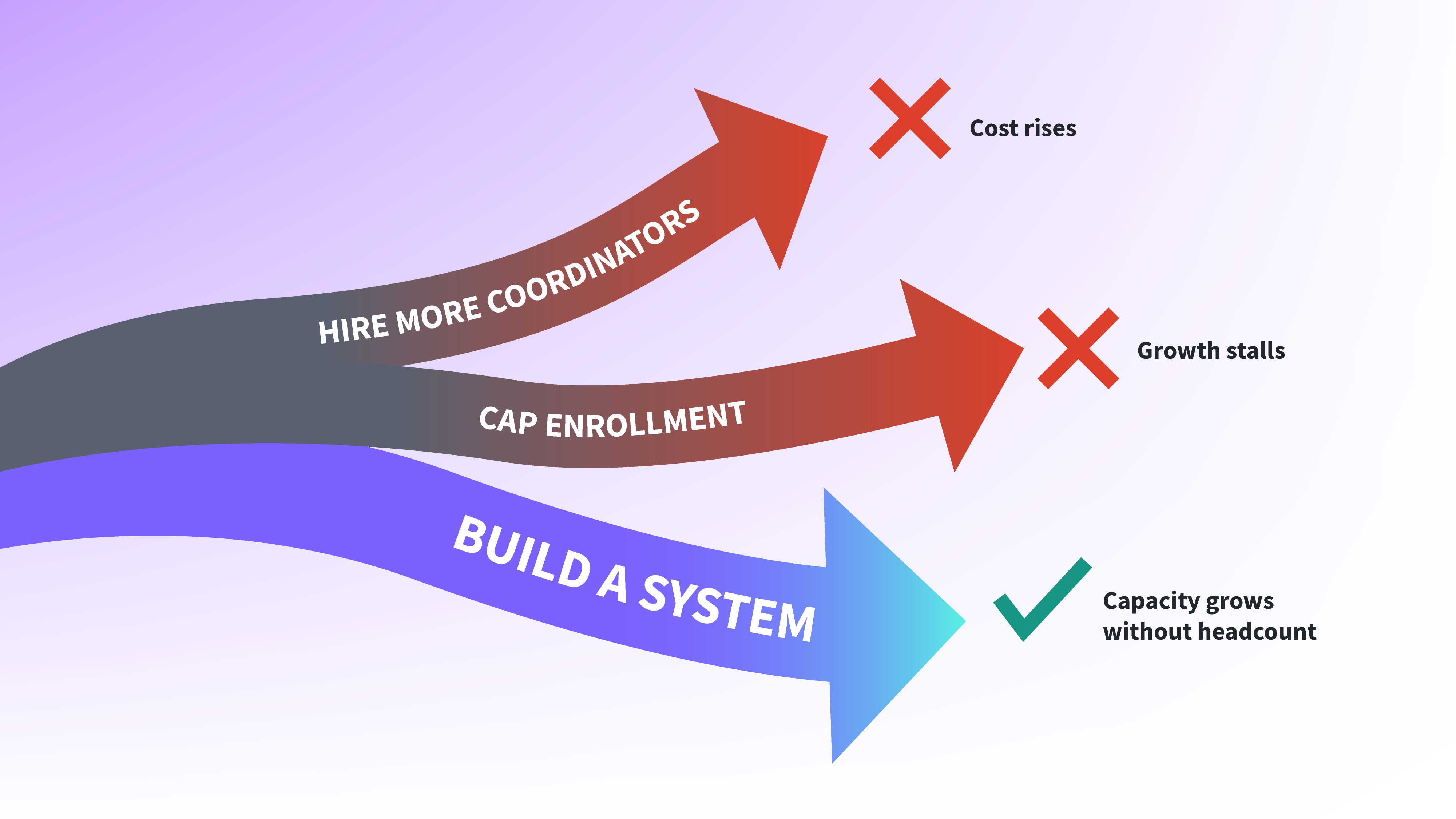
That is the moment most nurse practitioner programs run into a false choice. Grow the placement team to match the larger cohort, or cap enrollment at what the current team can source. Both options accept the same underlying assumption: that clinical placement capacity is tied to how many people you have doing outreach.
It does not have to be. There is a third path, and it starts by treating clinical placement as infrastructure that scales on its own terms rather than a task that scales with headcount. This piece walks through why capacity, not classroom space, is the real ceiling on scaling NP program enrollment, why adding staff to an ad-hoc model tends to reproduce the same bottleneck, and what a placement process built to grow actually looks like.
If your program is weighing a growth target against a placement team that's already stretched, the NPHub university team works through exactly that tradeoff with NP programs. Get in touch with our university team to talk it through.
Why clinical site capacity limits enrollment growth
Clinical placement capacity, not classroom seats or faculty lines, is the real ceiling on how many NP students a program can graduate. Lecture sections and online coursework can expand quickly. Approved clinical sites and qualified preceptors cannot, and because clinical hours are a fixed graduation requirement, every additional student needs a rotation before they can complete the program.
Most NP programs 750 or more direct patient care hours, with many programs and DNP tracks requiring more. Those hours are non-negotiable for certification, which makes preceptor and site availability the true constraint on enrollment. Admit a larger cohort without a proportional increase in clinical sites, and the gap surfaces one or two semesters later as students who cannot start their clinical rotations on time.
The national picture shows how tight the constraint has become. In 2025, U.S. nursing schools turned away 93,176 qualified applications, the highest number ever recorded, and insufficient clinical placement sites, faculty, preceptors, and classroom space were named among the primary barriers. Nearly 17,000 of those turn-aways were at the graduate level, the exact pipeline that feeds advanced practice nursing. Demand is not the problem. Capacity is.
That capacity pressure is not evenly distributed. It concentrates in the specialties where demand already outruns the supply of clinicians willing to teach, which is where any scaling plan tends to break first.
Can you grow enrollment by hiring more coordinators or faculty?
You can, but it rarely scales efficiently, because the constraint is the sourcing model, not the number of people running it. Adding staff to an ad-hoc, outreach-driven process increases cost in a straight line while still hitting the same wall, since each new coordinator restarts sourcing from scratch every term rather than drawing from capacity that already exists.
The deeper problem is where the work lands when it has no dedicated home. In many programs, sourcing flows to nursing faculty on top of teaching, mentorship, and their own clinical practice. Research on academic clinicians found that administrative duties already consume up to a quarter of their working hours, and that clinically burned-out faculty had less confidence in their teaching skills and fewer lifelong-learning habits. Burnout, in other words, does not stay contained to the person carrying it. It reaches the quality of clinical education students receive.
Three costs compound when a program tries to scale enrollment by scaling an informal model:
- Relationships walk out the door: When preceptor connections live in individual inboxes, faculty turnover takes years of relationship-building with it, and each departure sets capacity back.
- Documentation thins: Outreach that belongs to no single role produces uneven records, which becomes an accreditation problem later rather than a staffing problem now.
- Sourcing loses to the urgent: When the same person handles active clinical rotations and new outreach, the pipeline work is always the thing that gets deferred.
More people running the same process usually means more cost and more burnout, not proportionally more placements.
Considering where your own model tops out? The NPHub university team works with NP programs to map where the current placement process hits its ceiling and what a larger cohort would actually require. Talk through your program's numbers.
How to increase clinical placement capacity without expanding the team
The way to add capacity without adding headcount is to stop treating sourcing as a person's task and start treating it as a system. A system builds a continuous, vetted pipeline of preceptors ahead of demand, so capacity exists before a student needs it rather than being assembled term by term under deadline.
Two structural changes make that shift possible:
- Separate recruiting from coordination: These are different disciplines with different rhythms. Coordination is reactive and deadline-driven, managing schedules, paperwork, and active clinical rotations. Recruiting is proactive and pipeline-driven, sourcing potential preceptors, verifying clinical fit, and maintaining relationships across cohorts. When one person does both, recruiting consistently loses.
- Build ahead of demand: A continuous pipeline means the next cohort's clinical sites are being cultivated while the current cohort is still in rotation. This is a more structured allocation of sourcing effort than the cold-outreach cycle that resets every semester.
The payoff of this structured allocation is that capacity stops rising and falling with staff availability. It grows with the pipeline, which can scale well beyond what any single coordinator's calendar allows. This is also the difference between generic preceptor matching services that fill one slot and step away, and a sourcing function that keeps building supply between placements.
Where to focus first: high-bottleneck specialties and existing sites
The fastest way to add usable capacity is to prioritize the specialties that bottleneck earliest, then audit the clinical sites you already use for unclaimed capacity before recruiting new ones. Not every rotation is equally hard to fill, so scaling effort should follow the scarcity.
Demand consistently outruns supply in a predictable set of specialty tracks: psychiatric mental health, acute care, and women's health. These are the areas where a growing cohort will feel the squeeze first, partly because eligible preceptors are limited and partly because multiple nurse practitioner programs compete for the same clinicians each term. The preceptor supply itself is thin: in one survey of NPs, 60% reported they were not currently precepting, with many saying no one had asked them or that their employer restricted it. Psychiatric mental health deserves particular attention, both because the caseload of mental health disorders continues to grow and because PMHNP rotations require specific settings that not every clinical site can offer.
A practical plan for expanding placement capacity:
- Audit before you recruit: Existing clinical sites often have unused capacity, a preceptor who could take a second student, or an adjacent department that has never been approached. This is faster than net-new sourcing.
- Reserve recurring slots: Convert one-time placements into standing arrangements with partner clinics and health systems, so a site that hosts one student this term is prepared to host more next term.
- Recruit near your students: For online NP programs with geographically distributed cohorts, proximity matters more than it does for a single-campus program. Sourcing has to follow where students actually live, not where the school sits.
- Standardize the paperwork: Centralize affiliation agreements so a new site can be brought online quickly, with consistent liability and insurance terms rather than a bespoke negotiation each time.
Focusing capacity where the scarcity is real, and reusing sites you have already vetted, produces more placements per unit of effort than spreading outreach evenly across every specialty.
Scaling without creating accreditation risk
Capacity you cannot document is exposure. As a program grows, its documentation has to scale at the same rate as its placements, because CCNE and ACEN reviewers expect a repeatable, defensible process for how preceptors are qualified and how clinical sites are approved. Volume added through informal sourcing tends to produce exactly the uneven records that surface as findings during review.
Accreditation expectations have also tightened. The Sawyer Initiative pushed CCNE to strengthen requirements around clinical site preparation, preceptor qualifications, and the quality of clinical rotations, with particular attention to distance education. Reviewers are no longer only asking whether students completed their required hours. They are asking whether the program can defend how those placements were made.
What holds up under review, and needs to scale with the cohort:
- Preceptor qualification records: Active licensure, board certification, and clinical experience appropriate to the rotation, documented consistently for every preceptor.
- Current, signed affiliation agreements matched to active rotations, maintained centrally rather than reconstructed on request.
- Clinical site approval, separate from the individual preceptor: Evidence that the healthcare facility itself was vetted to host students, not just that a willing clinician was available.
- Ongoing oversight: Records showing conditions were re-checked during the rotation, not confirmed once at intake and never revisited.
If a reviewer asked for full documentation on a randomly chosen rotation from three cohorts ago, could the program produce it within the hour?
Benchmarking your own audit-readiness? The NPHub university team can walk through how documentation would hold up under CCNE or ACEN review as your cohort grows. Start that conversation.
Protecting faculty as the program grows
A growing program protects its faculty by moving sourcing off their plates entirely, so that enrollment growth compounds teaching capacity rather than administrative load. Faculty were hired to design curriculum, teach, oversee clinical training, and, in many programs, to keep evidence-based practice current through conducting research. Preceptor outreach is none of those things.
The stakes here are retention, because burnout among academic clinicians is closely linked to intent to leave academic medicine, and when experienced nursing faculty leave, the program loses both institutional knowledge and the preceptor relationships that faculty member held. Every hour a senior educator spends chasing potential preceptors is an hour not spent on the work only they can do, and the cost shows up later as thinner clinical nursing education and higher turnover.
Separating sourcing from teaching is what lets a program scale enrollment without asking faculty to absorb the difference.
What a scalable clinical placement model looks like
A scalable clinical placement model treats sourcing as continuous infrastructure and separates recruiting from coordination, maintains a vetted pipeline that grows ahead of demand, applies clinician input to site approval, and keeps preceptor relationships alive across cohorts instead of rebuilding them each term.
The elements that make it hold up at scale:
- Recruiting as a distinct function, staffed and measured separately from placement coordination.
- A continuous, vetted pipeline, so confirmed placements draw from existing supply rather than fresh outreach.
- Clinician-led site approval, because judging whether a setting's patient population and scope fit a given rotation is a clinical decision before it is an administrative one.
- Relationship continuity, so a preceptor who teaches well this year is invited back next year.
Programs do not have to convert everything at once. A workable sequence is to pilot the model in a single high-demand specialty, prove it, then extend it:
- Pilot one bottleneck specialty, often psychiatric mental health or acute care, where relief is felt fastest.
- Track placement fill rate by specialty, time from student request to confirmed placement, graduation timelines by cohort, and preceptor retention year over year.
- Iterate, then scale the workflow across the remaining specialty tracks once the pilot metrics hold.
- Maintain backup site lists for each rotation so a single dropped placement does not stall a student's clinical hours.
The throughline is that speed and volume become assets only when quality and documentation hold underneath them. A model built this way lets a program grow enrollment and defend every placement at the same time.
How NPHub helps programs scale clinical capacity
NPHub functions as clinical placement support that a program scales into, rather than a vendor a program manages at the margins or a team it has to staff up internally. The recruiting function is built around clinician-led oversight, so the judgment about whether a preceptor and site genuinely fit a rotation sits with people trained to make it.
Five components define the approach, each aimed at capacity a program can defend as it grows:
- Clinician-led sourcing and vetting: Board-certified nurse practitioners source and evaluate preceptors, applying clinical judgment that a credential check alone cannot.
- A structured NP-to-NP vetting interview: Every prospective preceptor completes a focused conversation covering scope, specialty, patient population, and teaching readiness, not just availability.
- Credential and license integrity screening: Active licensure and board certification are verified for every preceptor, with disqualification for any restriction.
- Clinical site approval, separate from the preceptor: The healthcare facility is vetted on its own merits before a placement is offered.
- 45-day re-verification: Active preceptors and sites are re-checked on a rolling basis, because practice settings, acuity, and staffing change mid-rotation.
The point of the structure is that capacity, compliance documentation, and relationship continuity all scale together, which is what makes a larger cohort sustainable rather than risky.
Conclusion: capacity is infrastructure, not headcount
The instinct when a growth target lands is to ask how many more people the placement team needs. The programs that scale sustainably ask a different question: how do we turn clinical placement into a system that grows without them?
That shift is the whole argument. You do not scale enrollment by scaling the team. You scale by decoupling capacity from headcount, so that sourcing runs as continuous infrastructure, documentation holds up under review by default, and faculty time returns to teaching. Growth targets tied to workforce demand become reachable only once clinical capacity no longer depends on how many people you can afford to hire.
The workforce need is real, the qualified applicants are waiting, and the ceiling is a solvable one. It just has to be treated as infrastructure rather than overhead.
If scaling clinical capacity is on your program's agenda, the NPHub university team works directly with NP programs on exactly this shift, starting with where your placement process is straining today and what dedicated recruiting infrastructure would change about it. Get in touch with our university team when it's a useful conversation to have.
Frequently asked questions
How many clinical hours do NP students need?
Most NP programs require a minimum of 750 or more direct patient care hours. The exact number depends on the specialty and certifying body, but the hours are a fixed graduation requirement, which is why the clinical placement bottleneck directly gates how many students a program can enroll.
What is the biggest barrier to scaling NP program enrollment?
The biggest barrier is clinical placement capacity, specifically the supply of qualified preceptors and approved clinical sites. Classroom and online coursework can expand quickly, but clinical rotations cannot, and national data consistently names insufficient clinical placement sites and preceptors among the primary reasons qualified applicants are turned away.
Should NP students find their own preceptors when a program scales?
Most programs treat self-placement as a last resort. Shifting sourcing onto students moves the burden to the people with the least leverage and visibility into compliance requirements, produces uneven clinical experiences, and creates thin documentation that resurfaces during accreditation review. Keeping placement inside a program-owned process yields more equitable outcomes and cleaner records.
How is preceptor recruiting different from clinical coordination?
Clinical coordination manages placements once preceptors are secured, including scheduling, paperwork, and communication. Preceptor recruiting works upstream, sourcing and vetting new preceptors and maintaining those relationships across cohorts. Recruiting builds capacity; coordination deploys it. When the same person does both, recruiting is usually the work that gets deferred.
Can online NP programs scale placement capacity the same way?
Yes, with one adjustment: sourcing has to follow geographically distributed cohorts rather than concentrate near a single campus. Online NP programs benefit from a continuous pipeline that recruits preceptors in the regions where their students actually live, and from documentation standards that hold up under the heightened scrutiny distance-education programs now face in accreditation review.
How quickly can a program add clinical placement capacity?
The fastest gains usually come from auditing existing clinical sites for unused capacity and converting one-time placements into recurring slots, which is quicker than net-new sourcing. Building a continuous pipeline takes longer to mature but produces durable capacity, because it develops supply ahead of demand instead of restarting outreach every term.
Find a preceptor who cares with NPHub
Book a rotation.webp)
.jpeg)

.webp)
.jpeg)
.jpeg)

%20(3)%20(2).svg)
.webp)