
.png)



.webp)
TL;DR
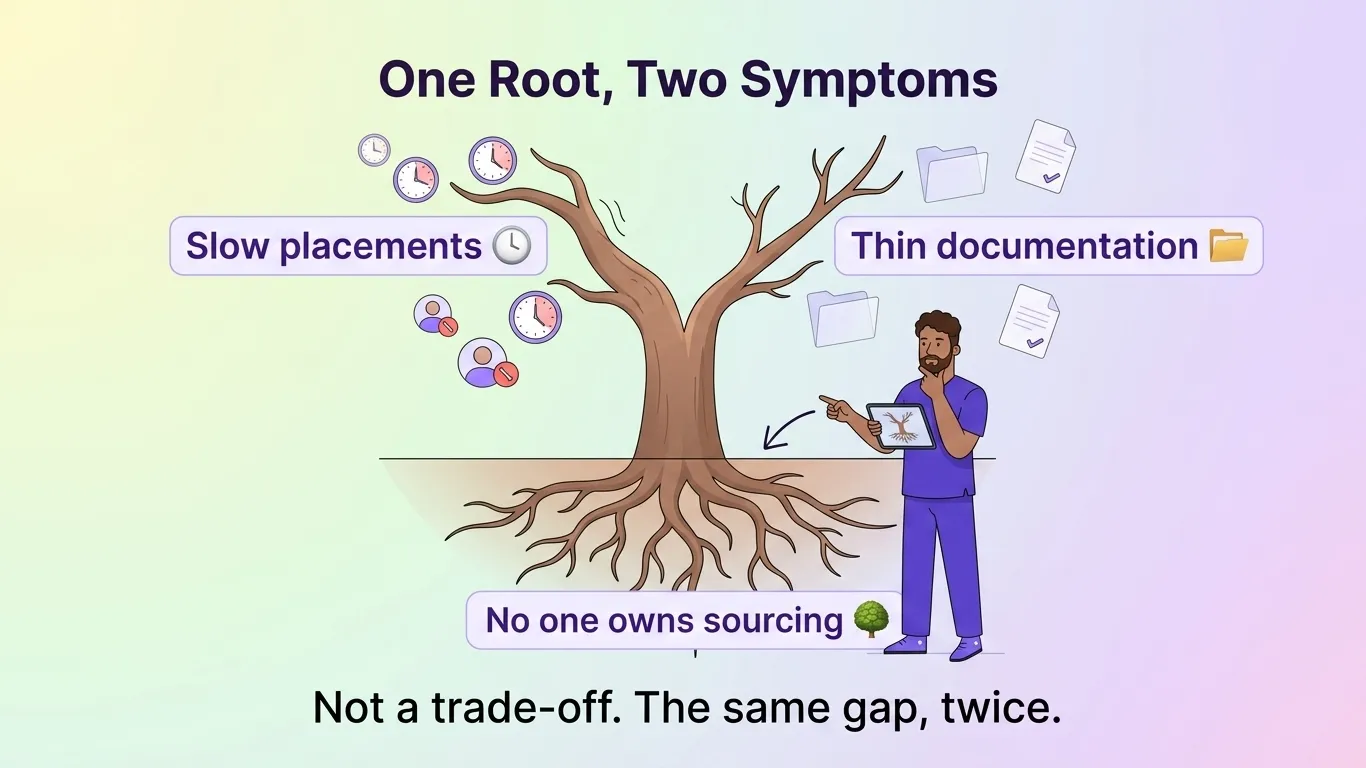
- Compliance and speed are not a trade-off: They are outputs of the same system. The infrastructure that places a student quickly, a continuous pipeline of vetted preceptors, is the same infrastructure that produces audit-ready records. When it is missing, both fail.
- The conflict is an artifact of ad-hoc placement: When no one owns sourcing, faculty absorb it alongside other duties, so timelines stretch and documentation thins for the same reason. Faculty burnout and accreditation exposure are one problem viewed from two angles.
- Compliance comes down to what reviewers can verify on demand: CCNE and ACEN expect documented, repeatable processes: preceptor qualification records, current signed affiliation agreements, clinical site approval handled separately from the preceptor, clinical clearance requirements, and oversight across the rotation.
- The fix is building capacity ahead of demand and standardizing vetting: A continuous pre-vetted pipeline, site approval before any clinical hours are logged, recruiting separated from coordination, and continuous re-verification make records a byproduct instead of a scramble. Each step makes placement both faster and more defensible.
- This is why programs treat preceptor recruiting as infrastructure, not support: NPHub's model (clinician-led oversight, structured NP-to-NP vetting, credential and license integrity screening, separate clinical site approval, and 45-day re-verification) is built so speed and compliance come from the same process. To see how it maps to your cohort mix and timeline, book a consultation with the NPHub university partnerships team.
Most NP programs treat compliance and speed as opposing forces. Move quickly to secure clinical placements, and the documentation thins out. Document every rotation properly and the placement process crawls. That tension feels like a law of nature to anyone who has run it, but it is not one. It is a symptom of how the work is organized.
Compliance and speed are outputs of the same system. The infrastructure that lets a program place a student quickly, a continuous pipeline of vetted preceptors, is the same infrastructure that produces audit-ready records. When that structure is missing, both fail together. When it is present, both hold.
This piece is written for the people who own the clinical placement process and answer for it later: NP and PA program directors, clinical coordinators, and faculty who carry the work between everything else on their plates. Late placements push back clinical hours, which push back graduation. Thin records surface as findings during a CCNE or ACEN review. Ad-hoc placement tends to produce both problems at once, and, for a single shared reason, this article walks through them.
If your program is trying to move faster without taking on compliance risk, NPHub's university partnerships team works with NP and PA programs on exactly this problem. More on that below, once the mechanics are clear.
Does staying compliant slow down the clinical placement process?
No. Rigor and speed only compete in programs where sourcing has no dedicated owner. When the clinical placement process is run as a structured function, the same pipeline that shortens time to placement also generates the documentation an accreditor expects. Speed is not bought by cutting corners, and compliance is not bought with delay.
The trade-off feels real because most programs experience it. When a placement coordinator is sourcing a preceptor two weeks before a rotation starts, verification gets compressed, and paperwork gets improvised. The placement happens fast, but the records are thin. The correction is to slow down and check everything, which then stretches timelines. Programs conclude they must choose.
What they are actually seeing is the absence of a system, not an inherent conflict. Speed and compliance both suffer when the work is reactive. Build the pipeline ahead of demand and standardize how each preceptor is cleared, and the choice disappears. You get a faster placement and a cleaner record from the same process.
What compliance requirements apply to NP clinical rotations?
Compliance in NP clinical placements comes down to whether a program can prove, on demand, that each rotation was placed with a qualified preceptor at an approved site, with current agreements and oversight in place. CCNE and ACEN reviewers expect documented, repeatable processes, not one-off records assembled the week before a site visit.
Reviewers consistently scrutinize the same categories:
- Preceptor qualification records: Active, unencumbered licensure, current board certification in the relevant specialty, and clinical experience appropriate to the rotation, whether that is primary care, pediatrics, women's health, or psychiatric mental health.
- Signed affiliation agreements: Current, executed, and matched to active clinical rotations, not expired or missing for the site in question.
- Clinical site approval, handled separately from the preceptor: Evidence that the placement site itself was reviewed and approved to host students, not assumed from the individual preceptor's willingness.
- Clinical clearance requirements: The background checks, immunizations, and liability coverage a site requires before a nursing student can begin.
- Ongoing oversight: Documentation that conditions were confirmed across the full length of the rotation, not just at intake.
Clinical clearance requirements are the health, safety, and legal items a student must complete before starting at a placement site, typically background checks, immunization records, drug screening, and proof of malpractice coverage. These vary by site, which is part of why they are hard to standardize across a cohort.
One missing record in a single cohort is not a finding. A pattern of gaps across cohorts is the one that ad-hoc sourcing tends to create. The Sawyer Initiative pushed CCNE to strengthen expectations for how preceptor decisions are made, how clinical sites are prepared, and how oversight is maintained, raising the bar for what counts as defensible for programs still running informal processes.
Why do speed and compliance break together in ad-hoc placement?
Because they share one root cause: no one owns sourcing. When there is no dedicated recruiting function, the work falls to faculty and coordinators who fit it around teaching, mentorship, and case management. Sourcing loses to the urgent, so timelines stretch. Documentation loses to the same pressure, so records thin. The two failures are the same failure viewed from different angles.
Faculty who absorb outreach, verification calls, and affiliation paperwork have less time for curriculum and clinical supervision, and the sourcing work remains invisible in how their contributions are evaluated. Because no single role owns the records end-to-end, the documentation degrades. Then a review arrives, gaps surface that no one knew were there, and remediation flows back to the same overextended faculty. Each cohort starts with less margin than the one before it.
This is also where quality erodes. A placement coordinator racing a start date can confirm a license, but confirming a license is not the same as evaluating whether a site's patient population and scope actually support the rotation's core competencies. That judgment takes time the ad-hoc model does not have, so it gets skipped, and the gap shows up later as an uneven clinical experience or a placement that does not hold up under review.
If your clinical placement process keeps hitting a wall, working harder won't fix it. You need a better system. Our university partnerships team works directly with programs to streamline placement workflows, accelerate turnarounds, and clean up documentation. Connect with Nicholas Carrizales, our Director of Business Development, to map out where your program stands.
How can NP programs speed up clinical placements without cutting compliance corners?
Programs move faster and stay compliant by building capacity ahead of demand and standardizing how every placement is vetted, so documentation is generated as a byproduct rather than assembled retroactively. The goal is to make the compliant path and the fast path the same path.
Five practices do most of the work:
- Maintain a continuous, vetted preceptor pipeline: Identify and clear preceptors before a student needs one, rather than restarting outreach every term. A standing network lets placements confirm compliance with program requirements in days rather than weeks.
- Standardize vetting so every placement produces identical records: When each preceptor is cleared through the same steps, the documentation is uniform by default, and there is nothing to reconstruct when a reviewer asks.
- Approve the clinical site before any clinical hours are logged: Confirm the site can administratively host a student and that its patient mix fits the rotation, separately from approving the individual preceptor. This prevents hours from accruing against a placement that later fails review.
- Separate recruiting from coordination: Sourcing and coordination are different disciplines on different clocks. When the same person does both, rigor bottlenecks behind whatever is due today. Splitting them lets each run at full speed.
- Re-verify continuously: A placement that is compliant in week one can drift by week six as licenses, staffing, and patient populations change. Scheduled re-verification catches those shifts before they become a mid-rotation scramble or an audit gap.
None of these steps trade one priority for the other. Each one makes the process both faster and more defensible, which is the whole point.
How do you keep clinical placement documentation audit-ready?
Documentation is audit-ready when the records exist before a reviewer asks for them, not after. That means logging clinical hours only for approved sites, capturing verification as the work happens, and keeping everything centrally retrievable so no one has to reconstruct a paper trail under deadline pressure.
A few habits keep records defensible:
- Log clinical hours against approved sites only: No hours accrue until site approval and the affiliation agreement are in place, so every logged hour is already backed by documentation.
- Centralize affiliation agreements and clearance records: One system of record, not a spread of spreadsheets and inboxes, so a placement coordinator can produce any file without a search.
- Timestamp verification: Record when licensure, certification, and clearance were confirmed, and when they were re-confirmed, to show oversight across the rotation rather than a single intake snapshot.
A useful stress test: if a reviewer asked for full documentation on a randomly selected rotation from three cohorts ago, could your program produce it within an hour? If the answer is no, the issue is that the records were never captured as a byproduct of a repeatable process, and that is the gap worth closing before a review makes it visible.
What should NP programs look for in a clinical placement partner?
You can tell a true partner from a vendor by how they handle documentation: is it built naturally into their daily workflow, or scrambled together right before an audit? A real clinical placement partner designs their process around your accreditation standards. Look for these four key markers:
- Clinician-led vetting: Someone with clinical judgment evaluates whether a site's scope and patient population fit the rotation, not only whether a credential checks out.
- Transparent credential and license integrity screening: Active licensure, board certification, and disciplinary history reviewed for every preceptor, with clear disqualification criteria you can see.
- Site approval separate from the preceptor: The placement site is vetted on its own merits, so an available preceptor at an unviable site does not become your problem mid-rotation.
- Ongoing re-verification, not one-time onboarding: Preceptors and sites are re-checked on a schedule, producing a living record rather than a snapshot that ages out.
A preceptor matching service that operates purely as a marketplace connects a name to a student and steps away, which leaves the compliance and continuity work back on your faculty. A recruiting partner operates as an extension of your clinical infrastructure, carrying the sourcing, vetting, and documentation as a standing function.
Programs weighing that decision can map it with NPHub's university partnerships team, which works through where a program-owned process holds up, where it strains, and where dedicated recruiting infrastructure would move the needle. The engagement is built to fit how programs actually buy: unbundled services, flat-rate pricing, and no revenue share, so you take on only what you need. You can schedule a consultation to talk through your specific cohort mix, specialty coverage, and timeline.
How NPHub keeps placements compliant without slowing them down
NPHub structures preceptor recruiting so that speed and compliance come from the same process rather than competing for it. Five components define the approach, and each one serves both goals at once.
- Clinician-led oversight: Board-certified NPs source and vet every preceptor, so fit is evaluated by clinical judgment. That produces better placements and cleaner qualification records in a single step.
- Structured NP-to-NP vetting interview: Every prospective preceptor completes a focused conversation covering scope, specialty, patient population, and teaching readiness. It surfaces mismatches early, before they cost a program a rotation, and it documents the evaluation as it happens.
- Credential and license integrity screening: Active licensure, board certification, and disciplinary review are standard, with disqualification for any license restriction. The screen protects the placement and satisfies the record at the same time.
- Clinical site approval: Sites are approved separately from the individual preceptor, so a placement is not offered against a site that cannot administratively support it. That prevents downstream delays and produces the site-level documentation reviewers look for.
- 45-day re-verification: Active preceptors and sites are re-checked on a rolling basis, because clinical settings change. Continuous verification catches drift before it disrupts a nursing student and keeps the audit trail current instead of stale.
Taken together, this is what it looks like when preceptor recruiting is treated as program infrastructure rather than a vendor relationship managed at the margins. Faculty get their time back, records are built in, and compliance stays continuous rather than becoming a fire drill before each review.
Compliance and speed are outputs of the same system
The programs that struggle with clinical placements are rarely short on effort. They are short on structure, and the missing structure is what makes speed and compliance feel like a tradeoff. Treat placement as logistics, and both keep breaking. Treat it as infrastructure, closer in spirit to faculty hiring or curriculum design than to scheduling, and both hold.
Compliance is not the tax you pay for moving carefully, and speed is not the reward for cutting corners. Both are what a well-built recruiting function produces as a matter of course. NP enrollment keeps climbing, accreditation expectations keep tightening, and the programs that build durable recruiting capacity now will be the ones that scale without compromising the quality of the education they deliver or the graduation timelines their students are counting on.
If you are rethinking how your program approaches clinical placement, that is exactly the conversation NPHub's university partnerships team has with NP and PA programs every week. It usually starts with where your process is holding up, where it is straining, and what dedicated infrastructure would change about both. Book a consultation with Nicholas Carrizales when it is a useful conversation to have.
Frequently asked questions
Does compliance have to slow down placements?
No. Compliance and speed only conflict in ad-hoc models where sourcing has no dedicated owner. When placement runs as a structured process with a vetted pipeline and standardized vetting, the same system that produces a fast placement also produces the documentation a review requires. Programs that separate recruiting from coordination consistently see both shorter timelines and cleaner records.
What documentation do NP programs need for a CCNE or ACEN review?
Programs should maintain preceptor qualification records (active license, board certification, relevant clinical experience), current signed affiliation agreements for each clinical site, evidence of clinical site approval beyond the individual preceptor, clinical clearance records, and ongoing oversight documentation showing conditions were confirmed across the rotation. Reviewers expect this to be repeatable for every student and producible on demand rather than assembled before a visit.
What are clinical clearance requirements?
Clinical clearance requirements are the health, safety, and legal items a student must complete before starting at a placement site. They typically include criminal background checks, immunization records, drug screening, and proof of malpractice coverage. Specific requirements vary by site and healthcare organization, making it difficult to standardize them across a cohort without a dedicated process.
Can a clinical placement service support accreditation compliance?
Yes, when the service applies consistent vetting and documentation standards to every placement. Services that verify licensure, approve clinical sites separately from preceptors, and maintain audit-ready records help strengthen a program's accreditation posture. Services that rely on open listings or basic credential checks generally do not meet that bar, so the vetting model matters more than the label.
How does ongoing verification keep a rotation compliant mid-term?
Ongoing verification detects changes in a preceptor's license status, scope, or clinical setting before they disrupt a student or create a documentation gap. A preceptor who was a clean fit in week one may not be by week six, as schedules shift and staffing turns over. Scheduled re-verification, rather than one-time onboarding, protects completed clinical hours and keeps a living audit trail current for both program stability and review.
Can programs speed up placements without adding to their placement team?
Yes. Placement capacity is limited by who owns sourcing, not by faculty headcount. Moving preceptor sourcing from faculty to a dedicated recruiting function frees faculty to focus on teaching, clinical supervision, and student support while a continuous pipeline builds capacity. Programs grow throughput this way without expanding instructional lines or overworking the faculty they already have.
Find a preceptor who cares with NPHub
Book a rotation.webp)
.jpeg)

.webp)
.jpeg)


%20(3)%20(2).svg)
.webp)