
.png)

.jpeg)


.webp)
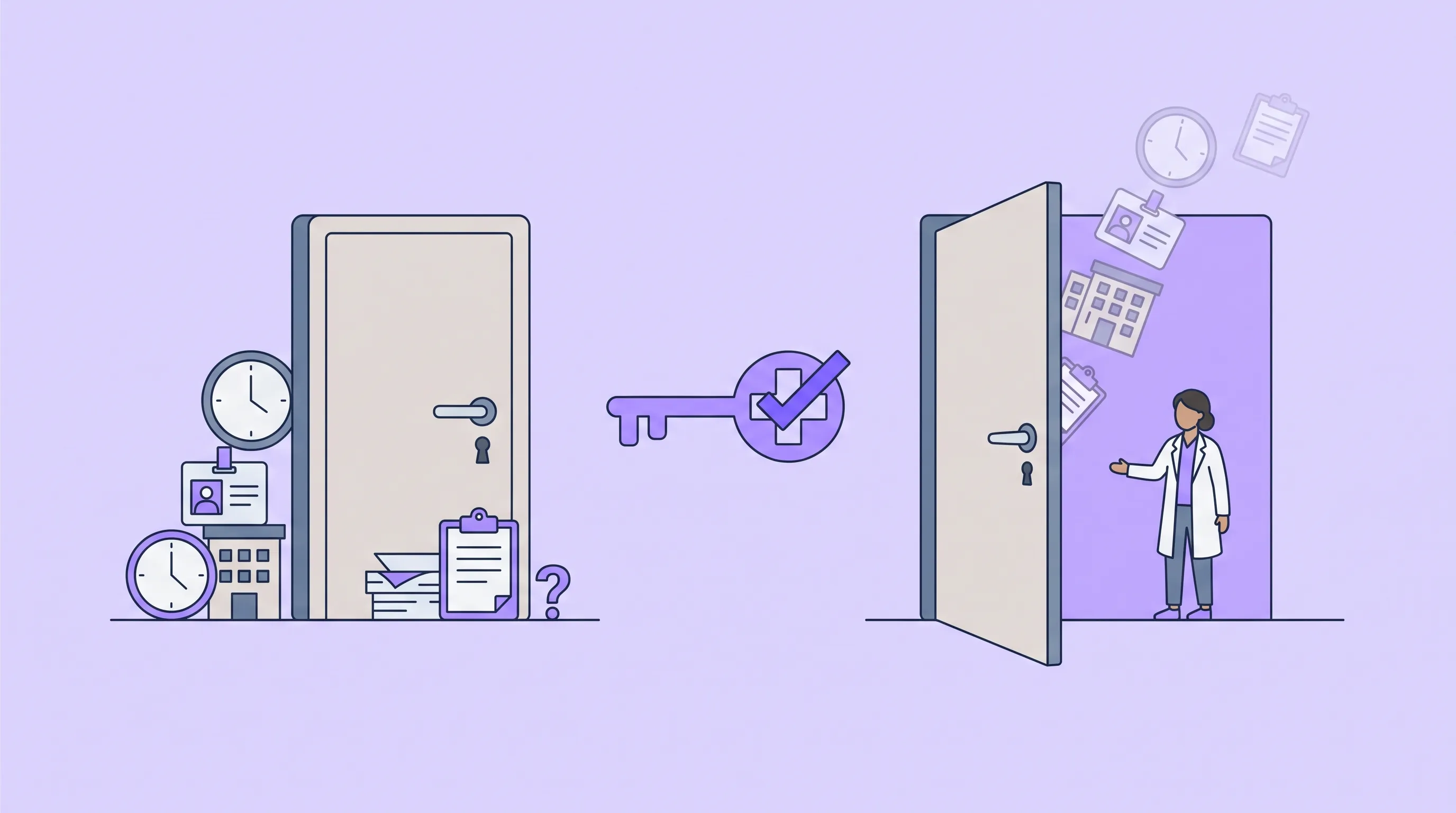
An NP clinical placement contingency plan is a program-owned protocol that defines who responds, what gets protected, and where replacement preceptors come from when a confirmed rotation falls through. It sets response timelines, maintains a vetted reserve of preceptors and clinical sites by specialty and region, and documents every step to an accreditation standard. With a plan in place, a lost placement is usually a short disruption. Without one, it can delay graduation.
TL;DR
- Confirmed doesn't mean secure: Preceptors cancel, health systems change student policies, and affiliation agreements stall in legal review, often close to the date the rotation begins.
- The first 48 hours decide the outcome: A program that can lock in completed clinical hours and activate a vetted backup quickly keeps the student on track. A program that starts from zero often loses weeks.
- Most NP programs have a placement process but not a continuity process: Without a named owner and a written protocol, the scramble falls to nursing faculty or to the student.
- Redundancy is now baseline infrastructure: In a market shaped by preceptor shortages, one confirmed preceptor per student is a single point of failure. Vetted backup depth by specialty and region is what turns a cancellation into a reassignment.
- Continuity should be a contractual expectation of any placement partner, not a favor: Ask about replacement commitments, timelines, and vetting standards before you sign. To pressure-test your program's current backup protocol, contact the NPHub university team.
The email usually arrives at the worst possible moment. Two weeks before the rotation begins, a preceptor writes to say their practice has stopped taking students. Or it comes in week five of a student's final semester, after a family emergency takes the preceptor out of the clinic indefinitely.
Every clinical coordinator has read a version of that email. What happens next varies widely between programs. The gap in outcomes comes down to whether a plan existed before the cancellation occurred.
This article lays out what that plan looks like: the protocol most NP programs rely on informally but have never written down.
If your program has lost a rotation recently, or is worried about losing one, the NPHub university team works directly with NP programs on placement continuity.
What is an NP clinical placement contingency plan?
An NP clinical placement contingency plan is a written protocol that tells a program exactly what to do when a confirmed placement falls through. It assigns ownership, defines response timelines, and identifies replacement options before they are needed. Its purpose is to protect a student's clinical hours and graduation timeline without pulling faculty into an unplanned search.
A complete contingency plan includes six components:
- A response owner: One named person or team responsible for every lost placement, from the first notice to the confirmed replacement.
- Trigger points: Clear definitions of when a placement is "at risk" and when it is "lost," so the response starts early rather than after the rotation has already stalled.
- A vetted reserve: Preceptors and clinical sites already credentialed and approved, organized by specialty and region, ready to activate.
- Clinical hour protection: A process for documenting and securing completed hours and evaluations the moment a disruption occurs.
- A documentation standard: Every replacement recorded to the same standard as the original placement, so records hold up during review.
- Escalation and extension criteria: Pre-agreed rules for when to escalate, when to grant extensions, and how appeals work.
How is a contingency plan different from a waitlist?
A waitlist tells a program who needs a placement. A contingency plan tells the program where that placement will come from and how fast. Many nursing schools keep informal backup lists, but a list of names that has never been contacted, vetted, or approved is closer to a starting point than a plan.
Why do confirmed NP clinical placements fall through?
Placements usually fall through because of system pressures, like heavy caseloads, employer mandates, and personal emergencies that pop up, variables no coordinator can control. Every term, some confirmed spots evaporate. A real contingency plan starts with that guarantee.
The most common causes include:
- Last-minute preceptor cancellation: Family emergencies, illness, job changes, and burnout can remove a preceptor with little notice.
- Health systems changing student policies: Organizations pause or restrict supervising students during staffing shortages, restructuring, or leadership changes. In one national survey of NPs, nearly a third of those not precepting said their employer restricted them from taking students.
- Productivity pressure: Clinicians working under constant pressure to meet visit targets may find precepting unsustainable once the term is underway.
- Affiliation agreements stalling: A placement can be confirmed with the preceptor but still stuck in the site's legal review when the start date arrives.
- Credential or license changes discovered late: A lapse, restriction, or change in board certification can disqualify a preceptor mid-term.
- Specialty alignment problems: Sometimes the patient mix at a site simply doesn't support the rotation's learning objectives, and this only becomes clear once the student arrives.
Staffing churn makes all of this more likely. National turnover among hospital registered nurses reached 16.4% in 2024, and it ran higher in areas like behavioral health. The same instability affects the advanced practice clinicians programs depend on as preceptors.
The COVID-19 pandemic showed how fast this can happen at scale. As one peer-reviewed analysis of the NP preceptorship shortage noted, preceptor commitments made for upcoming semesters simply couldn't be kept once practices closed to students, preceptors were redeployed or furloughed, and health systems removed students entirely.
Why do competitive specialties have the thinnest backup options?
Competitive specialties such as women's health, psychiatric mental health, and pediatrics have the smallest pools of willing preceptors, and multiple programs compete for the same clinicians every term. When a placement in one of these specialties falls through, there is often no obvious second option nearby. This is where the gap between programs with a reserve and programs without one is widest.
What happens to a program when a placement falls through?
A single lost rotation sets off a chain of consequences that moves quickly. Clinical hours stall, course progression pauses, and the student's graduation timeline comes under pressure within weeks. The costs spread across faculty time, tuition cycles, and accreditation records.
We covered the full financial picture in our piece on the hidden cost of ad-hoc clinical placement management. The contingency-specific version is shorter and faster:
- Clinical hours stall: Required clinical hours can't accumulate without a qualified preceptor at an approved site.
- The final semester comes under pressure: A disruption late in the program leaves little room to recover without an extension.
- Delayed graduation becomes likely: Every week without a replacement pushes licensure and workforce entry further out.
- Students pay out of pocket: When the program can't produce a replacement, many students turn to paid services on their own, often at a cost of several thousand dollars.
Scale makes these moments matter more. AACN data show nursing schools turned away 93,176 qualified applicants in the 2025-2026 academic year, with limited clinical sites and preceptors among the primary barriers. Capacity is already tight before a single confirmed placement collapses.
What is the accreditation risk of a rushed replacement?
Replacement placements made in a rush are where documentation gaps are born. When the priority is simply getting the student back into a clinic, credential verification, site approval, and affiliation agreements are the steps most likely to be shortcut or recorded late.
The 2022 National Task Force (NTF) Standards for Quality Nurse Practitioner Education expect programs to secure clinical sites and preceptors that meet learning objectives and to document faculty oversight of those sites and preceptors. That expectation doesn't pause for an emergency. A replacement placement needs the same records as the original.
Why most NP programs don't have a real backup protocol
Most NP programs have a well-defined process for making placements and almost no process for keeping them. The recovery work depends on whoever happens to be available when the cancellation arrives.
The pattern looks similar across many NP programs:
- Single-threaded relationships: One preceptor per student means one person is the entire plan.
- Backup lists that were never vetted: Names are collected but never credentialed or approved, so paperwork restarts from zero when they are needed.
- No named owner: Without clear responsibility, nursing faculty absorb the scramble on top of teaching and clinical oversight.
- The student as the default fallback: When the program runs out of options, the student starts cold outreach alone, often while working full time.
That last point deserves attention. Students with the least leverage, the least visibility into compliance requirements, and the least time end up running the recovery. In one survey of graduate nursing students, 61% rated finding a preceptor as extremely difficult, and some had already been asked to pay for a placement.
The underlying problem is simple: most programs have a placement process but not a continuity process.
Not sure whether your program has a continuity process or just a placement process? The NPHub university team can help map where your current approach would hold and where it would break.
What should an NP program do in the first 48 hours after losing a placement?
In the first 48 hours, a program should confirm the loss, protect the student's completed work, and activate a vetted replacement before turning to cold outreach. Moving these steps in parallel, rather than one at a time, keeps disruption short. The goal is a confirmed replacement pathway within two days, even if final paperwork takes longer.
A program's first-48-hour response should follow seven steps:
- Confirm the cancellation in writing: Get written confirmation from the preceptor or site, and log the reason and the date.
- Lock in completed work: Inventory the student's completed clinical hours, evaluations, and preceptor sign-offs, and secure them before the preceptor relationship fully closes.
- Triage by deadline: Prioritize by graduation date and program deadlines, so final-semester students are placed first.
- Activate the reserve: Contact pre-vetted preceptors in the same specialty and region before any cold outreach begins.
- Assign one point of contact: Give the student a single coordinator or program advisor for updates, so they don't start searching on their own.
- Run approvals in parallel: Begin school approval and affiliation agreement steps while the replacement preceptor is being confirmed.
- Document everything: Record each action to an audit standard, including dates, contacts, and approvals.
The same cancellation, handled two ways
The comparison below shows how the same lost placement plays out with and without a protocol in place.
If a placement has just fallen through and a student's timeline is at risk, contact the NPHub university team to talk through replacement options.
How do programs find replacement preceptors quickly?
Programs find replacement preceptors fastest by starting with the most prepared sources. Vetted reserve preceptors and alternate supervisors at the same site can often be confirmed in days, while cold outreach can take weeks. Ranking replacement sources in advance turns the search into a sequence rather than a scramble.
Replacement sources, from fastest to slowest:
- Vetted reserve preceptors in the same specialty and region, already credentialed and approved.
- Alternate supervisors at the same site, where the affiliation agreement already exists, and the student may already be oriented.
- Referrals from the canceling preceptor, who often knows colleagues with capacity and a similar patient population.
- Alumni and program networks, which are reliable but slower to activate.
- Placement partners with an established replacement process, which can draw on a larger network.
- Cold outreach, the last resort, because it is the slowest and least predictable.
Why must a replacement meet the same vetting standard?
A replacement preceptor needs the same verification as the original: active licensure, board certification, clinical experience, and a patient population that supports the course. Urgency makes it tempting to accept the first willing preceptor. But a placement that fails review, or fails the student clinically, costs more time than it saves.
The most useful question to ask about any replacement is whether the student will actually be managing patients, building treatment plans, and developing clinical skills, or only observing. Specialty alignment matters as much in week five as it did at the start of the term.
Can programs request provisional approval?
Where program requirements allow, programs can request provisional approval for a replacement while final paperwork is completed. This works best when the site already has an affiliation agreement on file, or when the program uses a standard agreement template that sites are familiar with. Provisional approval should never skip credential verification.
What makes cold outreach work when it's unavoidable?
When cold outreach is the only option, specificity is what earns a response. The first message should state the specialty, rotation dates, required hours, and program affiliation up front, so a clinician can decide quickly. A defined follow-up schedule, such as two touchpoints over the following week, keeps the outreach from stalling in an inbox.
Why redundancy in preceptor networks is no longer optional
In a market defined by preceptor shortages, one confirmed preceptor per student is a single point of failure. Redundancy means maintaining vetted backup capacity by specialty and region, so cancellations become reassignments rather than new searches. For programs growing enrollment, it is quickly becoming baseline infrastructure.
What does preceptor redundancy look like in practice?
Redundancy is backup depth where the program needs it most:
- By specialty: Extra vetted capacity in competitive specialties like women's health, pediatrics, and psychiatric mental health, where replacements are hardest to find.
- By geography: Backup options in every region where the program places students, which matters especially for online NP programs that enroll nationally.
- By site type: Secondary settings such as community health centers, urgent care centers, and family medicine and primary care practices, which can often absorb FNP students when a primary site falls through.
How do programs keep willing preceptors engaged between cohorts?
A reserve only works if the preceptors in it are still willing when they are needed. Research on what motivates NP preceptors offers useful direction. A recent survey of NP preceptors found that supportive coworkers and a clearly defined preceptor role mattered more to them than financial remuneration or gifts, and that credit toward certification or recertification was a meaningful motivator.
That points to practical preceptor incentives programs can offer:
- Continuing education credit tied to precepting hours.
- Clear expectations for each rotation, communicated before the student arrives.
- Easy logistics, including student EHR access, which ranked as the top motivator in the same survey.
- Regular, low-effort contact between cohorts, so the relationship doesn't go cold.
The untapped supply is also real. In a separate national survey of NPs who weren't currently precepting, more than a third said no one had asked them. Growing the pool starts with asking consistently and making the preceptor experience easy.
Why is redundancy a recruiting function?
Building backup depth is continuous sourcing work: identifying experienced nurse practitioners, vetting them, and keeping them engaged across cohorts. That is a recruiting function, not a coordination function. Coordinators manage active rotations under deadline pressure, and recruiting always loses to the urgent when one person holds both roles. We explored this distinction in more depth in our piece on why preceptor recruiters sit at the center of NP program health.
To see what backup preceptor depth would look like for your specialty mix and regions, get in touch with the NPHub university team.
How can programs protect clinical hours during a disruption?
Programs protect clinical hours by documenting completed work immediately, knowing which alternative hours their policies allow, and restructuring rotations where the curriculum permits. Unrecorded hours are the ones most at risk when a preceptor relationship ends suddenly. Protection starts before any disruption, with hours logged and signed off as they are earned.
How many clinical hours do NP students need?
The 2022 NTF Standards require a minimum of 750 direct patient care clinical hours for every NP track, raised from the 500-hour minimum in the previous criteria. Many programs require more. Because every one of those hours counts toward graduation, losing even a few weeks of a rotation can significantly affect graduation timelines.
Can telehealth count toward required clinical hours?
Yes, under national standards. The NTF Standards allow direct patient care hours to include care delivered through telehealth. Individual program requirements and state rules vary, so programs should confirm their own policy in advance and include it in the contingency plan rather than deciding case by case.
Can multiple rotations be combined at one site?
Sometimes. A family medicine practice with a strong chronic condition management panel, for example, may support learning objectives across more than one course, if the program's curriculum allows it. Consolidating multiple rotations at a single approved site can reduce the number of placements exposed to cancellation in the first place.
Does simulation help?
Simulation can support competency development, but it does not replace direct patient care hours. The NTF Standards FAQ states explicitly that simulation hours cannot count toward the 750-hour direct patient care minimum. It can keep a student's skills current during a short gap, but it isn't a substitute for a replacement placement.
What should an NP program's contingency protocol include?
A usable contingency protocol is a short written document that anyone on the placement team can follow without improvising. It defines roles, triggers, timelines, and the paperwork needed to approve a replacement quickly. Programs that write it down once rarely have to rebuild the process under pressure.
The core elements of the protocol:
- Named roles and ownership: Who owns the response, who approves replacements, and who communicates with the student.
- Trigger definitions: What counts as "at risk" (missed check-ins, delayed paperwork, preceptor schedule changes) versus "lost" (written cancellation or site withdrawal).
- Response timelines: Target windows for each step, starting with the first 48 hours.
- Extension and appeal criteria: When the program will grant extensions or incomplete grades, and what documentation is required, decided in advance rather than negotiated during a crisis.
- Communication templates: Pre-written messages for students, replacement preceptors, and sites.
What goes into a ready-to-go documentation packet?
Keeping two packets current for every student and site lets programs move straight to approval when a replacement is found.
Student packet:
- A one-page clinical CV
- Immunization and background check records
- Proof of malpractice coverage
- A current log of completed clinical hours and evaluations
Site packet:
- The program's affiliation agreement template
- A site approval checklist
- A preceptor credential verification form
With both packets ready, the paperwork students and sites would otherwise complete from scratch is largely done before anyone asks for it.
Building or revising your program's contingency protocol? The NPHub university team can walk through how it would map to your cohort size, specialty mix, and graduation timeline.
How can programs prevent placement collapse before it happens?
Programs prevent most placement collapses by starting early, watching for warning signs, and checking in throughout the rotation rather than only at the start. Many cancellations send signals weeks in advance. Catching those signals early turns an emergency into a planned transition.
Preventive practices that make the biggest difference:
- Start early: Begin securing student placements four to six months before the rotation begins, especially in competitive specialties.
- Watch for early warning signs: Changes to a preceptor's schedule, staffing turnover at the site, or slow responses on paperwork often come before a cancellation.
- Hold structured check-ins: Contact the preceptor and student at the start, midpoint, and end of every rotation, so issues surface while there is still time to act.
- Re-verify during the term: Recheck licensure, certification, and site status on a regular schedule, not just at onboarding. Clinical settings change mid-term.
- Treat outreach logs as program data: Records of which preceptors were contacted, and how they responded, belong in a shared system rather than in individual inboxes. When a faculty member leaves, the network should stay.
What should programs expect from a placement partner when a rotation falls through?
Programs should expect a placement partner to have a written replacement commitment, a defined timeline, and the same vetting standard for replacements as for original placements. Any partner can make a first match. How they respond when that match fails is the real test.
Questions to ask any placement partner before signing:
- Is there a written replacement commitment, and what triggers it?
- Is replacement provided at no additional cost to the program or student?
- What is the typical timeline from cancellation to confirmed replacement?
- Does the replacement preceptor go through the same vetting as the original?
- Does every replacement route through the program's own school approval process?
- Do completed hours and documentation carry over cleanly to the new placement?
A partner that can answer all six clearly is offering continuity. A partner that can't is offering a match. Knowing the difference helps programs make informed decisions before a cancellation, not after one. We cover the broader evaluation in our guide on whether NP programs should outsource clinical placements.
How NPHub approaches placement continuity
NPHub's preceptor recruiting function is built to keep placements, not only to make them. Board-certified nurse practitioners source and vet every preceptor through a structured NP-to-NP interview, and only about 13% of preceptor applicants are accepted into the network. Clinical sites are approved separately from individual preceptors, and every active preceptor and site is re-verified every 45 days. Check-ins at the start, midpoint, and end of each rotation are designed to surface problems while there is still time to act.
When a placement does fall through, the response draws on a network of 2,435 accepted preceptors across 45 states. If a site doesn't meet expectations or a student feels unsafe, NPHub provides a replacement at no additional cost. For programs, that means a lost preceptor becomes a reassignment handled within an existing vetting and documentation process, not a new search.
If you're thinking through how your program would handle its next lost placement, NPHub's university team, led by Nicholas Carrizales, Director of Business Development, University Partnerships, is glad to talk it through. It's a conversation, not a pitch, whenever the timing is right for your team.
Conclusion: Contingency is infrastructure
A contingency plan can look like paperwork for a problem that may never come. In practice, it is part of the same clinical infrastructure as preceptor recruiting, site approval, and documentation. Every NP program will lose confirmed placements, and the question is whether each loss costs days or a term.
The programs whose graduation timelines hold aren't the ones that never lose a preceptor. They are the ones that planned for it: a named owner, a vetted reserve, protected hours, and records that stand up to review.
To discuss how your program can turn a 48-day delay into a 48-hour response, contact the NPHub University team.
Frequently asked questions
What happens if a preceptor cancels mid-rotation?
The program should confirm the cancellation in writing, secure the student's completed hours and evaluations, and activate a replacement right away. Programs with a vetted reserve can often place the student with a new preceptor in the same specialty within days. Without one, the student may wait weeks, and their graduation date can slip.
Do completed clinical hours transfer to a new preceptor or site?
Generally, yes. Hours completed under a qualified preceptor at an approved site count toward the student's required clinical hours, as long as they are properly documented and signed off. How those hours apply to a specific course after a site change depends on program policy, so documenting hours immediately is the most important protective step.
How quickly can an NP program find a replacement preceptor?
It depends on how prepared the program is. With vetted reserve preceptors or an alternate supervisor at the same site, a replacement can often be confirmed within days. Programs starting from cold outreach may need several weeks or longer, especially in competitive specialties.
Do NP programs grant extensions when a placement falls through?
Many do, through extensions or incomplete grades that let a student finish required hours after the term ends. Policies vary widely by program. The best approach is to define extension criteria in advance so decisions are consistent and documented, not negotiated during a crisis.
Can telehealth hours count toward required clinical hours?
Under the 2022 NTF Standards, direct patient care hours can include care delivered through telehealth. Individual program requirements and state rules vary, so programs should confirm their policy in advance. Simulation, by contrast, does not count toward the 750-hour direct patient care minimum.
How far in advance should NP clinical placements be secured?
Most programs benefit from starting four to six months before a rotation begins, and earlier in competitive specialties like women's health, pediatrics, and psychiatric mental health. Early placement also leaves room to confirm a backup option before the start date.
How do online NP programs handle placement loss across states?
Online NP programs face added complexity because a replacement preceptor typically needs a current license in the state where the site is located, and the site must meet the program's state-specific requirements. An online program's contingency plan needs reserve capacity in every state where it places students, not just near campus.
What should programs ask a placement partner about replacement guarantees?
Programs should ask whether a written replacement commitment exists, whether replacement comes at no additional cost, what the typical replacement timeline is, and whether replacements go through the same vetting as original placements. They should also confirm that replacements route through the program's own approval process and that completed hours carry over cleanly.
Have a question about placement continuity at your program? Contact the NPHub university team.
Find a preceptor who cares with NPHub
Book a rotation.webp)


.webp)

%20(3)%20(2).svg)
.webp)