
.png)



.webp)
TL;DR
- Outsourcing is not automatically the right call, and not all outsourcing is equal: An NP preceptor matching service that connects a student to a preceptor and steps away is a very different decision from a recruiting partner that sources, vets, documents, and maintains relationships across cohorts.
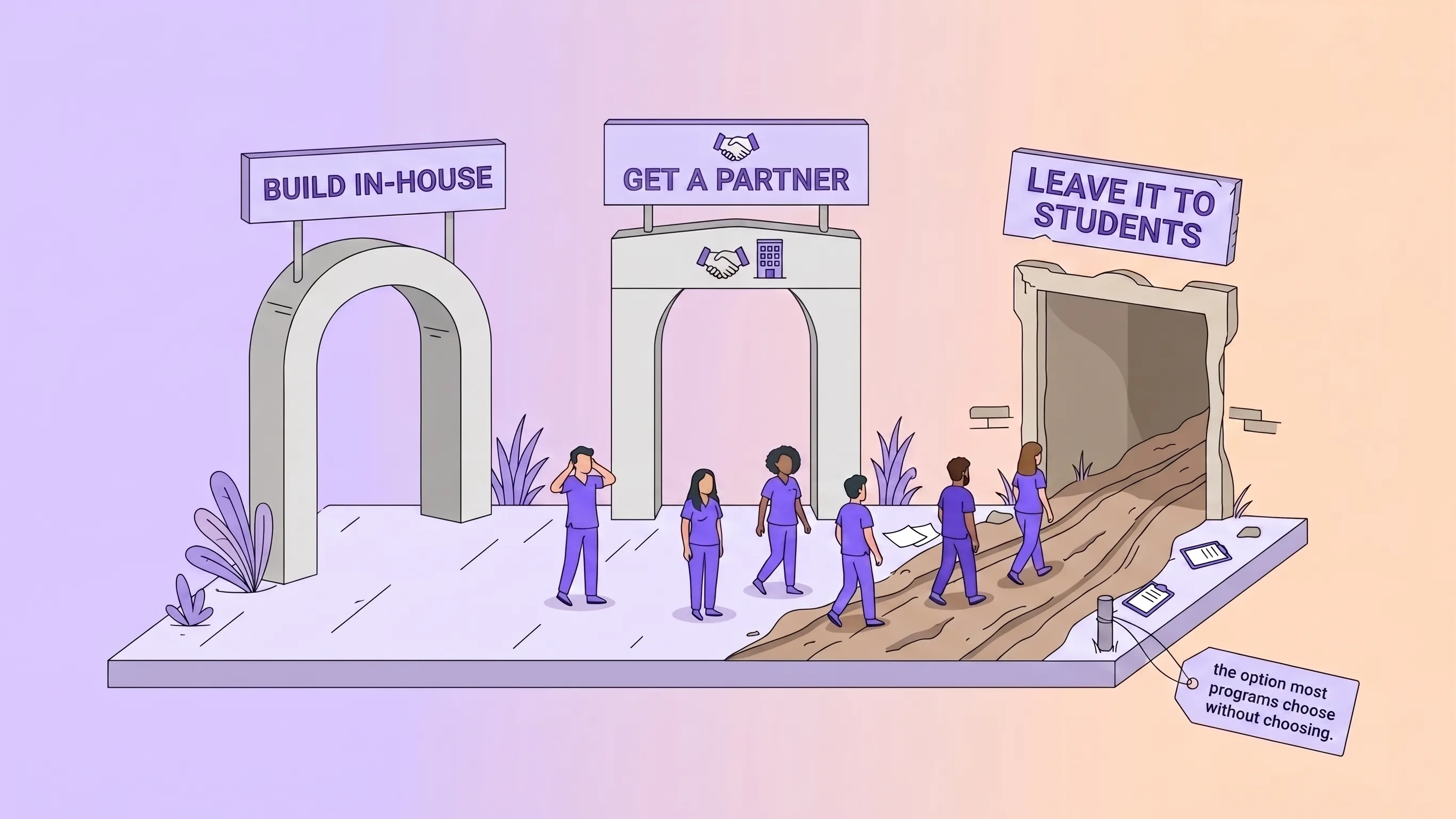
- The real question is build, buy, or leave it to students: Most programs are already outsourcing clinical placements by default to their own NP students, who self-place and often pay out of pocket for the rotations the program cannot provide.
- The strongest case for outsourcing is capacity and compliance, not convenience: Done well, it returns faculty hours, shortens time to placement, and produces audit-ready documentation for CCNE and ACEN review.
- The strongest case against outsourcing is loss of control: A bare marketplace with no clinician-led vetting can leave a program with thin records, uneven clinical sites, and preceptors who are available rather than genuinely qualified.
- The deciding factor is whether the arrangement keeps placement program-owned and defensible: If it does, outsourcing functions as infrastructure. If it does not, it is just moving risk around.
Clinical placement usually gets filed under logistics: a rotation to fill, a coordinator's task, a form to sign. At the program level, the actual decision is bigger than that. When enrollment grows faster than your access to clinical sites, you have three options. Build more in-house sourcing capacity, buy it from an external partner, or leave students to find preceptors on their own. That third option is the one most programs land on without deciding to, and it carries costs that rarely show up on a budget line.
This piece is written for the people who own that decision: program directors, deans, clinical coordinators, and placement teams weighing whether outsourcing clinical placement assistance is the right move, and if so, what separates a partner worth keeping from a vendor worth avoiding.
What does it mean to outsource clinical placements?
Outsourcing clinical placements means bringing in an external organization to source, vet, and secure clinical rotations for your NP students instead of relying entirely on faculty networks, coordinator outreach, or student self-placement. The term covers two very different service models, and the difference matters more than almost anything else in this decision.
A preceptor matching service operates like a marketplace. It connects a student with an available preceptor, processes the match, and steps away. A recruiting partner operates like program infrastructure. It continuously sources potential NP preceptors, applies clinician-led vetting for clinical fit, verifies credentials and clinical sites separately, secures affiliation agreements, and maintains those relationships across multiple rotations and cohorts.
Both are technically "outsourcing." Only one of them maintains documentation and quality control to a standard your accreditation review can rely on. When people ask which is the best preceptor matching service, the more useful question is which model they actually need: a one-time match, or a durable source of qualified nurse practitioner preceptors.
Why are NP programs considering outsourcing now?
Three pressures are compounding at the same time, and most programs are feeling all three at once.
- Enrollment is outpacing preceptor supply: Graduate nursing programs continue to grow, but the pool of clinicians willing to precept has not kept pace. The AACN reports that U.S. nursing schools turn away tens of thousands of qualified applicants each year, citing insufficient clinical sites, faculty, and preceptors among the primary barriers.
- Programs compete for the same limited pool of NP preceptors: A peer-reviewed analysis of the NP preceptorship shortage notes that nursing and other healthcare programs often compete for the same clinical sites and preceptors, and that many programs lack a standing network to call on, which pushes sourcing onto whoever has time.
- Faculty are absorbing sourcing work they were never hired to do: When placement has no dedicated owner, cold calling clinics and chasing affiliation agreements flow to faculty on top of teaching and clinical oversight. Research on placement quality describes sourcing as a recurring "scramble" that sits awkwardly against a faculty workload model built for lectures and tutorials, not outreach. That is where burnout and lost preceptor relationships begin.
- Accreditation expectations have tightened: The Sawyer Initiative successfully lobbied CCNE to strengthen expectations around clinical placements, preceptor qualifications, and clinical site quality, particularly for distance education programs. Reviewers now want to see how preceptor decisions are made and documented, whether clinical sites were formally approved rather than just used, and how oversight held up across the full rotation.
None of these is new on its own. Taken together, they are prompting programs to ask whether the current clinical placement process is still structurally sound or is running on borrowed faculty time.
The pros: what outsourcing clinical placements actually solves
When it works, outsourcing addresses the parts of the placement process that faculty realistically cannot scale.
- Reduced time to placement: A maintained pipeline of vetted NP preceptors means matching starts with a warm list rather than from zero every term, helping students begin clinical hours on schedule.
- Faculty hours returned: Sourcing, outreach, and school paperwork move off faculty, freeing time for curriculum, clinical instruction, and student support.
- Audit-ready documentation: A good partner treats records (licensure, board certification, affiliation agreements, site approvals) as a byproduct of how they work, not a scramble before review.
- Access to vetted clinical sites and specialties: Coverage can extend to high-demand specialties such as psychiatric mental health, women's health, pediatric NP, and family practice, as well as local clinics beyond your usual radius.
- Relationship continuity: Experienced preceptors are retained across cohorts rather than rebuilt every term.
- Placement cost stays off students: When the program owns the arrangement, students are less likely to pay out of pocket to fill a gap the program could not.
If you are trying to pinpoint where your own clinical placement process is straining before you decide anything, NPHub's university team maps that with programs regularly, no commitment attached. It can be a useful first conversation even if outsourcing turns out not to be your answer.
The cons and limitations: when outsourcing falls short
Outsourcing is not a fix for every program, and the risks are real enough to name plainly.
- Marketplace-only vendors underdeliver against program requirements: A service that matches based solely on availability, without clinician judgment regarding scope, acuity, and patient population, tends to produce placements that technically fill a slot but miss the learning objectives.
- Quality varies, and thin vetting shows up in audits: If a vendor relies on open listings or basic credential checks, you can inherit inconsistent preceptor qualifications and missing site approvals that surface during CCNE or ACEN review.
- You can lose control of the relationship: A transactional vendor holds the NP preceptor relationship, not you. If they disappear, so does the pipeline.
- Compliance gaps when documentation is not built in: Some arrangements leave affiliation agreements, immunization records, and site clearance loosely tracked, which defeats the purpose.
- Over-reliance without internal ownership: Handing off sourcing entirely, with no program point person overseeing it, trades one blind spot for another.
- Cost: A partner is a real line item. It should be weighed honestly, but it is not free.
Outsourcing done badly can leave you with less visibility than you had before. The safeguards that prevent that are the same ones worth screening for, covered further down.
When does outsourcing clinical placements make sense, and when doesn't it?
Outsourcing tends to make sense when:
- Sourcing has outgrown faculty capacity, and placement work is quietly eroding teaching and research time.
- Your accreditation documentation is thin or inconsistent across cohorts, and you know it.
- You are growing enrollment and cannot responsibly add students without a proportional increase in clinical site capacity.
- Students are already self-placing and paying for NP preceptor matching out of pocket, which means placement is being outsourced anyway, just to the people with the least leverage.
- You need consistent coverage in high-demand specialties where demand outruns supply.
Outsourcing probably does not make sense when:
- You have strong, well-documented internal placement capacity that already meets program requirements and accreditation standards.
- You only need occasional overflow help for a handful of rotations, where a lighter-touch arrangement fits better than a full partnership.
- The only options on the table are bare marketplaces with no clinician-led vetting, no separate site approval, and no ongoing assistance. In that case, outsourcing may add risk rather than remove it.
In-house versus outsourced clinical placement: which actually costs less?
In-house sourcing looks cheaper because it has no line item. Priced honestly, it often is not.
The in-house model incurs costs that are never attributed to placement: faculty hours diverted from teaching, the administrative burden of chasing affiliation agreements and school paperwork, and the turnover cost when a faculty member leaves and their preceptor relationships walk out the door with them. Delayed placements add another layer, because every rotation that starts late can push graduation back a term, and a delayed graduation defers the tuition cycle tied to that student.
An outside partner has a visible price. The fair comparison is not partner cost versus zero. It is partner cost versus the fully loaded internal cost of faculty time, lost relationships, and delayed throughput. When you price both sides honestly, the in-house option is frequently the more expensive one; it just hides the bill across several departments.
How do NP preceptor matching services work?
Most preceptor matching services follow a recognizable workflow, though the depth of each step varies:
- Placement request: The program or student submits rotation details: specialty, dates, required clinical hours, and location.
- Sourcing: The service searches its network or database for potential preceptors that fit the request.
- Vetting: Credentials and clinical fit are checked. This is the step that varies most, from a light credential scan to a structured, clinician-led evaluation of scope and teaching readiness.
- Site and paperwork: Affiliation agreements are secured, and the clinical site has confirmed it can host the placement.
- Confirmation: The match is finalized, and the student, preceptor, and program are notified.
The workflow looks similar across providers. The quality gap lives inside steps three and four. A marketplace may confirm a license and move on. A recruiting partner confirms that the patient encounters, acuity, and patient interactions at the site actually support the rotation's learning objectives, and that the site itself, not just the individual clinical preceptor, is approved.
What should NP programs look for in a clinical placement partner?
Use these as screening criteria. They separate a partner from a vendor and double as a checklist of what "good" looks like.
- Clinician-led vetting: Preceptors are evaluated by experienced NPs who can assess scope, specialty alignment, and teaching readiness, not just verify credentials.
- Separate site approval: The clinical site is vetted on its own merits (administrative readiness, patient population, documentation), independent of the individual NP preceptor.
- Credential and license integrity screening: Active licensure, board certification, and disciplinary history are checked against the relevant state boards, with clear disqualification rules for any restriction.
- Ongoing re-verification: Preceptors and sites are re-checked over time, because a strong fit in week one can change by week six as staffing and patient mix shift.
- Audit-ready documentation by default: The partner can produce qualification records, affiliation agreements, and site approvals on demand, so you can run reports for accreditation without a scramble.
- School-approved affiliation agreements: Contracts route through your approval process and align with your program requirements, rather than the vendor's template alone.
If these criteria describe what you need, the natural next step is to pressure-test them against your own numbers. NPHub's university team is glad to walk through how this would map to your cohort size, specialty mix, and graduation timeline, so you can see what the model would actually change for your program before committing to anything.
What does outsourcing clinical placements cost?
Pricing generally follows one of two models.
- Flat-fee (per rotation or per placement): You pay a set fee for a confirmed placement. Confirm exactly what the fee covers: sourcing only, or sourcing plus vetting, affiliation agreements, and site approval. Deliverables vary widely between providers.
- Database or subscription access: You pay for access to a national database of qualified preceptor profiles and do more of the outreach and vetting yourself. Here, verify data freshness and what response support you get, because a stale profile is worse than no profile.
For student-paid matching, a peer-reviewed study of the NP preceptorship shortage documents pay-for-preceptor arrangements ranging from roughly $600 to $800, and up to $2,000+, per rotation, or about $3.50 to $15 per hour across a semester. Program-level partnerships are priced differently, and models range from bundled to unbundled, flat-rate structures. Some providers also offer payment plans for students.
Two contract cautions worth flagging honestly:
- Watch for clauses that shift liability onto students: A signed affiliation agreement is what brings a student under the program's malpractice coverage. Any arrangement that leaves students personally exposed or that lets a facility shift liability onto the student is a red flag.
- Confirm final deliverables in writing before purchase: "Placement" can mean a warm introduction or a fully confirmed, documented, site-approved rotation. Pin down which one you are buying.
How outsourcing affects NP students
Even though this is a program-level decision, students feel the outcome most directly, and that should be included in the analysis.
When a program runs short on capacity and does not fill the gap, the work does not disappear. It shifts to students, who take on calling clinics, track their own school paperwork, and, in many cases, pay out of pocket for a preceptor-matching service. Survey research on the shortage found that most students rate finding a qualified preceptor as extremely difficult, and that a meaningful share had already been asked to pay for a placement or had used an online service to secure one. That burden falls hardest on students with the fewest professional connections, creating an equity gap between those with strong networks and those without. It also produces uneven records that can resurface during accreditation review.
Program-owned outsourcing changes who carries that load. When placement stays within a system the program controls, documentation remains defensible, student success is less dependent on personal networks, and the risk of a student delaying graduation due to a missing preceptor decreases. The point of outsourcing well is not to remove the program from the process. It is to keep the process, and its paperwork, from falling on the people least equipped to absorb it.
A decision framework: should your program outsource?
Work through three lenses, then pilot before you commit.
Screen on cost, coverage, and compliance:
- Cost: Have you priced the fully loaded internal cost (faculty time, turnover, delayed tuition) against the partner's fee, rather than against zero?
- Coverage: Does the partner reach the specialties and geographies where you consistently run short, including high-demand areas?
- Compliance: Can they produce audit-ready documentation and school-approved affiliation agreements on demand?
Then pilot with one cohort: Run the service for a single cohort or specialty cluster before a full rollout. Assign a program point person to own the relationship and the affiliation-agreement workflow.
Judge the pilot on real metrics:
- Time from request to confirmed placement
- Percentage of rotations that started on schedule
- Documentation completeness at audit standard
- Faculty hours returned to teaching and oversight
- Student and preceptor feedback on the experience
Weigh outsourcing against the alternatives: Outsourcing is one lever, not the only one. Simulation can carry part of the load: a large randomized controlled study by the National Council of State Boards of Nursing found that substituting high-quality simulation for up to half of traditional clinical hours produced comparable end-of-program outcomes and readiness for practice. Blended and virtual placement models show similar promise in easing pressure on sites while preserving learning, though the evidence base remains early. These approaches complement rather than replace hands-on clinical hours with real patient encounters, and they do not solve the core preceptor-sourcing problem. But a full decision compares outsourcing against simulation capacity, internal hiring, and the status quo, rather than treating it as the only option.
Involve the right stakeholders before making a selection: Talk to faculty, clinical coordinators, compliance staff, and a few students who have recently completed placement. Their view of where the current process breaks is the best input you have.
How NPHub approaches clinical placement
NPHub is built as a recruiting partner, not a marketplace. The distinction shows up in how placements are sourced and screened.
Preceptors are vetted by experienced clinicians before a student is ever assigned, so fit is treated as a clinical judgment first and an administrative one second. Clinical sites are confirmed as able to host a placement independently of the individual preceptor. Licensure and certifications are verified, affiliation agreements are secured, and check-ins run at the start, midpoint, and end of each rotation so issues surface early rather than mid-placement. Pricing is unbundled and flat-rate, with no revenue share and shorter contracts, so programs pay for the services they actually need. And through the Perfect Preceptor Promise, if a site does not meet expectations or a student feels unsafe, NPHub provides a replacement at no additional cost.
The goal is to give programs capacity they can lean on and documentation that holds up, while keeping faculty out of the sourcing business and students off the hook for placements the program should own.
Conclusion
Outsourcing clinical placements is not about handing off responsibility. Done well, it is about keeping placement program-owned, defensible under accreditation review, and off the backs of students who would otherwise self-place and pay for the privilege. Done badly, through a bare marketplace with no vetting and no documentation, it can leave a program with less control than it started with. The decision is not really "outsource or not." It is "if we bring in help, will it make our placement process more durable and more defensible, or less." That is the question worth answering before you sign anything.
If you are weighing that question for your own program, NPHub's university team, led by Director of Business Development Nicholas Carrizales, offers a free consultation to talk through where your placement process is holding up, where it is straining, and what a program-owned model would change about both. It is a conversation, not a pitch, and you are welcome to start it whenever the timing is right for your team.
Frequently asked questions
Who pays for preceptor matching fees?
It depends on the arrangement. When a program contracts a partner, the program typically pays. When a program cannot provide a placement, the cost often shifts to the student, who pays out of pocket. That shift is one of the clearest signals that placement capacity has outrun the program's internal model.
What does outsourcing clinical placements cost?
Student-paid matching is commonly discussed in the range of a few hundred to roughly two thousand dollars per rotation, and several thousand per semester across multiple rotations. Program-level partnerships are priced differently, often on a flat-rate or unbundled basis. Always confirm exactly what the fee covers before comparing prices.
Is it cheaper to source qualified preceptors in-house or use a partner?
It depends on how honestly the in-house cost is priced. Faculty-led sourcing appears free because it has no line item, but it carries real costs in faculty time, turnover, and delayed tuition payments. Compare a partner's fee against those hidden internal costs, not against zero.
What happens if our school rejects a matched preceptor or a clinical site?
A quality partner routes every match through your approval process, so you retain the final say. If a preceptor or site does not meet your program requirements, it should not be assigned, and a strong partner sources an alternative rather than pushing an unsuitable match. Confirm this approval workflow before signing.
Can a preceptor matching service support CCNE or ACEN compliance?
Yes, when it applies consistent vetting and documentation standards across every placement. Services that verify licensure, approve clinical sites separately, and maintain audit-ready records help strengthen your accreditation posture. Services built on open listings or basic credential checks generally do not meet that bar.
What is the difference between a preceptor matching service and a recruiting partner?
A matching service connects an available preceptor with a nurse practitioner student and steps away. A recruiting partner sources continuously, applies clinician-led vetting, verifies preceptors and sites separately, secures affiliation agreements, and maintains those relationships across cohorts. The first fills a slot. The second functions as program infrastructure.
Should nurse practitioner students find their own preceptors?
Most programs that rely on student self-placement see uneven outcomes. It shifts the sourcing burden onto students with the least time and leverage, creates equity gaps between those with and without professional networks, and produces inconsistent records that resurface during audits. A program-owned process tends to produce more equitable outcomes and cleaner documentation.
How long does it take to secure an NP clinical placement?
Anywhere from a few weeks to several months, depending on specialty, geography, and how sourcing is managed. Programs that rely on faculty networks or student self-placement often experience longer timelines and missed start dates. A maintained pipeline shortens the timeline by starting from a vetted list rather than from scratch each term.
Find a preceptor who cares with NPHub
Book a rotation.webp)
.jpeg)

.webp)
.jpeg)


%20(3)%20(2).svg)
.webp)