
.png)




.webp)
Most nurses have a moment they don't always want to talk about. It's the shift, the week, or the year when leaving nursing stopped being a thought and started to feel like a plan. In a new NPHub survey of 177 nurses, nearly two-thirds said they have seriously considered leaving the profession for good. Some went so far as to apply for jobs outside nursing or to have a resignation letter ready to submit.
We asked what pushed them to the edge, who pulled them back, and what that person actually did. Then we asked a harder question. Right now, does catching a nurse before they quit come down to luck, or is it built into the job? Half of the nurses who nearly left say luck.
Key Takeaways
- Nearly 2 in 3 nurses (64%) have seriously considered leaving nursing, and 1 in 5 (20%) have applied for jobs outside nursing or had a resignation ready.
- Among nurses who seriously considered leaving, 90% cite burnout as the factor that pushed them most, followed by a toxic workplace (68%) and unsafe staffing (61%).
- 53% of nurses who seriously considered leaving came closest mid-career, more than double the share who came closest as new grads (23%).
- About 3 in 5 nurses (61%) credit someone outside of work, such as family or a friend, with keeping them in nursing.
- About half of nurses (49%) say the action that mattered most to keep them in nursing was someone listening without judgment.
- 50% of nurses who seriously considered leaving say catching a nurse before they quit comes down to luck.
- Nearly 3 in 5 nurses (57%) have become the person who talks another nurse off the edge, and another 1 in 5 (20%) want to.
How Close Nurses Come to Leaving
Leaving nursing is rarely a snap decision. For most nurses, it's a set of steps, and many of them got further down that path than their coworkers ever knew.
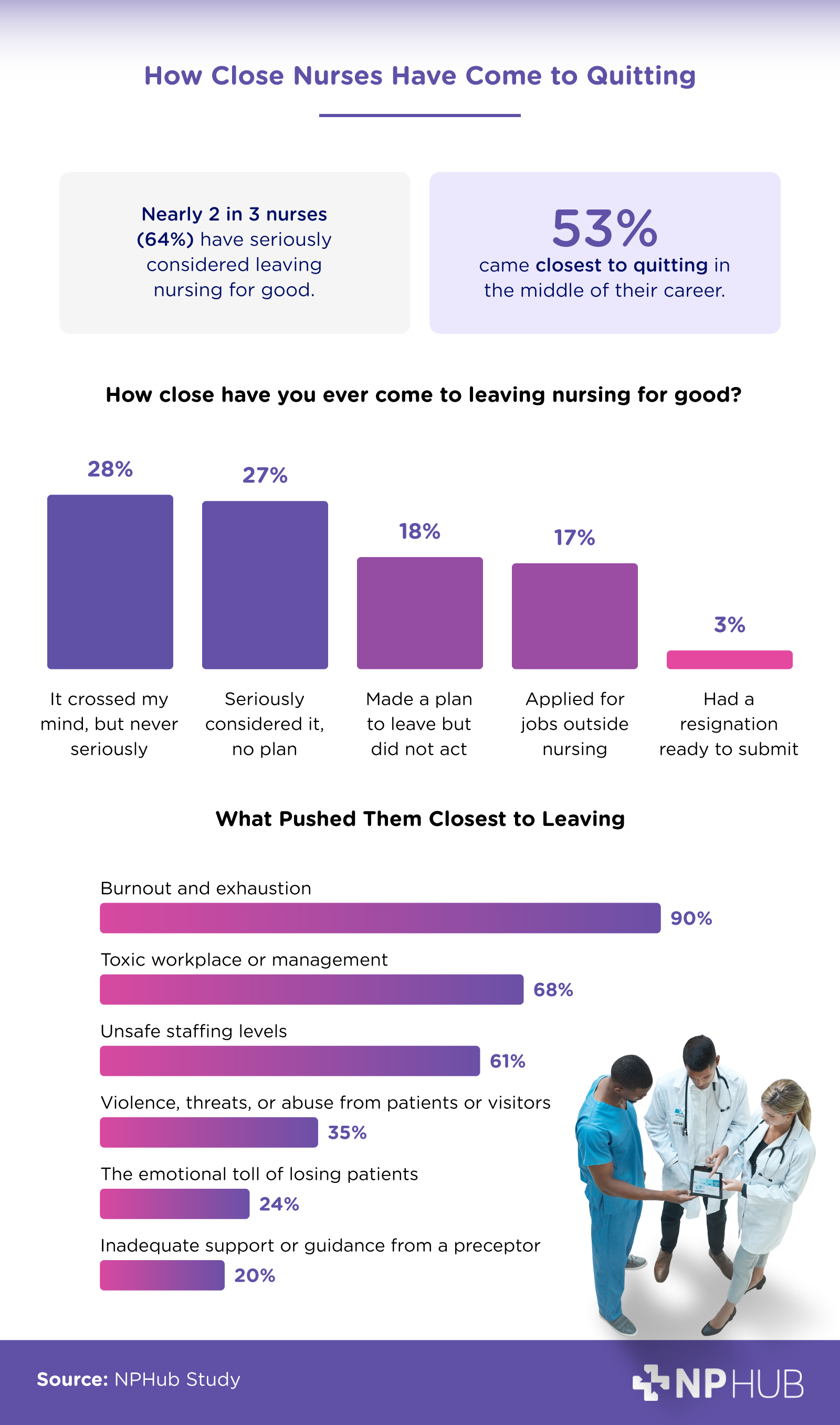
Nearly 2 in 3 nurses (64%) said they have seriously considered leaving nursing, and 1 in 5 (20%) went as far as applying for work outside the field or having a resignation ready. Only 7% said the thought had never crossed their mind. Among those who came closest, burnout was almost universal: 9 in 10 (90%) named it, well ahead of a toxic workplace (68%) and unsafe staffing (61%).
The riskiest stretch was not the new-grad years. Over half of nurses who seriously considered leaving (53%) said they came closest in the middle of their career, more than double the 23% who came closest as new grads.
The pressures also shifted by setting. Nurses on hospital units outside the ICU and ER were the most likely to point to the emotional toll of losing patients (30%), while financial pressure hit hardest in the ICU and ER (31%).
Who Pulls Nurses Back From the Edge
The person who kept a nurse in the profession was rarely the one the job assigned to the role. Most often, it was someone outside work, and what they did was simple.
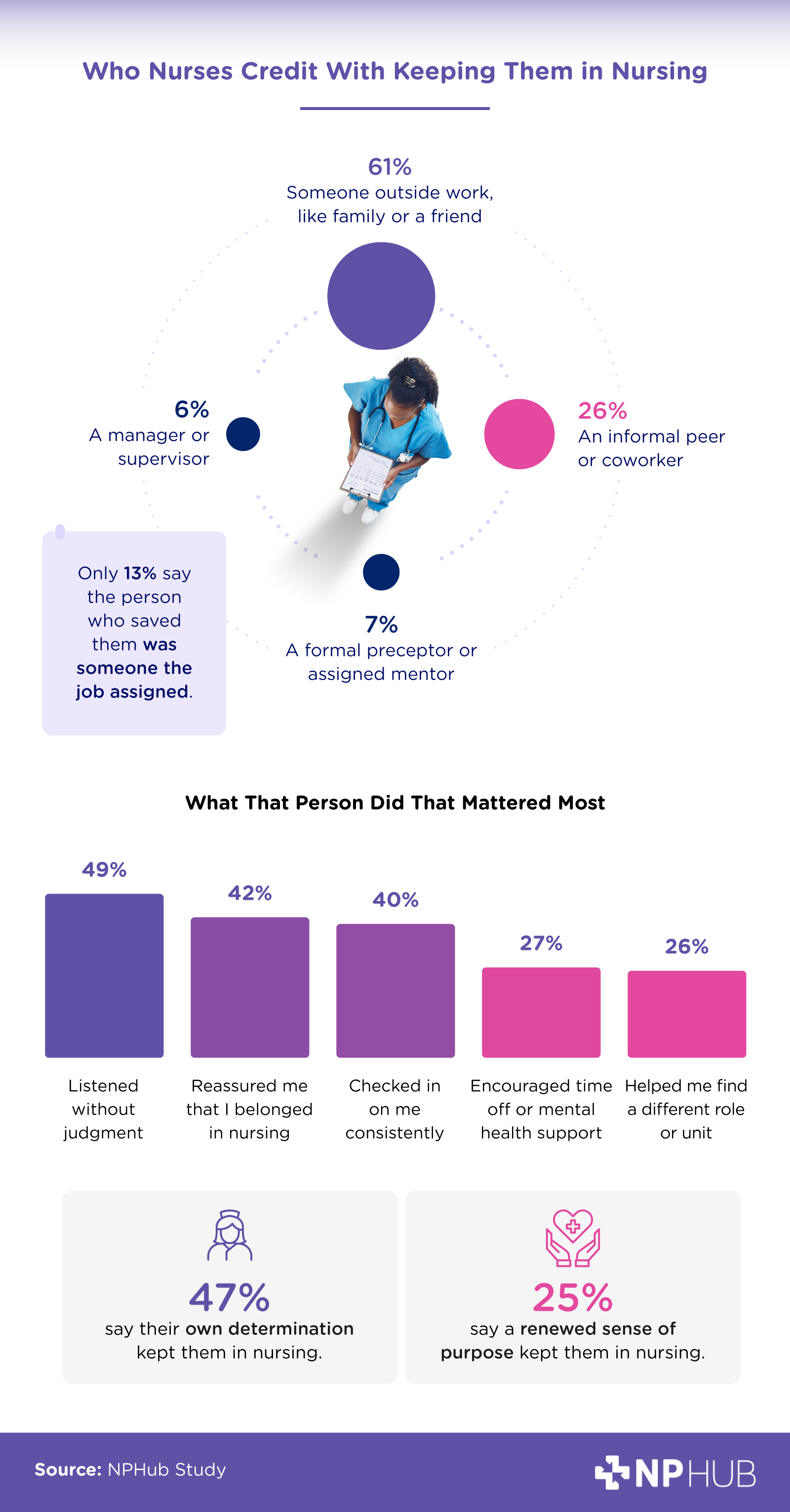
About 3 in 5 nurses (61%) credited someone outside of work, such as family or a friend, with keeping them in nursing. An informal peer or coworker came next (26%).
What that person did mattered more than who they were. Nearly half (49%) said the thing that helped most was someone listening without judgment, followed by being reassured they belonged in nursing (42%) and being checked in on consistently (40%).
Newer nurses leaned on these quiet acts the most. Among nurses under 35, 56% said being listened to without judgment mattered most.
Why Catching a Nurse Often Comes Down to Luck
Nurses who were caught in time are now catching others. But most say the safety net still has holes, and their own workload is one of them.
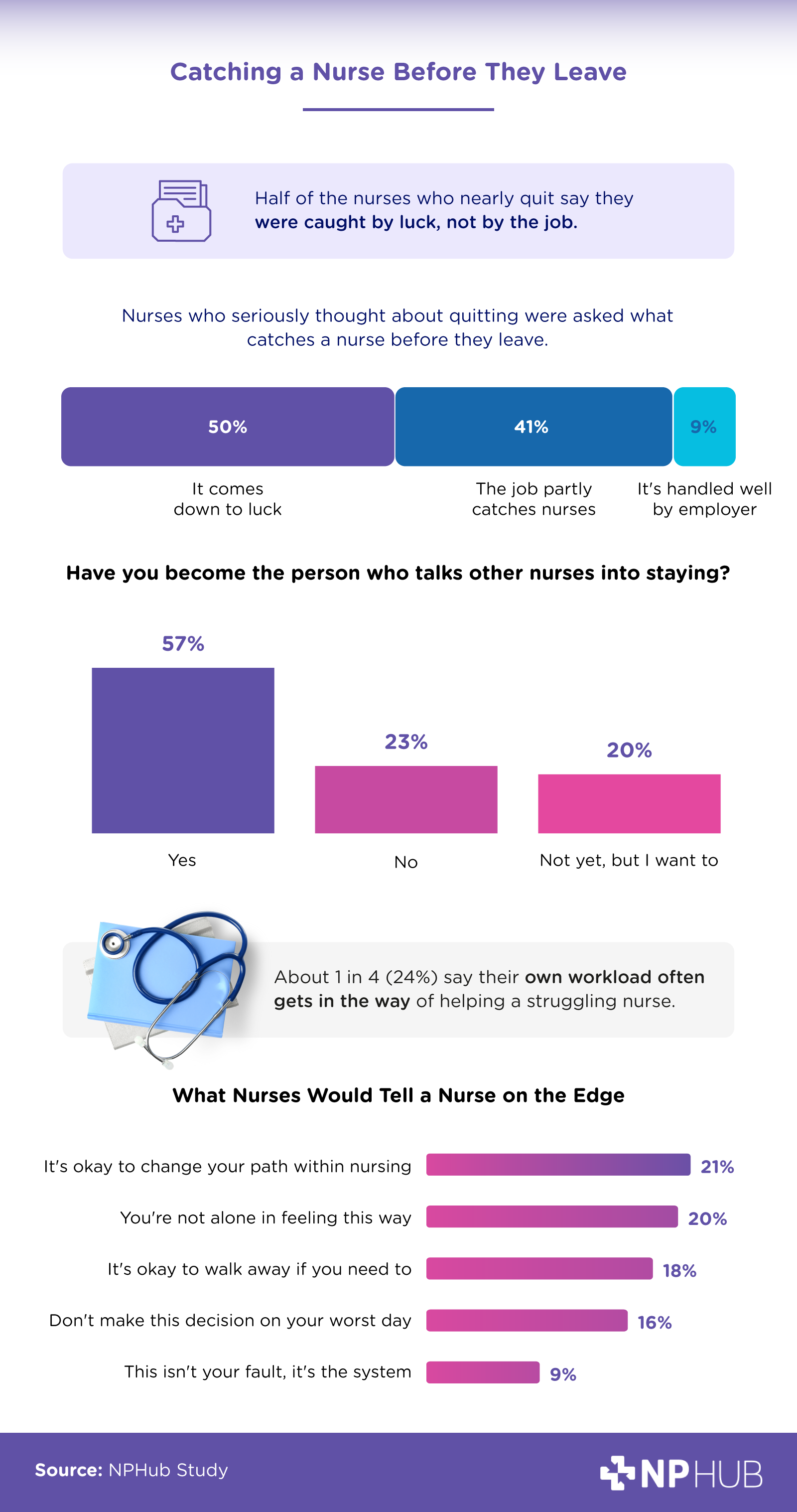
Half of the nurses who seriously considered leaving (50%) said being caught in time came down to luck, not anything built into the job. Across all nurses, 49% said catching a nurse is at least partly built in, 37% said it is luck, and only 14% said it is handled well where they work. The closer a nurse came to leaving, the more they credited luck.
The nurses who made it through are paying it forward. Nearly 3 in 5 (57%) said they have become the person who talks another nurse out of quitting, and another 1 in 5 (20%) said they want to. The obstacle is time. About 1 in 4 nurses (24%) said their own workload often gets in the way of helping a struggling colleague.
When asked what they would tell a nurse on the edge, their top answers were that it's okay to change your path within nursing (21%) and that you are not alone (20%).
Building the Catch Into the Job
Many nurses in this study got close to the exit at some point, and what kept them in was rarely a policy. It was a person, and more often than not, a person outside the building. Half of those who nearly left say their rescue came down to luck, and most of those who were caught are now catching others.
If you are the nurse on the edge today, take the advice of those who stood where you stand. Don't make this decision on your worst day, and remember that changing your path within nursing is an option, too.
Methodology
We surveyed 177 nurses, including 139 registered nurses (RNs), 17 nurse practitioners (NPs), 17 nurses in other roles, and 4 clinical nurse specialists, about how close they have come to leaving nursing: what pushed them to the edge, who pulled them back, what that person did, and whether catching a nurse before they quit is built into the job or left to luck. The age breakdown was 37% ages 18 to 35, 37% ages 35 to 44, and 26% ages 45 and older. By tenure, 44% had worked in nursing for 4 to 10 years, 28% for 11 to 20 years, 18% for more than 20 years, and 11% for 3 years or less. All figures have been rounded. Data was collected in September 2026.
About NPHub
Since 2017, NPHub has helped nurse practitioner students secure the clinical placements they need to graduate on time. Our vetted network of 2,400+ preceptors connects students with quality clinical rotations across specialties, from Family Practice to Mental Health/Psychiatric. With a team of 90+ clinical placement experts handling the paperwork and school-specific requirements, students can stop stressing about their rotations and focus on becoming amazing NPs.
Fair Use Statement
The data and findings on this page are free to use for noncommercial purposes. If you share them, please credit NPHub with a link so others can view the full study.
Find a preceptor who cares with NPHub
Book a rotation.webp)
.jpeg)

.webp)
.jpeg)


%20(3)%20(2).svg)
.webp)