
.png)



.webp)
Finding a preceptor for NP school is one of the most time-consuming parts of any nurse practitioner program, and AI tools are starting to change how that search works. Preceptor matching platforms now use smarter filtering and automated outreach to connect NP students with available clinical sites faster than a manual search can. For students with a rotation deadline, the difference between a tool that searches and a service that confirms is what keeps graduation on track.
TL;DR - How to use AI to Find a Preceptor
- Most NP students are responsible for finding their own preceptors, and the manual search of cold emails to local clinics, no responses, and unverified clinical sites costs weeks that most nursing programs cannot give back
- AI preceptor matching tools are being developed to improve how NP students find NP preceptors through smarter filtering and automated outreach, but their value depends entirely on the quality of the vetted preceptors underneath them
- AI tools like ChatGPT are also useful right now for the organizational side of the search: drafting outreach emails, building a list of potential preceptors, and tracking contacts systematically
- What closes a clinical placement is access to qualified nurse practitioner preceptors who are verified, available for your specific rotation dates and specialty, and ready to accept a rotation request today
- Ready to find a preceptor? Create your free NPHub account and browse 2,400+ active preceptors by specialty and location and secure your rotation.
Why Finding a Preceptor for NP School Takes Longer Than It Should
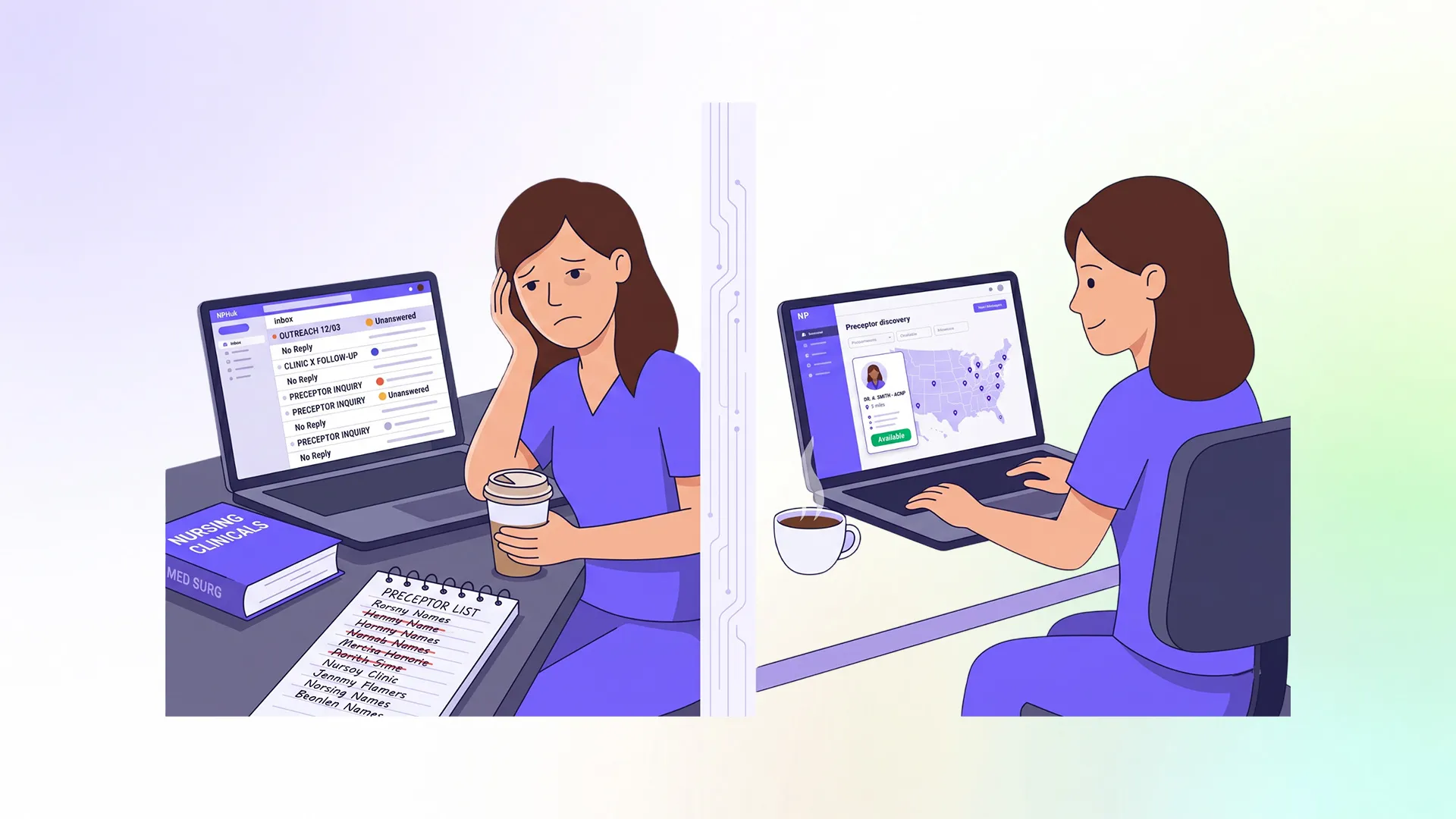
At some point in every NP program, the reality of finding a preceptor stops being a future problem and becomes an immediate one. You have submitted requests to local clinics. You have sent emails to healthcare providers you found through your professional network. Weeks have passed with no response. Your rotation start date is not moving, and your nursing program is not stepping in to solve it.
This is the structural reality for most NP students in the U.S. Clinical rotations are a required part of every nurse practitioner program, and the responsibility for securing a clinical preceptor falls almost entirely on the student. That has not changed. What is changing is the set of tools available to support that search.
AI tools are entering the preceptor matching space with real capabilities: smarter filtering, automated outreach to prospective preceptors, and faster ways to organize the search itself. This blog covers what those tools actually do, how NP students can use AI practically during their search today, and what a confirmed clinical placement actually requires so your graduation stays on track.
Why It's So Hard to Find a Nurse Practitioner Preceptor
Finding a nurse practitioner preceptor takes longer than most NP students expect, and the reasons are structural. Every barrier in this search carries a time cost, and those costs accumulate fast when a rotation deadline is fixed.
- No established network at most programs: Unlike medical schools, NP programs typically lack deep-rooted relationships with clinical sites, leaving most nurse practitioner students to start from zero each rotation with no practicum site network to draw on.
- A constrained supply: More than 385,000 NPs practice in the U.S., yet approximately 28,000 NP students still struggle to find clinical preceptors each year. The pool of experienced preceptors willing to take on students has not kept pace with growing enrollment across every NP program.
- No visibility into real availability: Most directories of potential preceptors are static. A provider listed as available may not be accepting students for your specialty, your rotation dates, or your program's specific requirements. Students spend weeks pursuing clinical sites that were never actually open.
- Credential verification falls on the student: Confirming that a preceptor meets your school's requirements for licensure, certification, and scope of practice is a manual process. Finding out a site does not qualify after weeks of back-and-forth is one of the most common ways NP students lose an entire month of their search.
- More than half of NP programs struggle to place students: Over 500 academic institutions graduate more than 36,000 NP students annually, and more than half of those programs struggle to find qualified preceptors for their students.
The search requires real-time availability data, credential verification, and coordinated paperwork. Those are the conditions for a confirmed clinical placement, and a cold email to a local clinic cannot produce any of them. That is the gap AI tools are working to close.
If your rotation deadline is approaching and you need a verified preceptor now, create your free NPHub account and browse available preceptors by specialty and location so your graduation stays on track.
How AI Tools Are Being Used to Find a Preceptor for NP Students
AI preceptor matching tools are entering the clinical placement space with capabilities that address real parts of the search. How useful they are in practice depends on the network of preceptors underneath them, but the core functions are worth understanding.
- Compatibility filtering: AI can process a student's specialty, location, rotation dates, and NP program requirements against a database of preceptors to surface relevant matches faster than a manual search. A student looking for a primary care preceptor in a specific state, for a specific rotation window, gets a filtered list instead of starting from scratch. The quality of those results depends entirely on how current and verified the preceptor information in the database is.
- Automated outreach to expand networks: Some preceptor matching platforms use AI-powered outreach to automatically identify and contact healthcare providers outside their existing network who match a student's specific needs. This approach addresses supply-side scarcity by recruiting prospective preceptors in real time, but it only produces results where outreach converts into a willing, credentialed, available clinical preceptor.
- Predictive availability signals: More advanced tools are working toward surfacing preceptors based on current capacity signals rather than static availability flags. The challenge is significant: only 17.1% of preceptors invited to participate in a structured preceptor portal actually enrolled, even with explicit support mechanisms in place. A matching algorithm that ranks unresponsive or unavailable preceptors produces a filtered dead end.
The ceiling for any NP preceptor finder tool is the depth and responsiveness of the preceptor network it draws from. Smarter filtering on a thin or outdated pool of potential preceptors does not close a placement. What closes a placement is a verified, active network of qualified preceptors who are actually accepting students for your specialty and dates.
How to Use AI to Find a Preceptor: What You Can Do Today
While preceptor matching platforms continue developing their networks, AI tools are already useful for the organizational side of the clinical preceptor search. Used correctly, they reduce the friction on parts of the search that consume time without producing a confirmed placement.
- Drafting cold outreach emails: A well-structured prompt in ChatGPT or Claude produces a concise, professional email in under two minutes. Include your specialty, NP program requirements, rotation dates, and clinical hours needed in the prompt. Edit the output before sending to personalize the provider's name, clinic type, and patient population. Generic AI output reads as generic to most preceptors, and personalization is what gets a response from busy healthcare providers.
- Building a target list of potential preceptors: AI can help identify the types of clinical sites that align with your rotation requirements across specialties like primary care, women's health, urgent care, and acute care. Cross-reference that list against your state's APRN directory or the NPI Registry to find actual licensed nurse practitioner and physician providers in your area who meet your program's preceptor requirements.
- Tracking outreach systematically: Ask AI to generate a simple tracking template with columns for provider name, clinical site, contact date, response status, follow-up date, and credential notes. NP students who lose track of who they have contacted waste time on duplicate outreach and miss follow-up windows that could have converted into a placement.
- Researching a site before outreach: AI can summarize what a practice does, what patient population it serves, and what specialty alignment looks like for your rotation. That information helps you personalize your outreach and assess whether a clinical site is worth pursuing before investing time in the request process.
These uses are real and they save time on a search that most NP students cannot afford to slow down. The limit is clear: AI tools do not have access to live preceptor availability, cannot verify credentials against your school's requirements, and cannot coordinate the paperwork between your program, your clinical site, and your preceptor. That coordination is what a structured preceptor matching service handles.
What Actually Gets You a Confirmed Preceptor Placement
Most NP students reach a point where the search has produced responses but no confirmed rotation. A preceptor who seemed available stops responding. A clinical site that looked qualified turns out not to meet the school's requirements. The gap between identifying potential preceptors and having a placement your program will approve is where most searches stall. Three things determine whether that gap closes.
- A verified, active pool of qualified preceptors: Experienced preceptors who are credentialed, currently accepting NP students, and matched to your specialty are the foundation of any confirmed placement. A large directory means nothing if the preceptor information is outdated. Real-time visibility into which qualified nurse practitioner preceptors are available for your specific rotation window, in your location, for your specialty, is what makes a search productive rather than circular.
- Transparent preceptor information before you commit: A preceptor's credentials, practice setting, patient population, student schedule, and clinical experience should all be visible before a rotation request is submitted. That level of detail is what allows NP students to assess whether a site meets their school's requirements before investing time in the process, rather than finding out weeks later that it does not.
- Paperwork coordination handled by someone other than the student: Affiliation agreements, required paperwork, school approval documentation, and credential verification are where confirmed placements fall apart. Most NP students are managing full course loads and clinical hours simultaneously. A preceptor matching service that handles all the required paperwork so students can focus on their program is not a convenience. It is what keeps a placement on track through to a confirmed rotation start date.
Browsing available preceptors on NPHub is free. Create your free NPHub account and see real-time availability across 2,400+ vetted preceptors in 45+ states, filtered by specialty and location.
How NPHub Helps NP Students Find a Preceptor Fast
Our platform puts NP students in control of the search from the first step. There are no hidden fees to browse, no commitment before you find a preceptor you want to work with, and a Student Coordinator team that handles the paperwork process from deposit to rotation start. Here is exactly how it works.
- Search by specialty and location on an interactive map. Filter by rotation start date to see which vetted preceptors are available for your specific window across primary care, women's health, acute care, urgent care, and 10+ other specialties in 45+ states.
- View full preceptor information before requesting. Every profile includes credentials, practice setting, average patients per day, student schedule, dress code, vaccination requirements, and rotation highlights. NP students can assess fit against their school's requirements before submitting anything.
- Submit your rotation request with your details. Total clinical hours needed, rotation start and end dates, paperwork due date, and your NP program's specialty requirement. A 15% refundable deposit secures the request and begins the coordination process.
- The preceptor reviews and accepts your request. Most preceptors respond within 5 to 7 business days. If a preceptor does not accept within 10 business days, your deposit is returned in full.
- Your Student Coordinator handles all the required paperwork. Preceptor resume, license, board certification, malpractice insurance, and affiliation agreements are all collected and organized to your school's specific requirements. Students download a completed package and submit it to their program.
- Once your school approves, your rotation is confirmed. Your Student Coordinator shares your preceptor's contact information so you can coordinate your schedule and prepare for your first day.
Our Perfect Preceptor Promise covers the full process. If your school does not approve the placement or the preceptor becomes unavailable, our team finds a replacement at no additional cost. If a suitable replacement cannot be found, you receive a full refund. Payment plans are available for every student, with options to pay over 3 or 12 months regardless of rotation cost or timeline.
What AI Means for NP Students Finding a Preceptor Today
AI is changing the preceptor search in real ways. Smarter filtering, automated outreach to prospective preceptors, and better organizational tools are all making the search faster and less manual for NP students. The direction is right. The question for any student with a rotation deadline is whether those capabilities exist in a usable, verified form for their specialty, location, and dates right now.
What NP students need today is a pool of qualified nurse practitioner preceptors who are actively accepting students, full preceptor information visible before committing to a request, and a team that handles all the required paperwork so the placement actually reaches school approval. AI tools support that process. A vetted preceptor network with experienced coordinators behind it is what completes it.
Our team has secured over 14,000 clinical placements for NP students across 230+ nursing programs. Every confirmed rotation moved a real student closer to finishing their clinical hours and graduating on schedule. That outcome is what the search is actually for.
Create your free NPHub account and see how a smarter approach to finding a preceptor, one that combines verified availability, full credential transparency, and coordinated paperwork, gets your clinical rotation confirmed and your graduation timeline back on track.
Frequently Asked Questions About How to use AI to Find a Preceptor
1. Can AI actually find me a nurse practitioner preceptor?
AI tools can improve how you search for a preceptor by filtering available clinical sites by specialty, location, and rotation dates faster than a manual search. What AI cannot do on its own is verify that a preceptor meets your NP program's specific requirements, coordinate affiliation agreements, or guarantee that a preceptor accepts your request. The search gets smarter with AI. The placement gets confirmed with a verified network and a coordination team behind it.
2. What is NP preceptor matching and how does it work?
NP preceptor matching is the process of connecting nurse practitioner students with qualified, available clinical preceptors for their required rotation hours. A preceptor matching service maintains a network of vetted preceptors across specialties and states, handles credential verification, and coordinates the school paperwork required for program approval. The goal is a confirmed placement that meets your school's requirements without the student managing every step of the process.
3. How is browsing a preceptor marketplace different from using an AI matching tool?
An AI matching tool filters a database based on your inputs and surfaces compatible options. A preceptor marketplace like NPHub gives you direct visibility into verified preceptor profiles, real-time availability by rotation start date, and full credential information before you commit to a request. The difference is transparency and verification. You see exactly who you are requesting and what their clinical site offers before any paperwork begins.
4. How do I use AI to help find a preceptor for NP school?
AI tools are most useful for the organizational side of the search. Use them to draft cold outreach emails to potential preceptors, build a target list of clinical sites across primary care, women's health, urgent care, and acute care, generate a tracking template for your outreach, and research a practice before reaching out. Cross-reference any list AI generates against the NPI Registry to confirm providers are licensed and active in your state.
5. How do I know if a preceptor on NPHub meets my school's requirements?
Every preceptor profile on NPHub includes credentials, licensure, board certification, practice setting, and clinical experience details. Our team has worked with 230+ nursing programs and knows what most schools require. Once a preceptor accepts your rotation request, your Student Coordinator collects and organizes all required paperwork to your program's specifications before you submit anything to your school.
6. How long does it take to get a confirmed clinical placement through NPHub?
The NPHub side of the process typically takes two to three weeks. That includes preceptor acceptance, document collection, and paperwork preparation. The remaining timeline depends on your school's approval process. Submitting your paperwork to your program as soon as it is ready and following up with your clinical coordinator regularly keeps the process moving.
7. Does NPHub handle affiliation agreements and all the required paperwork?
Yes. Once your preceptor accepts your rotation request, your Student Coordinator collects the preceptor's resume, license, board certification, malpractice insurance, and affiliation agreements. Everything is organized according to your school's requirements. You download the completed package and submit it to your program. There is no back-and-forth between you and the clinical site.
8. What if my school does not approve the preceptor I selected?
Our Perfect Preceptor Promise covers this. If your school rejects the placement, our team investigates the reason, searches our network for a qualified replacement, and prepares new paperwork at no additional cost. If a suitable replacement cannot be found, you receive a full refund. Create your free NPHub account and start your search knowing the outcome is protected.
Article details
- Last updated
Jun 16, 2026 - Fact-checked by
NPHub Clinical Placement Experts & Student Support Team - Sources and references
- https://blog.amopportunities.org/2024/06/12/navigating-the-nurse-practitioner-preceptor-shortage/
- https://www.sciencedirect.com/science/article/abs/pii/S0891524525003797
- https://www.analyticsinsight.net/education/how-ai-powered-matching-algorithms-are-tackling-the-clinical-preceptor-shortage-in-healthcare-education
- https://npiregistry.cms.hhs.gov/
- https://www.nphub.com/np-student-coordinators
- https://www.nphub.com/how-it-works
- https://www.nphub.com/perfect-preceptor-promise
Find a preceptor who cares with NPHub
Book a rotation.webp)
.jpeg)

.webp)



%20(3)%20(2).svg)
.webp)