
.png)



.webp)
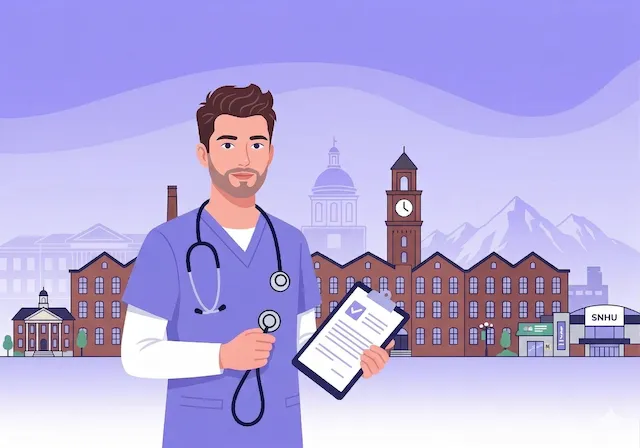
TL;DR: NP Preceptor Manchester NH
- New Hampshire is a full practice authority state — NPs practice independently, making the quality of your clinical training here especially consequential.
- Manchester is New Hampshire's largest city and healthcare hub, home to Elliot Health System, Catholic Medical Center, and Southern New Hampshire Health — but preceptor competition is real.
- NH APRN programs require a minimum of 480 clinical hours — every rotation counts toward your graduation timeline.
- Start your preceptor search at least 4–6 months before your rotation date to protect your options and your schedule.
- When your network runs dry, vetted matching services like NPHub offer verified preceptors, full paperwork support, and a 100% money-back guarantee. Create your free NPHub account here →
Why Manchester, NH Matters for Nurse Practitioner Training
You're not just searching for a preceptor. You're choosing the environment that will shape your clinical identity.
Manchester is New Hampshire's most populated city and its primary urban healthcare hub. The landscape here is layered — from large acute care systems to federally qualified health centers serving underserved populations. That range creates genuine opportunity for NP students who want varied, substantive clinical experience.
At the same time, New Hampshire is navigating a real primary care workforce challenge. The state has documented provider shortages across multiple regions, and practices throughout the Manchester area are under growing pressure as physician numbers decline and patient demand rises. Trained NPs graduating on time are genuinely needed here — and the preceptors who invest in students understand exactly why.
New Hampshire is part of AANP Region 1, alongside Connecticut, Massachusetts, Maine, Rhode Island, and Vermont. That regional community offers professional networks, state NP associations, and advocacy resources that are valuable to students actively searching for placements. Tapping into these networks early — before your timeline gets tight — puts you ahead of most of your peers.
Most importantly, New Hampshire's full practice authority status means that when you graduate here and stay in-state, you will have the legal autonomy to practice independently from day one. The preceptorship you complete now isn't just a box to check — it's the foundation of clinical decision-making that your license will soon authorize you to carry alone.
Start building your future today — create your free NPHub account →
The Reality of Finding an NP Preceptor in Manchester, NH
Before strategies, it's worth naming the honest reality: finding a preceptor is hard, even in a city with strong healthcare infrastructure.
Preceptors in Manchester are working clinicians first. They carry full patient loads, manage documentation demands, and often precept students as an add-on to an already demanding professional life. Most are not waiting by an inbox hoping for student outreach. Some have never been approached. Others have been approached so often they've become selective or simply stopped responding.
The Manchester area's ongoing healthcare consolidation adds a practical layer of complexity. As larger hospital systems absorb independent practices, individual preceptors sometimes lose the flexibility to make unilateral decisions about accepting students. Affiliation agreements, credentialing processes, and institutional approval chains can turn what might have been a quick yes into a multi-week back-and-forth — one that can cost you a semester if it starts too late.
The key is planning with realistic lead times. This is not a process you can compress in the final weeks before a rotation. Students who build an adequate runway — and who have contingency options ready — graduate on time. Students who don't, often don't.
New Hampshire APRN Requirements and Clinical Match Prep
Getting the requirements right before you begin searching protects you from wasted effort and last-minute surprises.
New Hampshire requires APRN candidates to complete a graduate program that includes a minimum of 480 clinical practice hours, with pharmacology components included. Your degree must be at the master's level or higher — MSN or DNP — from an institution accredited by an agency recognized by the U.S. Department of Education, such as CCNE or ACEN.
National certification from a board recognized by the NH Board of Nursing is mandatory before you can apply for APRN licensure. Without it, you cannot legally practice as an NP in New Hampshire. If you are completing an online NP program and planning your clinical hours in New Hampshire, confirm with your school that your program complies with the NH Board of Nursing's requirements for non-NH-based programs offering in-state clinical experiences.
Before you contact a single preceptor, confirm your program's specific clinical requirements — not just the state minimum. Your school may require more hours, additional documentation, or program-specific preceptor qualifications that go beyond what the state mandates. Discovering a mismatch after you've already invested time in a relationship is a situation you can avoid entirely with one early conversation with your clinical coordinator.
Preceptor Qualifications Schools Require
Request your school's preceptor credential checklist before outreach. Most programs require:
- An active, unencumbered license in the preceptor's clinical specialty
- A minimum of 1–2 years of post-graduation practice experience (many programs require more)
- Board certification, in some cases
- No current disciplinary history with their state board
Verify each of these before you invest time building a relationship. A preceptor who doesn't meet your school's criteria — regardless of how willing they are — will be rejected, costing you weeks you can't get back.
Where NP Students Should Look for Preceptors and Clinical Sites in Manchester, NH
Start with what your program already has
Before anything else, ask your clinical coordinator and faculty what preceptor resources already exist. Many NP programs maintain internal lists of preceptors who have worked with students before. Affiliation agreements with local health systems may already be in place — meaning institutional approval is handled, and you're simply stepping into an established relationship.
Ask faculty directly. They often have colleagues in Manchester-area practices who would consider taking a student from a familiar program. Alumni of your program who trained in the region are another underused resource — they remember the search, and many are willing to help.
Manchester's major clinical environments
Elliot Health System is one of the largest providers of comprehensive healthcare services in southern New Hampshire. It operates a 296-bed acute care hospital and a network of outpatient clinics, including urgent care locations in Bedford, Londonderry, and Manchester. Its scope makes it a strong candidate for NP students seeking outpatient and ambulatory rotation opportunities.
Catholic Medical Center is a 208-bed acute care hospital with 11 outpatient clinics and strong cardiovascular and specialty services. It holds partnerships with major regional academic medical networks.
Southern New Hampshire Health (SNHH) serves more than 32 communities in southern New Hampshire and northern Massachusetts and is the region's only clinical affiliate of Mass General Hospital. Its network through Foundation Medical Partners spans primary and specialty care settings across the area.
Amoskeag Health is a federally qualified health center in Manchester serving patients regardless of insurance or ability to pay. It provides primary care, mental health services, prenatal care, and medication-assisted treatment. FQHC settings are particularly valuable for students who want exposure to socioeconomically diverse populations — and their mission often makes them more receptive to student partnerships than large institutional systems.
Expand your search beyond the city
Don't stop at Manchester's city limits. Bedford, Londonderry, Nashua, Concord, and Derry are all within reasonable commuting distance and offer clinical environments that may be less competitive. Rural and suburban practices in New Hampshire sometimes have more flexibility to accept students than large urban systems navigating institutional approval layers.
HPSA-designated clinics — especially in areas north and west of Manchester — are worth identifying specifically. These are communities where provider access is most constrained, where your presence as a training NP makes a direct impact, and where preceptors may be more open to students than in high-volume urban settings.
Attend AANP Region 1 and NH NP Association events
The New Hampshire Nurse Practitioner Association and AANP's Region 1 community are resources most students overlook entirely. Attending local continuing education events, NP-focused conferences, or health fairs in the Manchester area puts you in the same room as practicing NPs who may be open to precepting — without the cold-outreach dynamic of an unsolicited email. A conversation at an event is worth five unreturned emails.
Not finding what you need? Browse verified preceptors available in New Hampshire right now →
How to Approach Potential NP Preceptors Professionally
How you approach preceptors matters as much as who you approach.
Prepare your CV first. Have a polished, current resume ready before your first outreach. It should clearly reflect your RN experience, current program, specialty track, expected rotation start date, required hours, and contact information. A strong CV signals preparation and makes a preceptor's decision easier.
Carry your paperwork. Know your school's affiliation and preceptor agreement requirements before you reach out. A preceptor who agrees in principle, then learns mid-process that your school's documentation requirements are more complex than expected, may withdraw. Arrive prepared to answer their questions.
Keep cold outreach short and specific. Introduce yourself briefly. Name your program and specialty. State your expected rotation dates and hours needed. Acknowledge that precepting is a meaningful commitment and that you appreciate their consideration. One focused message is far more effective than a long, comprehensive appeal. The goal is to open a conversation, not close a deal.
Follow up once, cleanly. If you don't hear back within 7–10 days, one polite follow-up is appropriate. If there is still no response, move on. Multiple follow-ups rarely change outcomes and can damage your professional reputation in a small clinical community.
Ask about teaching style and caseload. Before accepting a placement, ask targeted questions: How do you typically involve students in patient care? What's your average daily caseload? What would a typical week look like for me? These questions show maturity and help you assess whether the fit is genuinely right — not just available.
Treat initial meetings like professional interviews. Because they are. The impression you make in your first meeting with a potential preceptor often determines whether the relationship becomes a meaningful clinical experience or an uncomfortable 120-hour obligation.
When Your Search Isn't Working: Use a Preceptor Matching Service
Some students search for months without success. This is not a reflection of your ability or initiative. It is a reflection of a system that asks NP students — and only NP students among all healthcare trainees — to solve a structural problem on their own.
MD, DO, PA, and RN students all receive institutional support for clinical placements. NP students, in most programs, do not. That inequity is documented, widely acknowledged, and still unresolved at most institutions.
Before you commit to a paid service, honestly assess where you stand. If your program's resources have been exhausted, your professional network is tapped out, and cold outreach hasn't converted — a matching service isn't a shortcut. It's the appropriate next step.
When comparing services, look beyond price. Ask about their paperwork and school coordination process. Understand their refund and guarantee policies before you pay anything. A service that can't place you should give you your money back — make sure that commitment is clearly stated before you proceed.
NPHub connects NP students with vetted, experienced preceptors across the country, including in New Hampshire. Students work with real NP advocates — not an automated system — who understand regional preceptor availability, NH-specific documentation requirements, and how to navigate school approval processes. Most students are placed within two to three weeks. NPHub handles the paperwork. And if a match isn't found, students receive a 100% refund.
If your rotation date is approaching and you don't have a confirmed placement, contact a matching specialist now — not next week.
Schedule a free call with an NPHub matching specialist →
Timeline to Protect Your Graduation as an NP Student
The decisions you make about timing have direct consequences for your graduation date. Here is a realistic framework.
Six or more months out: Begin researching your program's preceptor requirements, New Hampshire's APRN standards, and the clinical landscape in Manchester and surrounding communities. Review your school's existing preceptor relationships. Identify your target settings and any HPSA-designated sites worth exploring.
Four to five months out: Begin active outreach. Start with warm connections — faculty, colleagues, alumni — then move to cold outreach for practices you've identified as a strong clinical fit. This is also the right time to explore matching services if your warm network is limited.
Two to three months out: If outreach hasn't produced a confirmed placement, engage a matching service immediately. This window is still workable, but it requires urgency. Do not wait until you are one month out.
One month out: A confirmed preceptor should be in place. Affiliation paperwork should be submitted to your school. Your first day should be scheduled. If you're still searching at this point, contact NPHub directly and be transparent about your timeline — the team is experienced in navigating urgent situations.
Don't wait — create your free NPHub account and start your search today →
What to Expect During Your Manchester, NH Rotation
Once your placement is confirmed, knowing what to expect helps you make the most of every hour.
Manchester-area clinical settings reflect the full range of patient needs in a mid-sized New England city. You may encounter patients managing chronic conditions in high-prevalence areas — including diabetes, cardiovascular disease, and substance use disorder, where the city has documented elevated rates relative to the broader state. Prepare for this reality. It is also an opportunity.
Students who can find clinical sites offering psychiatric and mental health exposure will be particularly well-prepared. New Hampshire's behavioral health workforce is under strain, and that gap translates directly into clinical learning opportunities for NP students willing to seek them out. Amoskeag Health and FQHC settings in the Manchester area offer some of this exposure within a primary care framework.
New Hampshire's full practice authority means that the NPs you train alongside are exercising genuine clinical autonomy every day. Watch how they handle uncertainty. Ask about their reasoning. Ask what full independence looks like in practice, and what it demanded of them in their early years. Use the rotation to absorb not just skills but the mindset of a fully autonomous provider.
On the logistics: dress professionally and appropriately for the clinical setting. Arrive on time, every time. When you have questions, ask them — but ask them thoughtfully. Bring your student ID, required clinical verification forms, your own stethoscope and basic clinical tools, and a notebook or device for capturing learning notes. Come with clear, written learning goals. Knowing what you want to get out of the experience helps your preceptor support you far more effectively.
The relationships you build during rotations often extend well beyond the hours. Preceptors become references. Clinical sites become job leads. Be professional, be present, and be the student your preceptor is glad they said yes to.
Final Advice, Clinical Match Recommendations, and Next Steps
Finding a preceptor in Manchester, New Hampshire rewards students who start early, document every step of their outreach, and stay clear on what they're actually looking for.
Confirm your school's preceptor criteria before you contact anyone — not after. Build relationships with NP preceptors in your clinical community with the long view in mind. The NP who preceptors you today may be the one who refers you for your first job, writes your strongest recommendation, or becomes a professional mentor years down the line. Every clinical relationship is worth treating with that level of care.
If your search isn't working on its own, scheduling a call with a matching specialist is not an admission of failure. It's the right call for a student who values their time and their graduation date. The NPHub team works with students in exactly your situation every day — and they're ready to help you move forward.
You are not being picky when you want a preceptor who is engaged, a setting that reflects your goals, and a process that respects your finances. You are protecting your future. That is the right instinct.
Browse verified preceptors available in New Hampshire →
Explore flexible payment plans →
Read reviews from NP students who graduated on time →
Schedule a free consultation with an NPHub matching specialist →
Create your free NPHub account and start your search today →
Key Definitions for NP Students
APRN (Advanced Practice Registered Nurse): The legal classification for licensed nurse practitioners in New Hampshire. APRN licensure requires a graduate degree, national certification, and a current RN license.
Clinical Preceptor: A licensed healthcare provider — most often a nurse practitioner, physician, or physician assistant — who supervises and mentors an NP student during hands-on clinical rotations. Your preceptor shapes not only your clinical hours but your reasoning, communication, and professional identity.
Clinical Hours / Clinical Rotation: The required period of direct patient care completed under preceptor supervision. New Hampshire requires a minimum of 480 clinical hours as part of APRN program requirements. Your individual program may require more.
Full Practice Authority (FPA): A state designation allowing licensed NPs to evaluate, diagnose, treat, and prescribe for patients without physician collaboration or supervision. New Hampshire is one of 27 full practice authority states in the U.S.
Preceptor Agreement / Affiliation Agreement: A formal contract between your clinical site, your preceptor, and your university that governs the terms of your rotation. Your school requires this document before approving any placement.
HPSA (Health Professional Shortage Area): A federally designated area experiencing a documented shortage of primary care, dental, or mental health providers. Parts of New Hampshire, including areas in and around Manchester, carry HPSA designations — underscoring the urgent need for trained NPs in this region.
NP Student Advocate / Matching Specialist: A human support professional who works directly with NP students to understand their goals, timeline, and location needs, then identifies and secures appropriate preceptor matches — not an algorithm, not a queue.
FAQs for NP Students Seeking a Preceptor in Manchester, NH
What are the minimum clinical hour requirements for NP programs in New Hampshire?
New Hampshire requires APRN candidates to complete a graduate program that includes a minimum of 480 clinical practice hours, with pharmacology components. However, your individual NP program may require more hours than the state minimum — and your school's requirements are what govern your graduation. Always confirm your program's exact expectations with your clinical coordinator early in your planning process.
Does New Hampshire require physician supervision for NPs?
No. New Hampshire is a full practice authority state, meaning licensed NPs can evaluate patients, diagnose conditions, interpret diagnostic tests, and prescribe medications independently — without physician collaboration or supervision. This makes New Hampshire one of the more professionally empowering states for NP practice, and it makes the depth of your clinical training here especially formative.
Can I complete my clinical rotation in Manchester if my NP program is based in another state?
In most cases, yes — but it depends on your program and your RN licensure. Many online NP programs allow students to complete clinical hours in the state where they live or work, provided they hold a valid RN license in that state and the program complies with that state's requirements. The NH Board of Nursing has specific provisions for non-NH-based programs offering clinical experiences in-state. Confirm your eligibility with your program's clinical coordinator before assuming this is an option.
How long does it typically take to find a preceptor in Manchester?
There is no guaranteed timeline, but students who begin their search six months in advance and use a combination of warm-network outreach and professional matching services typically secure a placement within four to eight weeks of active effort. Students who begin two months before their rotation start date are at real risk of missing their intended timeline. If you are working with NPHub, most students are placed within two to three weeks.
What qualifications does my preceptor need to meet?
Your preceptor must hold a current, active, and unencumbered license in their clinical specialty — most programs require at least one to two years of post-graduation experience. Some programs require board certification. These requirements are set by your NP program, not the state of New Hampshire, so review your school's preceptor qualification criteria before approaching anyone. Discovering a disqualifying issue after you've invested time in the relationship is entirely avoidable.
What should I do if my school rejects the preceptor I found?
The most common reasons for school rejection include the preceptor not meeting credential requirements, the clinical site lacking an active affiliation agreement, or incomplete paperwork. To reduce this risk: confirm your school's preceptor criteria before outreach, check whether your school already has an affiliation agreement with any sites you're considering, and submit your preceptor's credentials to your clinical coordinator for a preliminary review before finalizing anything. If you use NPHub, the team coordinates documentation and works directly with your school — significantly reducing the risk of a rejection that costs you time.
Is it acceptable to pay for a preceptor placement service?
Yes — and for many students, it's the most practical and financially sound decision available. Services like NPHub exist precisely because the system wasn't designed to support NP students the way it supports other healthcare trainees. Paying for a service that vets preceptors, handles paperwork, and guarantees your placement is not a shortcut. It's an informed decision to protect your time, your tuition, and your graduation date. NPHub offers flexible payment plans and a 100% money-back guarantee if a match cannot be found, which removes the financial risk from the equation. Review NPHub pricing and payment options →
Can I use telehealth or non-traditional settings for some of my clinical hours?
This depends on your program's policies. Some programs accept a portion of telehealth hours; others require all hours to involve in-person, direct patient care. Non-traditional settings — rural clinics, FQHCs, school-based health centers, urgent care centers — are generally acceptable as long as they meet your program's criteria and your preceptor is properly qualified. Always confirm with your clinical coordinator before committing to a non-traditional setting.
About the author
- NPHub Staff
At NPHub, we live and breathe clinical placements. Our team is made up of nurse practitioners, clinical coordinators, placement advisors, and former students who’ve been through the process themselves. We work directly with NP students across the country to help them secure high-quality preceptorships and graduate on time with confidence.
- Last updated
April 3, 2026
- Fact-checked by
NPHub Clinical Placement Experts & Student Support Team
- Sources and references
- NH Office of Professional Licensure and Certification — APRN Applications and Requirements https://www.oplc.nh.gov/applications-aprn
- NH Office of Professional Licensure and Certification — Board of Nursing Forms and Documents (including Clinical Preceptor Agreements) https://www.oplc.nh.gov/board-nursing-forms-and-other-documents
- NursePractitionerLicense.com — New Hampshire Nurse Practitioner Licensure Steps https://www.nursepractitionerlicense.com/nurse-practitioner-licensing-guides/new-hampshire-nurse-practitioner-licensure-steps/
- NursingLicensure.org — New Hampshire Nurse Practitioner License Requirements https://www.nursinglicensure.org/np-state/new-hampshire-nurse-practitioner/
- NPHub Blog — Nurse Practitioner Scope of Practice: State NP Clinical Requirements https://www.nphub.com/blog/nurse-practitioner-scope-practice
- NPHub Blog — How to Find an NP Preceptor Near Me https://www.nphub.com/blog/find-np-preceptor-near
- NPHub Blog — NP Clinical Rotations FAQ https://www.nphub.com/blog/np-clinical-rotations-faq
- American Association of Nurse Practitioners — New Hampshire State Page https://www.aanp.org/advocacy/new-hampshire
- NH Department of Health and Human Services — Primary Care Office and HPSA Designations https://www.dhhs.nh.gov/programs-services/health-care/rural-health-primary-care/primary-care-office
- NH DHHS — 2024 Legislative Report on the New Hampshire Health Care Workforce https://www.dhhs.nh.gov/sites/g/files/ehbemt476/files/documents2/2024-legislative-report-on-the-new-hampshire-health-care-workforce-and-data-collection.pdf
- NH Business Review — Critical Condition: Are Primary Care Doctors Becoming a Vanishing Breed in New Hampshire? https://www.nhbr.com/critical-condition-are-primary-care-doctors-becoming-a-vanishing-breed-in-new-hampshire/
- MCPHS University — Manchester Healthcare Community https://www.mcphs.edu/student-life/manchester/manchester-healthcare-community
- Elliot Health System https://www.elliothospital.org
- Amoskeag Health https://www.amoskeaghealth.org
- NH DHHS — 2021 Statewide Primary Care Needs Assessment https://www.dhhs.nh.gov/sites/g/files/ehbemt476/files/documents/2021-12/pc-needsassesssment2021.pdf
Find a preceptor who cares with NPHub
Book a rotation.webp)
.jpeg)

.webp)


%20(3)%20(2).svg)
.webp)