
.png)



.webp)
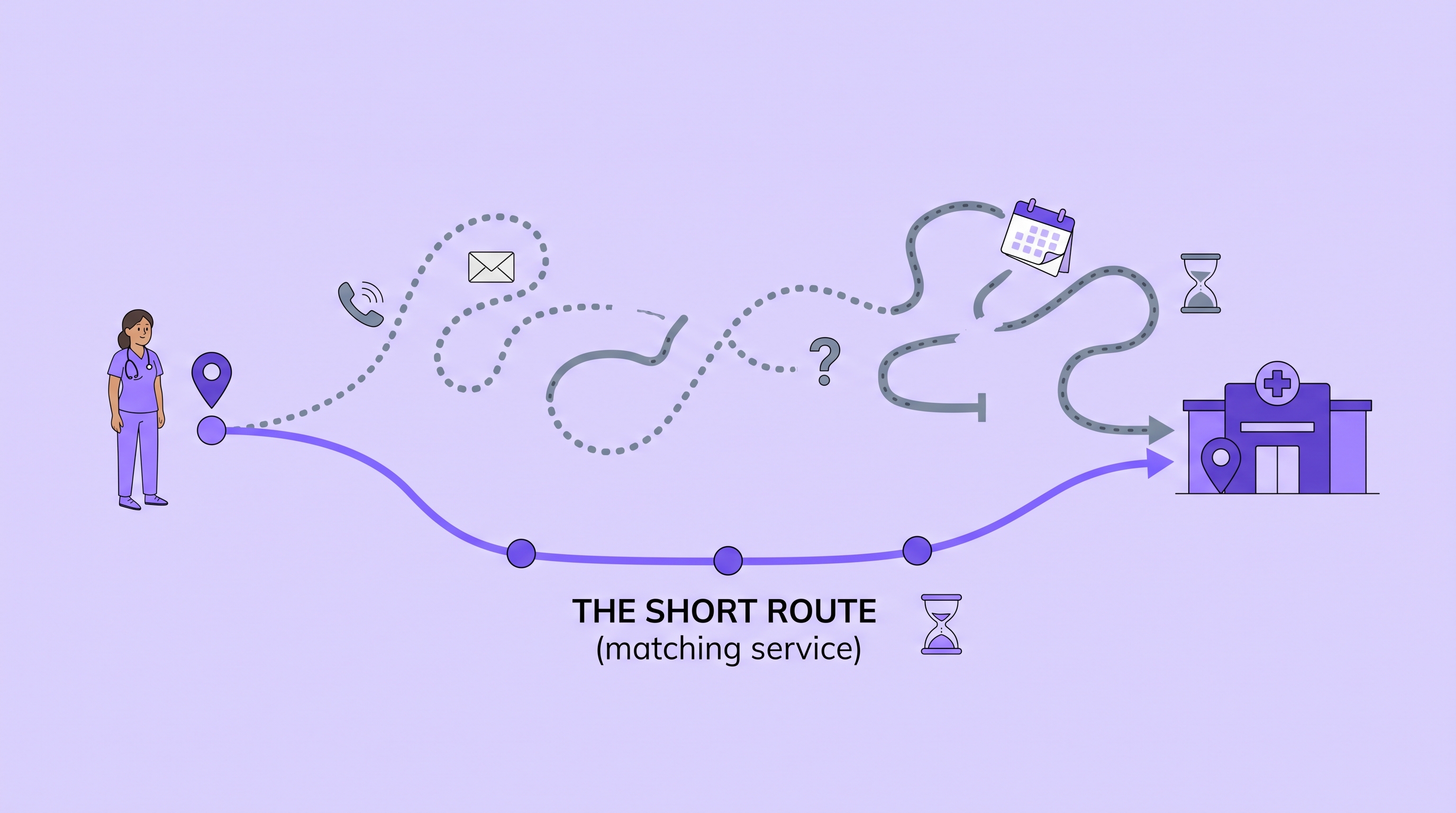
How long it takes to find an NP preceptor depends mostly on how you search and what you specialize in. Nurse practitioner students who search on their own, through phone calls, cold emails, and cold calling clinics, usually spend several months finding a preceptor, and some lose a semester. Through a preceptor matching service like NPHub, students can find an available preceptor in under 30 minutes when one is in the network, and the preceptor then has up to 7 business days to accept, with paperwork taking up to 14 business days, often sooner. Acute care, geriatrics, and women's health tend to take the longest because they have the fewest qualified preceptors, while psychiatric mental health stays competitive because it's the most requested rotation.
TL;DR: How long does it take to find an NP preceptor?
- Searching on your own takes months: Most NP students who rely on cold outreach spend several months finding a preceptor, and some sit out a semester waiting.
- Preceptor matching is faster: Through NPHub, you can find an available preceptor in under 30 minutes when one is in the network, because the search starts from vetted preceptors who have already agreed to teach. Acceptance takes up to 7 business days and paperwork up to 14, often sooner.
- Supply matters more than effort: Your NP specialty and location decide how many qualified preceptors exist near you. NPHub's network has 1,623 primary care preceptors and 1,195 in psychiatric mental health, but only 235 in acute care and 125 in geriatrics.
- A "yes" isn't your first day: After a preceptor agrees, the affiliation agreement, credentialing, and school approval still have to clear, and they are often the slowest part of the clinical placement process.
- Start 6–12 months early: Starting early leaves room for both the search and the paperwork. If your rotation is less than a few months away, widen your search or use a matching service.
How long does it take to find an NP preceptor?
It depends mostly on how you search. If someone you already know precepts, you can have an answer within days. Starting from zero with cold outreach usually takes months, and it takes the longest in scarce specialties and crowded metros. A preceptor matching service is faster because it starts with preceptors who have already agreed to teach.
The reasons cold outreach is slow are well documented. A survey of 334 nurse practitioners found 60% weren't precepting. Of those surveyed, 37.6% said no one had asked them, and 32.8% said their employer didn't allow it (Gigli & Gonzalez, 2022, as reported by Wiggins et al.). In other words, many phone calls go to people who can't say yes. Students feel this: in a survey of 232 graduate nursing students, 61% rated finding a preceptor an 8, 9, or 10 on a 10-point difficulty scale (McInnis, Schlemmer & Chapman).
Why some NP students find a preceptor in weeks and others take months
Your timeline is mostly set by supply before you send a single email. Four factors decide it.
Your NP specialty: Supply is uneven across specialties. In NPHub's network, primary care has 1,623 active preceptors and psychiatric mental health has 1,195, while acute care has 235 and geriatrics has 125. A family practice student and a geriatrics student can follow the same steps and end up months apart.
How selective the role is: Out of 18,314 healthcare professionals who applied to precept through NPHub, 2,435 were accepted and have completed at least one rotation, or 13.3%. Most applicants didn't meet the credentialing, site, and availability requirements schools set, or NPHub's own screening. Finding a willing clinician isn't the same as finding a qualified one.
Turnover: The average active preceptor stays in NPHub's network about 16.62 months, or 21.34 months for those who take repeat students. A preceptor who had an opening last term may be booked this term.
Location: Demand clusters in a few high-volume states. Texas leads with 2,696 completed rotations, followed by Florida (2,511) and California (1,585). Florida (716) and Texas (685) also have the most active preceptors. Dallas–Fort Worth (945 rotations), Los Angeles (893), and South Florida (787) are the busiest metros, which makes them the most competitive markets for preceptor availability. The pool of physicians who can precept is under strain too: HRSA projects a shortage of 70,610 primary care physicians by 2038, rising to 39% in nonmetro areas.
You'll likely search more than once. Only 35% of the rotations NPHub places are a student's first. Another 23% are second rotations, 23% are third, and 18.9% are fourth or fifth. A single rotation averages 101 to 149 clinical hours depending on specialty, so most students need several to reach their program's total. That means your search timeline repeats each time you need a new rotation.
How long it takes by NP specialty
FNP students have the most options, which also means the most competition. The student-heavy metros get crowded first. Clinics a short drive outside them often have openings.
PMHNP students are in the most crowded lane. Psychiatric mental health is the most requested rotation in NPHub's data, and although it also has the largest preceptor pool, demand keeps pace with it. HRSA projects a shortage of 43,810 psychiatrists by 2038. A University of Washington Rural Health Research Center analysis found that 74.4% of rural counties had no PMHNP at all in 2019. Telehealth sites help, since many programs count direct patient care delivered by telehealth. Confirm your program's limit before relying on it.
Women's health is scarce mostly because few practices take students. HRSA projects a shortage of 7,660 OB-GYNs by 2038, and 46% in nonmetro areas. Start this search before any other rotation.
Pediatric NP students have a relatively accessible path nationally, with 396 active preceptors in NPHub's network. The exception is areas where nearby universities already have the big children's hospitals locked into agreements. Community settings like FQHCs and school-based clinics are less contested there.
Acute care students can find a willing preceptor and still wait, because hospitals credential students on their own schedule. Start the hospital paperwork immediately, and keep an outpatient option available in case it stalls. Acute care rotations average 149 clinical hours, the most of any specialty, and only 235 preceptors in NPHub's network take them.
Geriatrics has the smallest pool of any specialty in NPHub's network: 125 active preceptors and 241 completed rotations. If your program allows adult-gerontology hours in internal medicine or long-term care, include those settings from the start.
Finding a preceptor is only half the timeline: paperwork and school approval
There are two timelines. The first runs until a preceptor says yes. The second runs until your first clinical day, and it's often longer than students expect. Between the yes and the first day, five things usually have to happen:
- Check state board eligibility: Some states set their own preceptor rules, such as Texas (22 TAC §219) and California (16 CCR §1484). Others leave it to your program and its accreditor. Check before you commit to a preceptor, not after.
- Collect the preceptor's documents: Programs typically want a current license, board certification, CV, and sometimes proof of malpractice coverage.
- Get the affiliation agreement signed: This contract is between the clinical site and your school, not you and your preceptor. It goes through legal review on both sides, which is why it's often the slowest step.
- Get school approval: Your clinical faculty reviews whether the site and preceptor meet the course's learning objectives.
- Confirm your clinical hours will count: The 2022 National Task Force Standards set a minimum of 750 direct patient care hours. Telehealth hours can count and simulation can't. Your program may require more.
These steps take time for a good reason: patient safety. Programs verify credentials and sites because students will be treating real patients under that preceptor's supervision.
A practical tip: in one preceptor survey, student EHR access was the top-rated factor in the decision to precept. Sorting out system access early helps you keep a preceptor who has already said yes.
How to shorten your search (without starting over)
Most of the time you save comes from starting sooner and making every contact count. For the month-by-month plan, see our NP clinical placement timeline. The short version:
- Start early: Six to twelve months before your clinical start date gives you room for outreach and paperwork.
- Ask your personal network first: Talk to colleagues, former instructors, managers, and recent graduates from your program. Among NPs who weren't precepting, over a third said they'd never been asked.
- Make your rotation request easy to say yes to: Preceptors rate a clearly defined role highly. Include your dates, total clinical hours, learning objectives, and your school's clinical coordinator contact in the first message.
- Track every contact: Keep a simple spreadsheet with who you contacted, when, how, and the response.
- Follow up every 7-10 days: Many clinicians who don't reply the first time just missed the message.
- Widen your location preferences around three months out: An extra 30 minutes of driving can open up a lot more potential preceptors.
If your clinical rotation starts in less than 4 weeks
Short notice changes the priorities:
- Be flexible: Offer any days, any hours, and a wider area.
- Loop in your practicum coordinator now: Tell them your start date and ask them to move any pending paperwork forward.
- Consider a matching service: If your graduation date is at risk, working from an active network is usually faster than more cold outreach.
Preceptor directories vs. preceptor matching services: what changes the timeline
Not every service shortens your search the same amount, and the difference comes down to who does the outreach.
A preceptor directory or NP preceptor finder gives you access to a list of preceptors. You still contact them, wait for replies, confirm eligibility, and handle the school paperwork yourself. Some platforms, such as Preceptor Point, use a searchable-network model where students browse and apply. See our Preceptor Point vs. NPHub comparison for how the two approaches differ.
A personalized matching service starts from vetted preceptors who have already agreed to teach, matches them to your specialty, location preferences, and school requirements, and handles the affiliation agreement. With NPHub, you review each preceptor profile and choose who you work with. A coordinator handles the back-and-forth with your school.
Before paying any service, ask:
- Time to first match: What's your typical time to a first clinical match in my specialty and state?
- School paperwork: Will you work with my school's affiliation agreement and paperwork requirements?
- Total cost: What's the full cost, and are there hidden fees for extra hours or rescheduling?
- Payment plan: Do you offer one?
- Refunds: What happens if the placement falls through or my school rejects the site?
Our guide to NP preceptor costs covers typical pricing.
Physician assistant students are in a different position. Their programs more often arrange clinical sites, and 43.7% of PA programs reported paying clinical sites in 2017. Most NP programs leave the search to the student. That gap is a large part of why NP students spend so long searching.
When to pay for a matching service vs. keep searching on your own
There's no single right answer. It depends on how much time you have and who you know.
- Search on your own if you have strong local contacts in your NP specialty and six or more months before your clinical start date.
- Use a matching service if your graduation timeline is at risk, you're in a scarce specialty, or you've already exhausted your network.
- Do both, with a deadline. Search on your own first, and pick a date, such as 90 days before your start date, when you'll switch to a matching service if you still don't have a confirmed preceptor.
If you're at that point, you can create a free NPHub account and see which vetted preceptors are available in your specialty and area today. Browsing is free, with no commitment.
Work at an NP program? The same supply problem affects programs, which spend faculty hours on placements while students wait. NPHub's university team works with NP programs to add preceptor capacity and cut the time students spend waiting for a placement, without adding coordination work for your faculty. Talk with our university team →
Frequently asked questions
How long does it take to find an NP preceptor on my own?
Most NP students searching on their own through phone calls, emails, and cold calling clinics spend several months finding a preceptor. Specialties with small preceptor pools, like acute care, geriatrics, and women's health, usually take the longest. Starting six to twelve months before your clinical start date leaves room for both the search and the paperwork.
How long does preceptor matching take?
It varies by service. Through NPHub, you can find an available preceptor in under 30 minutes when one is in the network for your specialty and area. The preceptor then has up to 7 business days to accept, and the paperwork takes up to 14 business days, often sooner, depending on specialty, location, and school requirements. Services that only provide a preceptor directory usually take as long as searching on your own, because you still do the outreach.
Can a matching service find a preceptor the same day?
Sometimes. When a vetted preceptor in your specialty has an opening near you, a match can happen within hours. School paperwork and approval still take time after that, so plan for your first clinical day to come later than the match.
Which NP specialty is hardest to find a preceptor for?
It depends on the type of scarcity. Psychiatric mental health and women's health are hard because demand far exceeds available sites. Acute care and geriatrics are hard because the pool of qualified preceptors is small. In NPHub's network there are 235 active acute care preceptors and 125 in geriatrics, compared with more than 1,600 in primary care.
Why does school approval take so long after I find a preceptor?
Your school has to verify the preceptor's license and certification, approve the clinical site, and sign an affiliation agreement with the site. That agreement usually goes through legal review on both sides, which makes it the slowest step. Starting it the same week you get a yes can save you weeks.
Do NP programs find preceptors for students?
Some do, but most NP programs expect students to find their own preceptors or offer only limited help. Accreditation standards say programs must ensure adequate clinical sites, but in practice many programs step in only after students have exhausted their own options. Ask your program directly what it provides.
How early should NP students start looking for a preceptor?
Six to twelve months before your clinical start date, and earlier for scarce specialties or crowded metros. See our NP clinical placement timeline for a month-by-month plan.
Article details
- Last updated
September 25th, 2026 - Fact-checked by
NPHub Clinical Placement Experts & Student Support Team- https://pmc.ncbi.nlm.nih.gov/articles/PMC12459130/
- https://pubmed.ncbi.nlm.nih.gov/35727194/
- https://ojin.nursingworld.org/table-of-contents/volume-26-2021/number-1-january-2021/the-significance-of-the-np-preceptorship-shortage-/
- https://bhw.hrsa.gov/data-research/projecting-health-workforce-supply-demand
- https://www.registerednursing.org/articles/psychiatric-nurse-practitioner-demand/
- https://www.nphub.com/blog/preceptor-requirements-by-state-a-nurse-practitioner-preceptors-guide
- https://nursingschoolsnearme.com/np-school-while-working/?utm_source=gemini#:~:text=They%20require%20your%20physical%20presence%20in%20a,programs%2C%20raised%20from%20the%20previous%20500%2Dhour%20standard.
Find a preceptor who cares with NPHub
Book a rotation.webp)
.jpeg)

.webp)
.jpeg)
.jpeg)

%20(3)%20(2).svg)
.webp)