
.png)



.webp)
TL;DR
- Speed and quality are not a trade-off: Nearly all the delay worth recovering lives in process friction, paperwork that sits, sourcing that restarts each term, compliance handled late, not in careful vetting. Fixing the friction costs nothing in quality, while cutting vetting to move faster costs far more one accreditation cycle later.
- Diagnose before you fix: Time-to-placement is the elapsed time from a student's need to a confirmed, compliant rotation start, and the delay concentrates in a few predictable phases: sourcing, agreement execution, and student compliance. Map the clinical placement process end to end and baseline it before changing anything.
- A vetted pipeline is the single biggest lever: Building qualified preceptors ahead of demand turns placement into matching from a ready pool rather than scrambling to fill a slot under a deadline, which shortens timelines and protects quality at the same time.
- The fastest wins are administrative: Standardized, pre-negotiated affiliation agreements and student compliance that runs parallel to sourcing recover weeks of calendar time without touching a single quality standard.
- One vetting standard is what keeps speed safe: A repeatable, clinician-led vetting bar applied to every placement, with the clinical site approved separately from the preceptor and both re-verified through the rotation, is what lets quality and speed compound instead of compete. It is the model NPHub is built around.
When a program sets out to reduce NP student time to placement, the first worry is usually quality. The assumption is that speed and rigor pull in opposite directions, and that the only way to place students faster is to lower the bar on preceptors or sites. In practice, the reverse is closer to the truth. Nearly all the delay worth recovering lives in process friction: paperwork that sits, sourcing that restarts every term, compliance steps that happen in the wrong order. The vetting itself is rarely the bottleneck.
Earlier pieces in this series made the strategic case for treating clinical placement as infrastructure rather than logistics. This one is the tactical playbook: where the time actually goes in the clinical placement process, and how to get it back without loosening a single standard.
If you would rather work through your own program's timeline directly, you can book a call with the NPHub university team to map where your placement process is losing time.
What is time-to-placement, and why does it matter for NP programs?
Time-to-placement is the elapsed time from when a nurse practitioner student needs a clinical rotation to when a confirmed, compliant rotation begins. It is the operational metric that quietly governs graduation timelines, program throughput, and the tuition cycles tied to both. For advanced practice nursing programs, it is one of the few numbers that touches academics, operations, and reputation at once, which is exactly why it deserves to be measured rather than assumed.
How does slow placement compound across a cohort?
One late placement affects one student. Slow placement as the default affects everyone behind them. When even a fraction of a cohort waits an extra term to start clinical rotations, graduation timelines slip in aggregate and the number of students a program moves to completion each year drops.
The cost is rarely visible in any single case, which is why it goes unmanaged. A useful way to see it: count how many students in the last three cohorts started their first rotation on the originally scheduled date. The gap between that number and the cohort size is your throughput leak.
What KPIs should programs track for placement speed?
A short set of numbers tells you most of what you need:
- On-time rotation starts: the share of students who begin each rotation on the originally planned date.
- Time-to-placement: median days from request to confirmed, compliant start.
- Affiliation agreement turnaround: days from first draft to full execution.
- Students sourcing their own clinical placements: a rising percentage signals the program's placement process is falling behind demand.
Set a baseline before you change anything. You cannot tell whether a fix worked without the before.
Can NP programs reduce time-to-placement without lowering quality?
Yes. Most delay comes from a disorganized process, not from careful vetting. Time lost to unsigned agreements, duplicated outreach, or late compliance is fully recoverable at no cost to quality. Time "saved" by skipping site approval or waving through any available preceptor is not a saving at all. It converts into compliance findings and weak clinical experiences that cost far more to fix later.
What separates a safe accelerator from a false shortcut?
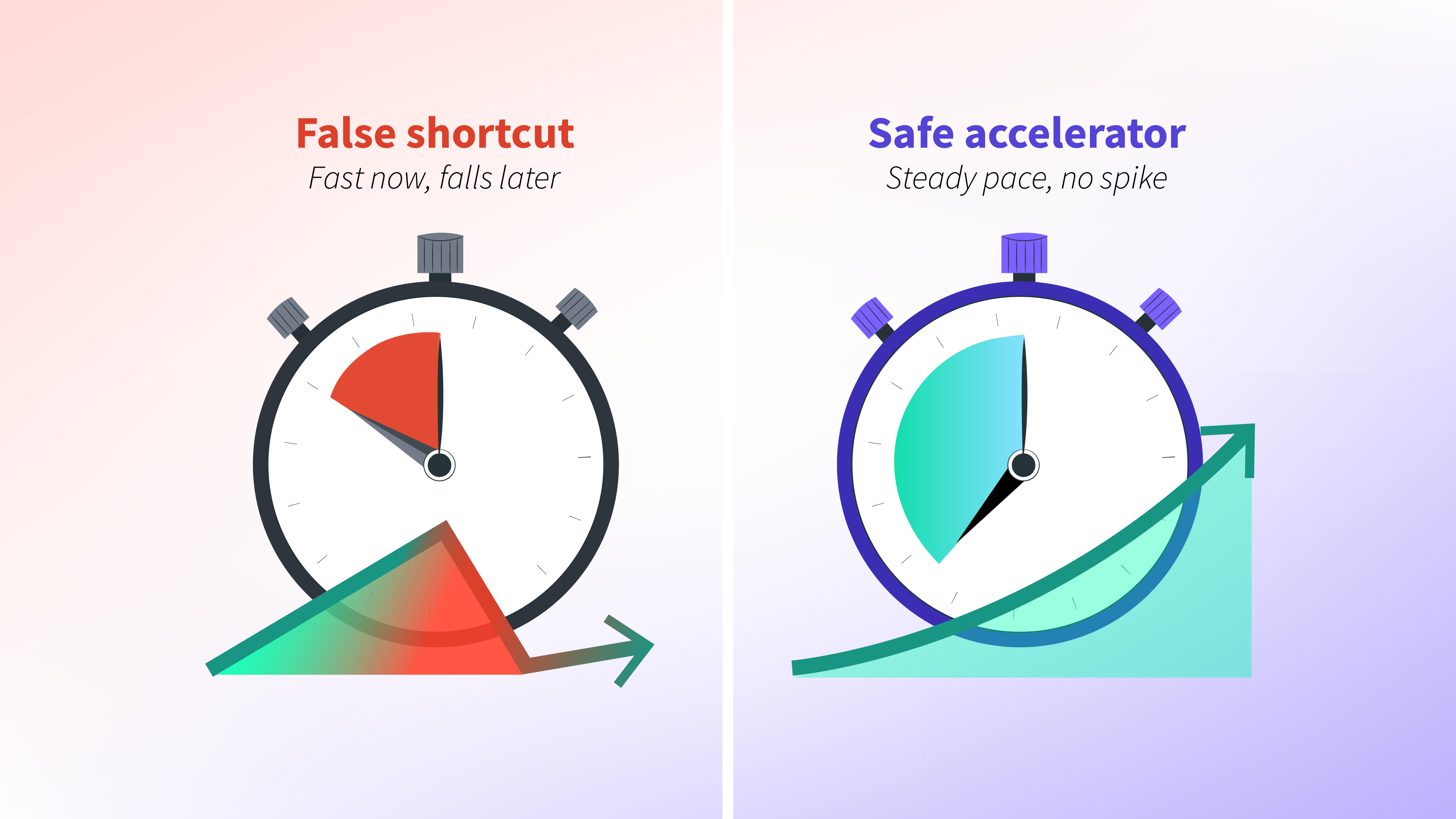
The distinction is simple: safe accelerators remove friction, false shortcuts borrow against quality.
Everything that follows is either a safe accelerator or the guardrail that keeps the accelerators honest. The reason the distinction matters is that false shortcuts feel productive in the moment. A placement gets filled. A box gets checked. The bill arrives one accreditation cycle later, when a reviewer asks how a preceptor was qualified and the answer is thin.
Where do clinical placement delays actually come from?
Delay concentrates in a few predictable phases, not evenly across the process. In most NP programs, the time sinks are sourcing (finding a willing, qualified preceptor), agreement execution (getting the affiliation agreement signed), and student compliance clearance (immunizations, background checks, onboarding). You cannot fix what you have not located, so the first move is to map the process end to end.
Map the clinical placement process
Lay out every step a placement passes through, with a rough time estimate for each:
- Request: a student's rotation need enters the queue.
- Sourcing: identifying a preceptor in the right specialty and location.
- Vetting: confirming licensure, board certification, and clinical fit.
- Site approval: confirming the clinical site itself can host a student.
- Affiliation agreement: drafting, negotiating, and executing the contract.
- Student compliance: immunizations, background checks, and required documentation.
- Rotation start.
Seeing the steps in one line makes the stalls obvious. Most programs are surprised by how much calendar time sits between steps 4 and 5.
How do you baseline your current time-to-placement?
Pull the last two or three cohorts and measure median days for each phase. The phase with the widest spread, not just the longest average, is usually where the process is least controlled. Wide variance means outcomes depend on who happened to handle the case rather than on a repeatable clinical placement process.
Who should you ask about friction points?
The people inside the process see friction that dashboards miss. Short, specific questions work best: Where do you wait on someone else? What do you redo most often? Clinical coordinators tend to point to paperwork loops, faculty to sourcing dead ends, and preceptors to slow or unclear communication from the program. Preceptors expect a smooth, professional handoff, and when they do not get one, they may decline the next student.
How can programs build a preceptor pipeline ahead of demand?
A continuously maintained, vetted preceptor pipeline is the single largest lever for speed, and it protects quality at the same time. When qualified preceptors are identified before a cohort needs them, placement becomes a matter of matching from a ready pool rather than scrambling to fill a slot under a deadline. Speed and standards stop competing, because the vetting already happened.
Rolling pipeline across specialties
Build the bench in areas where demand is predictable and in specialties where preceptor shortages are hardest: primary care, family practice, women's health, psychiatric mental health (PMHNP), and acute care. Depth in each area gives a program redundancy, so a single preceptor's schedule change does not strand a student. It also widens student exposure to diverse patient populations, which strengthens the clinical experience rather than just filling clinical hours.
Separate preceptor recruiting from coordination
Sourcing and coordination are different jobs on different clocks. Coordination is reactive and deadline-driven; recruiting is proactive and relationship-driven. When one person owns both, recruiting always loses to the next urgent deadline. Programs that treat recruiting as its own discipline, a point the piece on why preceptor recruiters are program infrastructure develops in full, build capacity steadily instead of in panicked bursts.
How do you target sites and health systems deliberately?
Rather than reopening outreach every term, prioritize a standing list of clinical sites worth a long-term relationship: outpatient clinics, specialty clinics, urgent care centers, and larger health systems. A single agreement with a multi-site system can unlock many placements at once, which does more for capacity than dozens of one-off asks.
Understanding why clinicians agree to precept makes this outreach convert better. Research on NP preceptors has found that a clearly defined role and supportive colleagues matter more to them than payment or gifts, so outreach that spells out expectations and makes precepting easy tends to land. One survey of practicing nurse practitioners found that among those not currently precepting, the most common reason was simply that no one had asked them. A structured professional network of preceptors closes that gap by asking, consistently and well.
Building and maintaining a vetted pipeline is the piece most programs have the least capacity to own in-house. If that is where your time-to-placement slips, the NPHub university team can walk through what a dedicated recruiting function would look like for your specialty mix and region. See how it would work for your program.
Speed up affiliation agreements
Affiliation agreements are usually the most recoverable delay in the entire process, because the lag is administrative rather than substantive. Standardizing and pre-negotiating the paperwork removes weeks of calendar time without touching a single quality standard.
How do standardized templates and addenda help?
Maintain one clean master template plus a small set of pre-approved addenda for recurring situations, such as added sites, insurance language, or data-handling clauses. When a new placement matches a known scenario, the document is ready rather than redrafted from scratch.
Should programs pre-negotiate master agreements?
Yes, wherever a health system hosts students regularly. Negotiate a master affiliation agreement once and execute placements under it thereafter. The heavy legal review happens a single time instead of per student.
How do you keep agreements from stalling in review?
Two habits do most of the work:
- Set a review SLA with legal, for example, five business days for a standard template, so a contract has a clock on it.
- Track each agreement by milestone: drafted, sent, in review, signed. A visible tracker keeps a contract from disappearing into an inbox, which is where most agreement delay actually happens.
How do you prevent lapsed agreements from delaying starts?
A lapsed agreement stalls a rotation as surely as a missing one. Keep a calendar of expiration and renewal dates and start renewals well ahead, so an expired contract never becomes the reason a student cannot begin.
How can programs get students rotation-ready faster?
Student compliance clearance is a large, controllable share of time-to-placement, and it does not have to wait until after the match. Run it in parallel with sourcing so that the day a preceptor is confirmed, the student is already cleared to start. Clinical hours are the bridge between classroom knowledge and the national certification exam, and every one has to be logged and defensible, so this step is worth getting right early.
Pre-rotation compliance checklist?
Give students a single checklist at the start of the term, well before a placement is confirmed: immunization records, background check, CPR, HIPAA, and any site-specific clinical requirements. Early planning here removes the last-minute scramble that pushes start dates. Many NP students work as registered nurses and carry real personal responsibilities alongside school, so a program that front-loads compliance removes friction they cannot easily absorb and helps them plan realistically around clinical requirements.
Centralizing documentation and ownership speeds placement
Handoff delays are the ones no one tracks, and everyone feels. A single source of truth, one accountable owner, and real-time visibility into capacity remove the gaps where a placement sits waiting for someone to pick it up. The goal is a clinical placement journey a coordinator can see end to end.
What belongs in a single system of record?
Keep preceptor credentials, affiliation agreements, site approvals, and student compliance in one place rather than scattered across inboxes and spreadsheets. A standardized preceptor packet, what the site needs from the program and what the program needs from the site, turns a long back-and-forth into a single exchange.
Why does placement need one clear owner?
When everyone is responsible, no one is. Assign a named owner for the clinical placement process, even when the work is shared, so nothing falls between roles. This is also what makes the KPIs meaningful, because someone owns the number.
Keep quality intact while moving faster
Speed is only safe when vetting scales with it. The mechanism is a single, repeatable, clinician-led vetting standard applied to every placement, plus ongoing re-verification so a fast placement stays a sound one. Get this right and quality and speed stop trading against each other, because the same system delivers both. This matters well beyond graduation: as nurse practitioners move toward independent practice in a growing number of states, the quality of their clinical training carries over into how they care for patients for years.
Consistency is what makes speed defensible. Every preceptor should pass the same checks no matter how quickly the placement came together:
- Active, unencumbered license verified with the state board.
- Board certification confirmed through the American Nurses Credentialing Center or the AANP Certification Board.
- Specialty and scope confirmed to fit the rotation's learning objectives.
A licensed preceptor is the floor, not the finish line. Fit matters as much as credentials.
Why approve the clinical site separately from the preceptor?
A strong clinician at an unprepared site still produces a weak rotation. Approve the site on its own merits: patient volume, the range of diagnostic tests and physical exams a student will encounter, and whether the caseload lets a student practice developing treatment plans rather than only observing them. An outpatient clinic that manages chronic disease day to day gives a student the repeated exposure that builds real clinical skills. The right clinical environment is what turns clinical hours into clinical reasoning, and gives a student the caseload they need to demonstrate competence rather than just complete hours.
Why re-verify through the rotation?
Vetting is not a one-time event. Licenses change, scopes shift, and a site's patient mix can move over a term. Re-checking active preceptors and sites on a set cadence catches those changes before they disrupt a student mid-rotation, and keeps documentation current as the rotation progresses.
What does this look like in practice?
This is the approach NPHub is built around, and it exists precisely so programs do not have to choose between fast and defensible. Board-certified nurse practitioners source and vet every preceptor, so fit is judged by someone who has supervised students and knows what a given specialty track demands. Each prospective preceptor completes a structured NP-to-NP conversation; credential and license integrity screening is standard; clinical sites are approved separately from the individuals in them; and active preceptors and sites are re-verified every 45 days. The documentation accreditors expect accumulates as a byproduct of that work rather than being reconstructed under deadline. Quality and speed compound instead of competing.
Which metrics tell you it's working?
Define time-to-placement as the core KPI, then track a small set of supporting numbers monthly. A handful of well-chosen metrics beats a crowded dashboard no one reads. These numbers are proxies for student success and for the quality of clinical education a program delivers.
How often should you review the numbers?
Start from the baseline you measured while diagnosing, and review the same numbers monthly so you can see movement rather than a single snapshot.
Which supporting KPIs are worth tracking?
- Median time-to-placement, overall and by specialty.
- On-time rotation starts.
- Affiliation agreement turnaround time.
- Share of students self-sourcing their placements.
- Re-verification compliance: the percentage of active placements re-checked on schedule.
- On-time graduation rate, the outcome all of this rolls up to.
How do you close the loop with preceptors?
After each rotation, ask preceptors a few short questions about the program's communication and support. Their answers predict retention, and retention is what keeps the pipeline deep. A program that is easy to work with earns the next placement; one that is not, does not. Feed what you learn back into the process and iterate.
How can programs avoid delays when a placement falls through?
Even a well-run process loses a placement occasionally. A preceptor's schedule changes, or a site reorganizes. Building slack into the system keeps a single failure from stalling a student's clinical rotations.
Having backup sites and standby preceptors
A short bench of vetted backup preceptors and approved sites turns a fallen-through placement into a swap rather than a restart. Because they are already vetted, using them costs nothing in quality.
Keep building the pipeline to provide a safety net
Keep sourcing even when the current cohort is placed, and hold a small amount of reserved capacity for overflow. The pipeline that fills next term's placements is also the one that rescues this term's surprises.
Conclusion: Speed is a byproduct of a well-built system
The programs that place students fastest are the ones that removed the friction and made quality repeatable, so that a fast placement and a defensible placement are the same placement. Reducing NP student time to placement is less about pushing harder and more about building a process that does not stall.
A short starting checklist:
- Baseline your time-to-placement by phase before changing anything.
- Standardize and pre-negotiate your affiliation agreements.
- Front-load student compliance so it runs parallel to sourcing.
- Build a pre-vetted preceptor pipeline ahead of demand.
- Hold one clinician-led vetting standard for every placement, fast or slow.
If your program is working through where its clinical placement process strains, and what a dedicated recruiting and vetting function would change, the NPHub university partnerships team works directly with NP programs on exactly this. Get in touch with our university team to talk through your cohort size, specialty mix, and graduation timeline.
Frequently asked questions
What is a good time-to-placement benchmark for NP programs?
There is no single national benchmark, because timelines vary by specialty, region, and how a program sources. The more useful target is internal: measure your current median, then work to shorten it cohort over cohort. On-time rotation starts are often a clearer goal than a fixed day count, since it ties directly to graduation timelines.
Does reducing time-to-placement lower placement quality?
Not if the speed comes from fixing process friction rather than cutting vetting. Recovering time lost to unsigned agreements, duplicated outreach, or late compliance costs nothing in quality. Quality drops only when a program skips site approval, places with unvetted preceptors, or drops re-verification to move faster.
How can programs reduce time-to-placement without hiring more faculty?
By moving sourcing off faculty and into a dedicated function, and by removing administrative delay through standardized agreements and front-loaded compliance. Most recoverable time is process time, not headcount. Faculty hours then return to teaching and supervising students rather than cold outreach.
What is the single fastest lever to shorten time-to-placement?
A vetted preceptor pipeline built ahead of demand. When qualified preceptors are already identified and cleared, placement becomes matching rather than searching, which removes the largest and least predictable delay in the process. It also protects quality, since the vetting happened before any deadline pressure.
Should NP students find their own clinical placements to save time?
It rarely saves time overall, and it shifts cost and risk onto the people with the least leverage. Student self-placement widens equity gaps between well-connected students and isolated ones, produces uneven clinical experiences, and thins the documentation a program needs for accreditation. Some students end up paying out of pocket for placements the program could not provide. A program-owned process produces more consistent and more defensible outcomes.
How long does it typically take to secure an NP clinical placement?
It ranges from a few weeks to several months, depending on specialty, geography, and how the program sources. Programs relying on ad-hoc outreach or student self-placement tend to see the longest and least predictable timelines. A maintained pipeline shortens the wait because the program is not starting from zero each term.
Find a preceptor who cares with NPHub
Book a rotation.webp)
.jpeg)

.webp)
.jpeg)


%20(3)%20(2).svg)
.webp)