
.png)



.webp)
When NP program leaders hear "managed clinical placement" or "outsourced placement," the picture that comes to mind is often a marketplace: a service that matches a student with an available preceptor and then disappears. A fully managed clinical placement model is a different thing entirely, and that difference determines whether the placement becomes more defensible or simply less visible.
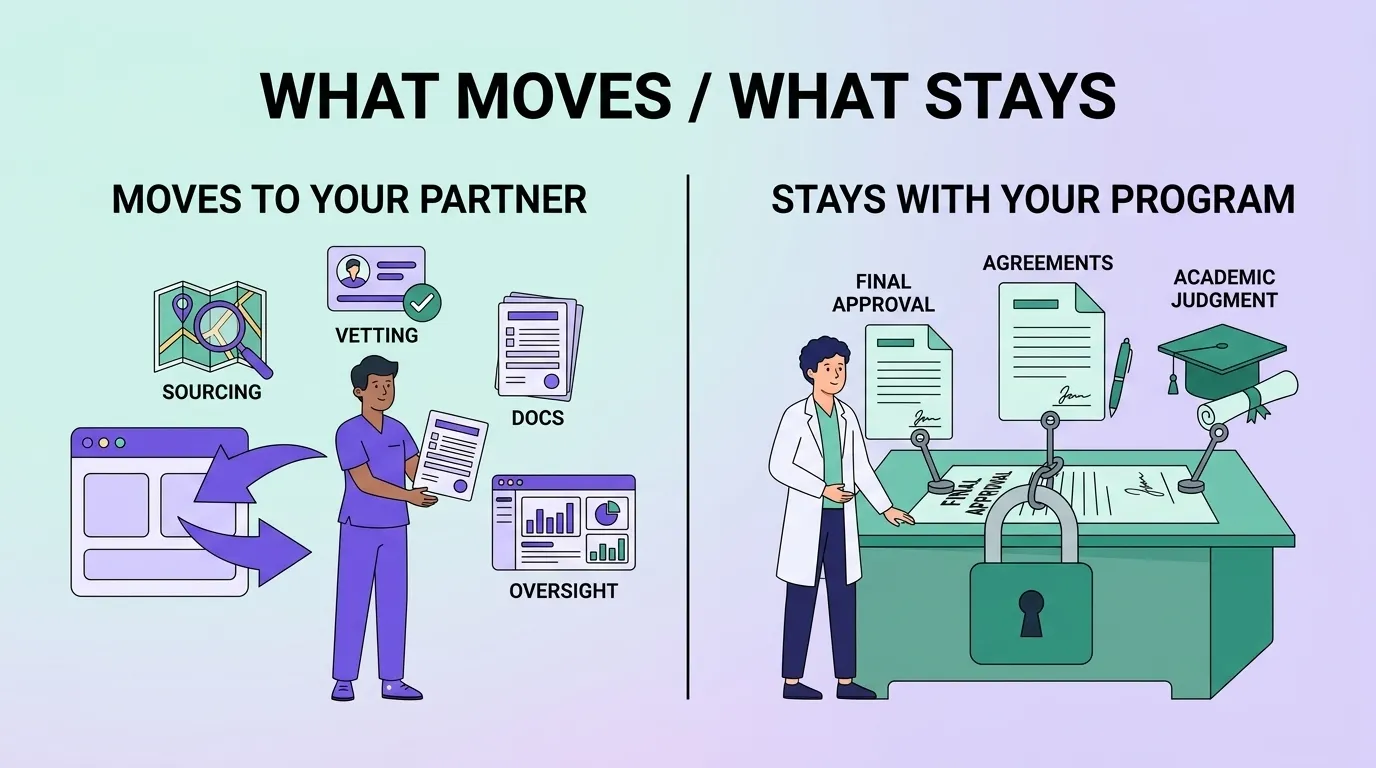
This piece defines what a fully managed model entails, how the placement process runs end to end, and where authority lies once a program brings in a partner. The short version is that a fully managed model does not move clinical placements out of the program's hands. It moves the sourcing, vetting, and documentation off faculty desks while leaving academic judgment and final approval exactly where accreditation expects them, inside the program.
The short version
- Managed is not the same as a marketplace: A marketplace fills one slot and steps away. A fully managed model owns the whole placement process and keeps it running across cohorts.
- A fully managed model covers the full lifecycle: Sourcing, clinician-led vetting, clinical site approval, affiliation agreements, onboarding, ongoing oversight, and offboarding run as one continuous process with a single owner rather than a set of tasks handled by whoever has time.
- Control stays with the program: Faculty keep the responsibilities accreditation assigns them, affiliation agreements go through the school's own approval process, and the program has the final say on every preceptor and clinical site.
- The payoff is capacity, speed, compliance, and faculty time: Placement shifts from a per-term scramble to a repeatable operational process, which allows a program to grow without overloading faculty.
- Vetting is what makes added capacity safe: More clinical sites only help if they hold up under CCNE or ACEN review, so clinician-led screening and ongoing re-verification are what turn raw capacity into defensible capacity.
If your program is weighing whether to move clinical placement work off faculty desks, the NPHub university partnerships team works with NP programs on exactly that question. It can be a useful conversation even if a fully managed model turns out not to be the right fit.
What is a fully managed clinical placement model?
A fully managed clinical placement model is an arrangement in which an external partner owns the end-to-end clinical placement process, from sourcing preceptors and approving clinical sites to securing affiliation agreements and maintaining documentation, while the program retains academic authority and final sign-off on every match. It treats placement as ongoing infrastructure rather than a task a coordinator restarts each term.
It helps to see the model as one point on a spectrum of how nursing clinical placements get handled:
- Self-managed (in-house): Faculty and clinical coordinators do everything (outreach, verification, affiliation agreements, and scheduling). The program maintains full control, but capacity is capped by how many hours those people have available.
- Partially outsourced: A partner covers overflow or specific specialties where the program consistently runs short, while the program still runs the core placement process itself.
- Fully managed: The partner runs the entire lifecycle as continuous infrastructure, and the program approves, oversees, and evaluates rather than sourcing.
The distinction that matters most is that a fully managed model is a model, not a one-time transaction. A vendor completes a task and closes it out. A fully managed partner operates the placement process on the program's behalf, term after term, and is accountable for the whole thing rather than a single introduction.
Clinical placement management: What’s included in a fully managed model?
A fully managed model covers every step from sourcing a preceptor to closing out a clinical rotation. Instead of a series of disconnected administrative processes handled by different people, the work runs as one continuous process with clear ownership and a single point of coordination.
Here is the placement process end to end:
- Continuous sourcing: A pipeline of potential preceptors is built ahead of demand across specialties and different healthcare settings, so a placement request starts from a warm list rather than from zero.
- Clinician-led vetting: Experienced NPs evaluate scope of practice, specialty alignment, patient population, and teaching readiness. Assessing whether a clinical setting fits a rotation is a clinical judgment, not an administrative one.
- Credential and license integrity screening: Active licensure and board certification are verified, and disciplinary history is reviewed, so a preceptor's qualifications hold up later.
- Clinical site approval: The clinical site is approved on its own merits, including administrative readiness, patient care mix, and documentation, separately from the individual preceptor.
- Affiliation agreements: Contracts go through the program's own approval process and align with its requirements rather than relying on a vendor's template alone.
- Matching to program requirements: Specialty, required clinical hours, geography, and student fit are aligned to the program's clinical curriculum and learning outcomes.
- Onboarding and compliance: Immunizations, background checks, HIPAA and site clearances, and other clinical readiness requirements are tracked so records are audit-ready by default rather than assembled under pressure.
- Ongoing oversight: Check-ins at the start, midpoint, and end of each clinical rotation surface issues early, and active preceptors and sites are re-verified on a set cadence so the placement that was sound in week one stays sound.
- Offboarding and evaluation: Completed clinical hours, preceptor evaluations, and records of student progress are captured and filed at the close of each rotation.
- Replacement when needed: If a site or preceptor does not hold up, a replacement is sourced to prevent the student from having to restart their clinical hours.
Effective communication and coordination across student, preceptor, and program run through that single owner, which is what keeps ordinary scheduling conflicts from turning into missed start dates. The point of the model is not that any one of these steps is novel. It is that they stop being ten separate scrambles and become one process a program can rely on.
What does a fully managed model change for the program?
A fully managed model changes clinical placement management from an unpredictable, per-term scramble into a repeatable operational process. The operational gains show up in five areas, and two more that the institution feels directly: faculty time and accreditation posture.
The five gains compound across cohorts:
- Capacity: Pipeline depth grows continuously, so site availability expands rather than resetting every term.
- Speed: Time from request to confirmed placement shortens because sourcing starts from a vetted list rather than cold outreach.
- Compliance: Documentation is standardized and audit-ready as a byproduct of how the work already runs.
- Quality: Preceptors are evaluated for teaching readiness and clinical fit, which protects learning outcomes rather than just filling a slot.
- Reliability: Relationships with experienced preceptors are maintained across cohorts instead of rebuilt from scratch each term.
The faculty effect is the one programs tend to underestimate. When sourcing has no dedicated home, it flows to faculty on top of teaching, curriculum, and clinical oversight, and every hour spent chasing preceptors is an hour not spent on the work faculty were hired to do. A fully managed model returns that time. The accreditation effect follows from the same structure: because qualification records, affiliation agreements, and clinical site approvals are maintained continuously, the documentation a reviewer asks for already exists.
The wider case for why a single delayed rotation ripples through faculty workload, tuition timing, and enrollment growth is worth reading alongside this piece, as is the honest accounting of what ad hoc placement quietly costs a program. Treated as strategic planning rather than logistics, placement capacity becomes something a program can build toward on purpose.
Does a fully managed model mean giving up control?
No. Done well, a fully managed model increases a program's control rather than reducing it. The program keeps final approval for every preceptor and clinical site, routes affiliation agreements through its own process, and faculty retain the academic responsibilities accreditation assigns to them. What changes is who does the sourcing and paperwork, not who holds authority.
The roles accreditation cares about stay exactly where they are. Program faculty remain responsible for meeting program outcomes and for evaluating student outcomes, including the preceptor, the setting, and the clinical rotation itself, and for communicating the level, intended progression, and objectives of each rotation to the preceptor. The preceptor still plays a crucial role in guiding clinical skills, diagnostic reasoning, and treatment in the clinical setting, and in evaluating the student against predetermined objectives. The graduate student still owns their own compliance and communication with faculty and site. A fully managed partner steps into none of those roles. It absorbs the upstream sourcing burden that has no natural home in the program and, if left unowned, defaults to faculty.
The safeguard that makes this real is the approval workflow. A quality partner routes every match through the school's own approval process, so if a preceptor or site does not meet program requirements, it is not assigned, and the partner sources an alternative rather than pushing an unsuitable fit. Control, in other words, is not something the program trades away. It is something the model is built to preserve.
If you want a concrete sense of what a fully managed model would change for your program, the NPHub university team can walk through it with you: where faculty time is currently going, where placements are slowing down, and what audit-ready documentation and a maintained pipeline would do for your capacity. There is no commitment attached, and it is useful even if you decide to keep placement in-house.
How is a fully managed model different from a preceptor matching service?
A preceptor matching service connects a student with an available preceptor and then steps away. A fully managed model sources continuously, vets through clinical judgment, approves clinical sites separately, and maintains those relationships across cohorts. The first fills a slot. The second functions as program infrastructure.
The practical tell is what happens after the match. A matching service's job ends at the introduction, so documentation, site approval, and any mid-rotation problem fall back on the program or the student. A fully managed model treats the match as one step within a process it continues to own, which is why the records remain complete and the relationships with healthcare providers compound over time rather than reset.
Both are technically outsourcing. Only one of them maintains quality control and documentation to a standard an accreditation review can lean on. For the build, buy, or leave-it-to-students decision, the pros, cons, and screening criteria are laid out in our guide on whether NP programs should outsource clinical placements.
When does a fully managed model make sense (and when doesn't it)?
A fully managed model tends to make sense when sourcing has outgrown faculty capacity, when accreditation documentation is thin or uneven across cohorts, or when a program wants to grow enrollment without adding instructional lines. It makes less sense when a program already has strong, well-documented internal placement capacity, or when it only needs occasional overflow help for a handful of rotations.
It helps to be honest about the alternatives. Most programs already default to outsourcing clinical placements to their own students, who self-place and sometimes pay out of pocket for rotations the program cannot provide. A 2020 survey of NP students found that roughly 14 percent had to secure their own preceptors, and that most rated finding one as extremely difficult. So the choice is rarely "keep it free in-house or pay a partner." In-house sourcing looks free because it carries no line item, but priced against faculty hours, faculty turnover, and the tuition a delayed graduation defers, it is frequently the more expensive option. It simply spreads the bill across enough departments that no single owner sees the total.
How NPHub delivers a fully managed model
NPHub is built as a recruiting and placement partner, and its fully managed model runs on clinician-led oversight, structured NP-to-NP vetting, credential and license integrity screening, separate clinical site approval, and re-verification every 45 days.
Five pillars define the approach:
- Clinician-led oversight: Board-certified NPs source and vet every preceptor, so fit is treated as a clinical decision first and an administrative one second.
- Structured NP-to-NP vetting interview: Every prospective preceptor completes a focused conversation with a board-certified NP covering practice location, scope, specialty, patient population, and teaching readiness.
- Credential and license integrity screening: Active licensure, board certification, and disciplinary history are reviewed for every clinician in the network, with any restriction triggering disqualification.
- Clinical site approval: The healthcare setting that hosts a student is verified for administrative readiness and program alignment, separately from the individual preceptor.
- Continuous re-verification: Active preceptors and clinical sites are re-checked every 45 days, because shifts in practice settings, acuity, and staffing turnover, as well as significant changes mid-rotation, are easier to manage when they are caught early.
That vetting is deliberately selective, and the numbers reflect it. Of more than 18,314 clinicians who have applied to precept through the NPHub network, roughly 2,435 were accepted, an acceptance rate near 13.3 percent, across more than 14,000 rotations in 45 states. Selectivity at that scale is only workable because recruiting is a full-time function rather than a task squeezed between other duties.
A few operational details round out the model. Through the Perfect Preceptor Promise, if a site does not meet expectations or a student feels unsafe, NPHub sources a replacement at no additional cost. Pricing is unbundled and flat-rate, with no revenue share and shorter contracts, so a program pays for the services it actually uses rather than a bundle it does not. And check-ins run at the start, midpoint, and end of each rotation, so issues surface early rather than at final evaluation. The intent is infrastructure a program can lean on, with faculty kept out of the sourcing business and students kept off the hook for placements the program should own.
Infrastructure the program owns, not responsibility handed off
A well-executed, fully managed clinical placement model does not hand off responsibility. It keeps the clinical placement program owned and defensible during accreditation review, off faculty's plate, and off students' backs. The academic judgment stays with the program; the sourcing, vetting, and documentation move to a function built to carry them.
NP enrollment continues to climb, and the demand for advanced practice nurses across the nursing profession shows no sign of easing. The programs that treat placement as core infrastructure rather than logistics are the ones positioned to grow without straining the quality of the clinical education they provide.
The NPHub university team, led by Director of Business Development Nicholas Carrizales, offers a free consultation to talk through where your placement process is holding up, where it is straining, and what a program-owned, fully managed model would change about both. It is a conversation, not a pitch, and you are welcome to start it whenever the timing fits your team.
Frequently asked questions
What is a fully managed clinical placement model?
A fully managed clinical placement model is an arrangement in which an external partner runs the entire placement process on a program's behalf, including sourcing and vetting preceptors, approving clinical sites, securing affiliation agreements, and maintaining documentation, while the program retains academic authority and final approval. It treats placement as ongoing infrastructure rather than a per-term task.
Does a fully managed model reduce a program's control over clinical placements?
No. A well-built model preserves control by routing every match through the school's own approval process and leaving faculty responsible for program outcomes, student evaluation, and rotation objectives. The partner takes on sourcing, vetting, and paperwork, not academic judgment or final sign-off.
How is a fully managed model different from partially outsourcing placement?
Partial outsourcing brings in help for overflow or specific specialties while the program still runs the core placement process. A fully managed model runs the entire lifecycle continuously, from sourcing through offboarding, so the program approves and oversees, rather than coordinating, the day-to-day work.
What happens mid-rotation if a preceptor or clinical site falls through under a managed clinical placement process?
Because active preceptors and sites are re-verified on a set cadence and checked at the midpoint of each rotation, changes in license status, scope, or setting tend to surface early. When a site does not hold up, a fully managed partner sources a replacement so the student's completed clinical hours are protected rather than lost.
Can a program keep some placements in-house and manage others through a partner?
Yes. Many programs run a hybrid arrangement, keeping placements they already source well internally and handing the specialties or geographies where they consistently run short to a partner. The key is that a program point person still owns the relationship and the affiliation-agreement workflow.
How does a program transition to a fully managed model?
A common approach is to pilot with a single cohort or specialty cluster before a full rollout, assign an internal point person to own the partner relationship, and judge the pilot on real metrics: time from request to confirmed placement, the share of rotations that started on schedule, documentation completeness at audit standard, and faculty hours returned to teaching.
Does a fully managed model work for distance or multi-state NP programs?
It can, and multi-state and distance programs are often where the need is sharpest, since faculty networks rarely stretch across every region a cohort lives in. A partner that maintains a pipeline across many states and approves clinical sites separately from preceptors is built to cover that spread, which also matters as CCNE expectations around clinical site preparation for distance nursing education programs have tightened.
Find a preceptor who cares with NPHub
Book a rotation.webp)
.jpeg)

.webp)

.jpeg)

%20(3)%20(2).svg)
.webp)