
.png)



.webp)
TL;DR
- A strong network is judged by what it reliably produces, not how many names it holds. One filled rotation solves one problem. A durable nurse practitioner clinical placement network solves the same problem every term, for every cohort, without starting from zero.
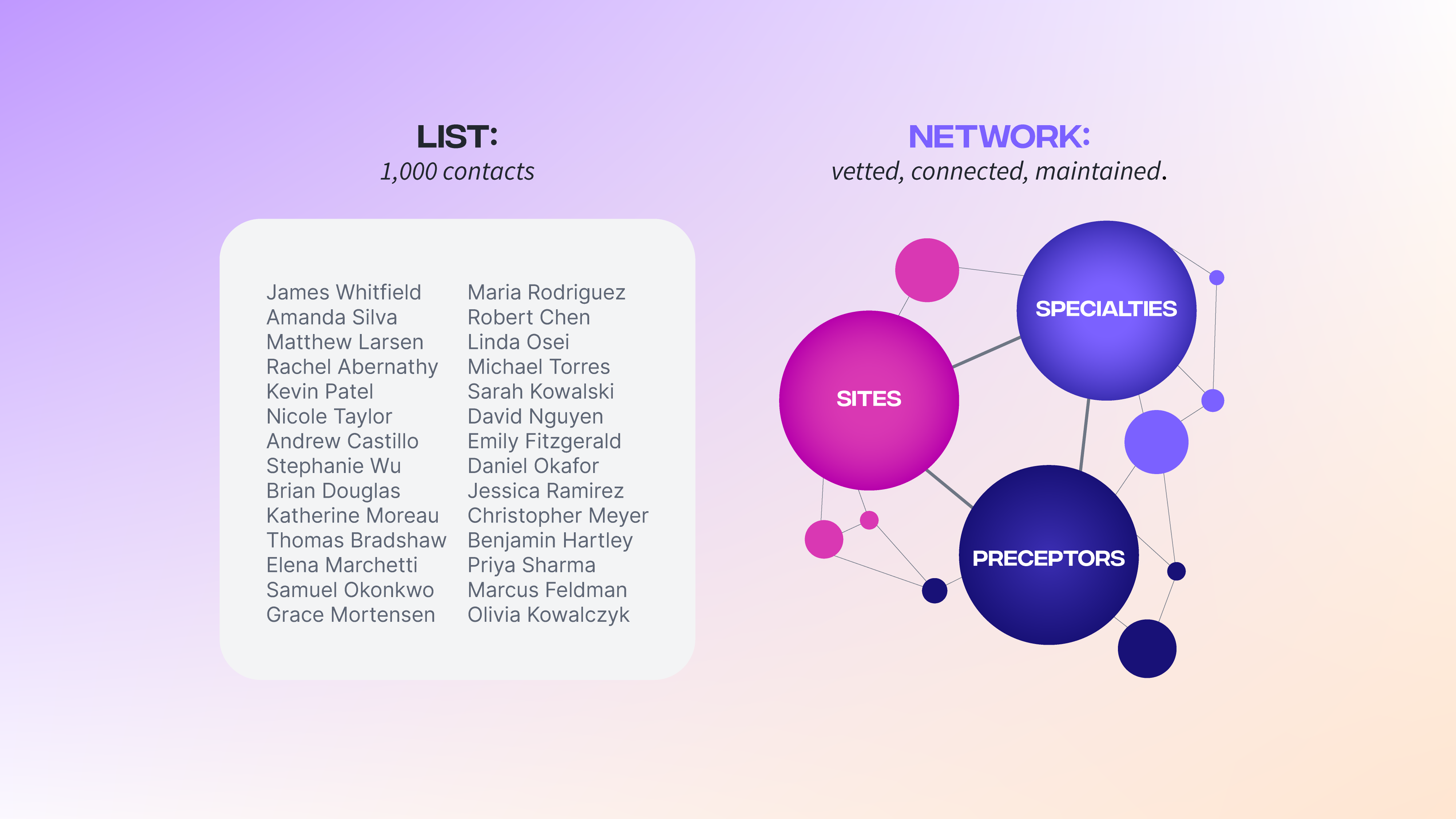
- Seven structural qualities define network strength. Pipeline depth, specialty and geographic coverage, clinician-led vetting, continuous verification, separation of recruiting from coordination, audit-ready documentation, and relationship continuity across cohorts. Volume alone is a list, not a network.
- The distinction is between a capacity partner and a listings marketplace. A directory or preceptor marketplace connects a student to an available preceptor and steps away. A recruiting partner sources continuously, vets through clinical judgment, and maintains those relationships across cohorts, so capacity compounds instead of resetting.
- Serving students well and running a sound program are the same act. When placement runs on infrastructure instead of improvisation, students complete their clinical hours on time and programs protect enrollment capacity, faculty workload, accreditation posture, and reputation at once. That matters more as demand climbs: AACN's most recent survey showed master's enrollment up 4.8% and DNP enrollment growing for a twenty-first consecutive year, while more than 13,000 qualified applications to graduate nursing programs were turned away, with insufficient clinical placement sites, faculty, and preceptors named among the primary barriers.
- NPHub is built around these same qualities. Clinician-led oversight, a structured NP-to-NP vetting interview, credential and license integrity screening, separate clinical site approval, and re-verification every 45 days. To see how a structured network would map to your program's cohort size, specialty mix, and graduation timeline, get in touch with the NPHub university partnerships team.
When a rotation needs filling, the natural question is "how do we place this student this term?" It is the right question for the moment and the wrong one for the decade. The more important question, the one a growing number of NP programs are starting to ask, is what makes the underlying network sound in the first place. One filled rotation solves one problem. A strong nurse practitioner clinical placement network solves the same problem every term, for every cohort, without starting from zero.
This article is about that distinction. A strong network is not luck, volume, or a bigger contact list. It is a set of structural qualities that hold up under enrollment growth, accreditation review, and faculty turnover. Those same qualities are what separate a genuine capacity partner from a listings marketplace, and knowing them gives a program a clear standard to measure any option against, including building the capability in-house.
If your program is already rethinking how it approaches clinical placement, the NPHub university partnerships team works through this shift with NP programs and is happy to compare notes on where yours stands.
What is a clinical placement network?
A clinical placement network is an organized, continuously maintained supply of vetted clinical preceptors and approved clinical sites that a program can draw on to place nurse practitioner students in clinical rotations. Unlike a one-time search, a network exists before the need arrives and grows cohort over cohort instead of resetting each term.
Three very different things get filed under the word "placement," and it helps to separate them:
- A directory or marketplace lists available preceptors and lets a student or coordinator make contact. It is a lookup, not a relationship. Vetting is usually shallow, and the connection ends when the rotation does.
- Ad-hoc sourcing is what most programs actually run: faculty, coordinators, or students making calls each term and rebuilding contacts every cycle. Effort is high, records are thin, and continuity is accidental.
- A true network treats supply as infrastructure. Preceptors are sourced and screened in advance, clinical sites are approved on their own merits, and relationships are maintained across cohorts so capacity compounds rather than resetting.
The difference shows up under pressure. A directory looks fine until the family practice preceptor is already booked by three other schools. A network is judged by what it can actually produce for the specialty and geography a program needs, on the timeline a rotation actually starts.
Why network strength matters more than any single placement
Because clinical placement is not a logistics task, it is program infrastructure. A single confirmed rotation touches one student. The strength of the network behind it shapes enrollment capacity, faculty workload, accreditation posture, and program reputation at the same time.
The stakes are institutional, not administrative:
- Capacity. A program cannot responsibly admit larger cohorts without a proportional increase in clinical site capacity. Enrollment can grow with a signature; quality clinical sites cannot. When the network is thin, growth becomes a placement backlog a semester later.
- Faculty load. When sourcing has no dedicated home, the work flows to faculty on top of teaching, mentorship, and curriculum. Every hour spent chasing preceptors is an hour not spent on the work they were hired to do.
- Compliance. CCNE and ACEN reviewers expect documented, repeatable processes for preceptor qualification and clinical site oversight. A strong network produces that documentation as a byproduct. Ad-hoc sourcing produces gaps that surface during review.
- Reputation. Students talk. A program known for stable, well-matched clinical placements recruits its next cohort more easily than one known for leaving students to fend for themselves.
The national picture makes the pressure concrete. In the American Association of Colleges of Nursing's most recent survey, master's-level nursing enrollment rose 4.8% and DNP enrollment grew for a twenty-first consecutive year, while more than 13,000 qualified applications to graduate nursing programs were turned away, with insufficient clinical placement sites, faculty, and preceptors named among the primary barriers. Demand for NP education keeps climbing. The infrastructure underneath it has not kept pace.
Most programs know where this pinches without needing a report to confirm it. If yours is weighing where its clinical placement process is straining and where it is holding up, the NPHub university partnerships team works through exactly that map with NP programs.
What makes a clinical placement network strong?
A strong clinical placement network is defined by seven structural qualities: pipeline depth, specialty and geographic coverage, clinician-led vetting, continuous verification, separation of recruiting from coordination, audit-ready documentation, and relationship continuity across cohorts. Volume alone is not strength. A thousand unscreened contacts is a list, not a network.
Depth and continuity of the preceptor pipeline
Depth means vetted preceptors are identified ahead of demand, not sourced the week a rotation starts. A deep pipeline changes a program's starting position: instead of beginning outreach from zero each term, it draws from a standing pool of qualified nurse practitioner preceptors. Continuity means that pool is renewed and expanded every cycle rather than rebuilt. The practical test is simple. When a request comes in, does capacity already exist, or does the clock start over?
How does specialty and geographic coverage protect program requirements?
Coverage is what turns a pipeline into a usable one. A network is only as strong as its match to the specialties and locations a program's curriculum requires. Primary care and family practice carry the largest volume, but the hardest rotations to secure tend to cluster in a few areas: women's health, pediatric NP placements, and psychiatric mental health, particularly across rural areas and saturated metros where several programs compete for the same clinicians. Family nurse practitioner students, for instance, need documented exposure across populations, from women's health to pediatrics, to meet clinical requirements and licensure hour thresholds. Coverage across those specialties, and the geographies where students actually live, is what lets a network meet program requirements instead of filling whatever happens to be available. A placement that does not fit the competency goal is not really a placement.
Clinician-led vetting and clinical judgment
Whether a clinical site fits a given rotation is a clinical decision before it is an administrative one. A coordinator can confirm a license is active. Assessing whether the scope of care, patient population, acuity, and the kinds of treatment plans a student will help develop actually support a meaningful family practice or psychiatric rotation takes clinical judgment. That is why the strongest networks put experienced preceptors and board-certified clinicians at the vetting layer rather than credential checkers. The distinction separates available preceptors from genuinely qualified preceptors, and it is the clearest reason marketplaces that operate purely as listings tend to underdeliver against program requirements.
What does rigorous, continuous verification look like?
Verification is what makes added capacity defensible rather than just large. A rigorous standard covers three things: credential and license integrity screening (active, unrestricted licensure and current board certification, with any restriction triggering disqualification), separate approval of the clinical site itself (confirming the site can administratively host a student and produce required documentation, not just that one preceptor is willing), and re-verification on an ongoing cadence rather than once at onboarding. Clinical settings change mid-term. Schedules shift, staffing turns over, patient mix evolves. A preceptor who was a strong fit in week one may not be by week six. Continuous verification catches those changes before they disrupt a student's clinical hours.
Why separate recruiting from coordination?
Recruiting and coordination are different disciplines on different clocks. Coordination is reactive and deadline-driven: scheduling, school paperwork, and managing active rotations. Recruiting is proactive and pipeline-driven: sourcing preceptors, vetting clinical fit, and maintaining relationships over the long horizon. When one person owns both, recruiting always loses to the urgent, because the rotation starting Monday will always outrank the pipeline the program needs next year. Networks that separate the two build capacity continuously instead of scrambling seasonally, and faculty time returns to teaching.
Audit-ready documentation by default
In a strong network, the records an accreditor asks for already exist, because they are a natural output of how the network operates, not a project assembled under deadline. That means preceptor qualification records, current and signed affiliation agreements, evidence of clinical site approval separate from the individual preceptor, and oversight records showing conditions were re-checked during the rotation. The honest test a program director can run: if a reviewer asked for full required documentation on a randomly selected rotation from three cohorts ago, could the program produce it within an hour? A network built for audit-readiness answers yes without flinching.
Why does relationship continuity across cohorts matter?
A preceptor relationship is an asset that either compounds or evaporates. In ad-hoc models, the relationship often lives with an individual faculty member, and when that person leaves, the relationship walks out with them. A strong network holds those relationships at the system level, so a clinical preceptor who took a student this year is far more likely to take one next year. Continuity is what lets a network grow rather than tread water, and it is why the programs investing in durable preceptor matching now are the ones positioned to scale later.
How does a strong network serve NP students and programs at the same time?
A strong network protects the program by producing reliable outcomes for its students. The two are not in tension. When placement runs on infrastructure instead of improvisation, students complete their clinical hours on schedule and programs protect the metrics that depend on it.
For nurse practitioner students, instead of calling to find a preceptor while a semester start looms, NP students move into clinical rotations that were vetted for fit, gaining the hands-on experience and direct patient care that turn classroom knowledge into real-world skills. A well-matched clinical experience is a more stable one: the student spends the rotation building clinical skills rather than managing a placement that was never quite right. For most students, that is the difference between a scramble and something much closer to a stress-free experience.
For the program, those same reliable placements protect what leadership actually answers for. Students who start on time graduate on time, which keeps throughput and tuition cycles intact. A program-owned network also supports students more equitably than self-placement, which quietly advantages students with strong professional networks and penalizes those without. And because the network keeps placement and its documentation inside a defensible system, the program protects both its accreditation posture and its standing in the healthcare community it recruits from. Serving students well and running a sound program are, in a strong network, the same act.
How does a strong network differ from a preceptor marketplace or directory?
A marketplace connects an available preceptor to a student and steps away. A recruiting partner sources continuously, vets through clinical judgment, verifies preceptors and sites separately, and maintains those relationships across cohorts. The first fills a slot. The second builds capacity a program can rely on.
Four models sit on a spectrum, and it helps to name them plainly:
- Self-placement puts the sourcing burden on students, who have the least leverage and the least visibility into clinical requirements. It produces uneven clinical experiences and thin records.
- A directory or NP preceptor finder lists names and contact details. Useful as a starting point, but the vetting is shallow and the program still does the real work.
- A preceptor marketplace adds matching, but typically ends its involvement at the connection. Documentation and ongoing oversight remain the program's problem.
- A recruiting partner operates as program infrastructure: continuous sourcing, clinician-led vetting, separate site approval, audit-ready documentation, and relationships that carry cohort to cohort.
The signal that separates a partner from a vendor is not price or polish. It is whether the process is built to support program requirements and accreditation review, or only to fill a placement slot. A directory is judged by how many names it holds. A network is judged by what it reliably produces.
Programs comparing options often find the useful conversation is not "which vendor," but "what should we require of any partner." If that framing is helpful, the NPHub university team is glad to walk through what to look for, whether or not NPHub turns out to be the right fit for your program.
How NPHub structures its clinical placement network
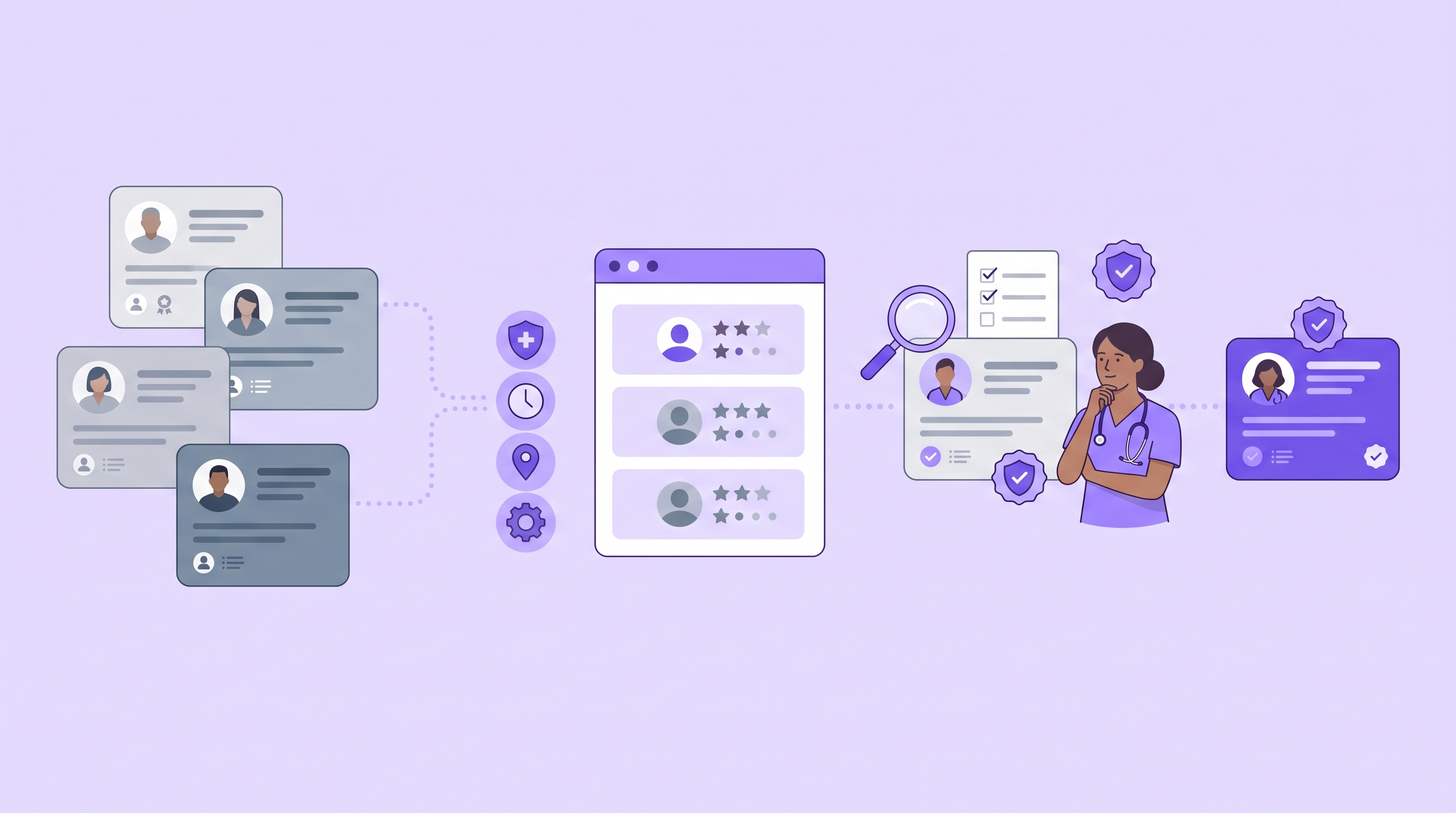
NPHub structures its network around the same qualities that define a strong one, built on five operational pillars: clinician-led oversight, a structured NP-to-NP vetting interview, credential and license integrity screening, separate clinical site approval, and re-verification every 45 days. The design treats preceptor recruiting as ongoing clinical infrastructure rather than a transaction that ends at the match.
The five pillars, briefly:
- Clinician-led oversight: Board-certified nurse practitioners source and vet every preceptor, so questions of scope, fit, and teaching readiness are answered by people trained to answer them.
- Structured NP-to-NP vetting interview: Every prospective preceptor completes a focused conversation that evaluates practice setting, specialty alignment, patient population, and readiness to teach, not just willingness to sign.
- Credential and license integrity screening: Active licensure, board certification, and disciplinary history are reviewed for every preceptor, with any restriction triggering disqualification.
- Separate clinical site approval: The site is vetted on its own merits, confirming it can administratively host a student and produce the required documentation, independent of the individual preceptor.
- Re-verification every 45 days: Active preceptors and sites are re-checked on a rolling cadence, because a placement that was sound at the start of a term should stay sound through it.
Taken together, these are less a service to manage than infrastructure a program can lean on. Faculty get time back, documentation is built in, and the records are ready when accreditation review arrives.
Every program's situation is specific: a different cohort size, specialty mix, and graduation timeline. The NPHub university partnerships team works directly with NP programs to map how a structured network would fit those particulars. When it is a useful conversation to have, get in touch.
A better way, and maybe help
The programs asking sharper questions about clinical placement have mostly reached the same conclusion. The model built for smaller cohorts and softer accreditation expectations is straining, and effort alone will not fix it. What replaces it is not a bigger contact list or a harder-working coordinator. It is treating the placement network as core infrastructure, closer in spirit to faculty hiring or curriculum design than to scheduling.
A strong nurse practitioner clinical placement network is defined by qualities a program can measure: a deep and continuous pipeline, real specialty and geographic coverage, clinician-led vetting, continuous verification, recruiting kept separate from coordination, documentation that is audit-ready by default, and relationships that compound across cohorts. Programs that build or partner into that kind of network are the ones that will grow without compromising the quality of the education they offer or the nurse practitioners they prepare.
If that is the direction your program is heading, the NPHub university team is a straightforward place to start the conversation.
Frequently asked questions
What is a clinical placement network?
A clinical placement network is a continuously maintained supply of vetted clinical preceptors and approved clinical sites that a program can draw on to place students in clinical rotations. Unlike a directory or one-time search, a network exists before the need arises and is renewed cohort over cohort, so capacity compounds rather than resetting each term.
What makes a nurse practitioner preceptor qualified?
A qualified NP preceptor holds an active, unrestricted state license and current board certification in the specialty they precept, along with clinical experience appropriate to the rotation. Verification should include a license integrity screen for any disciplinary history. Beyond credentials, a strong network also confirms teaching readiness and that the preceptor's scope and patient population fit the student's clinical requirements.
How is a recruiting partner different from a preceptor matching service?
A preceptor matching service connects a student to an available preceptor and ends its involvement at the match. A recruiting partner operates as ongoing infrastructure: it sources preceptors continuously, vets them through clinical judgment, approves clinical sites separately, maintains audit-ready documentation, and keeps relationships going across cohorts. The distinguishing signal is whether the process is built to support program requirements and accreditation, not just to fill a slot.
What specialties are hardest to place, and how does a strong network cover them?
The hardest rotations to secure are typically psychiatric mental health, pediatric NP, women's health, and family practice, especially in rural areas and saturated urban markets where multiple programs compete for the same clinicians. A strong network covers them by sourcing ahead of demand across specialties and geographies rather than reacting to each shortage, so coverage exists before a cohort needs it.
How does ongoing verification protect a rotation mid-term?
Ongoing verification catches changes in a preceptor's license status, scope, patient population, or clinical setting before those changes disrupt a student. Because clinical environments shift during a term, one-time onboarding checks can go stale by mid-rotation. Re-verifying active preceptors and sites on a regular cadence (NPHub does this every 45 days) protects completed clinical hours and keeps a living record that supports both stability and accreditation review.
Can a placement network support CCNE or ACEN compliance?
Yes, when it applies consistent vetting and documentation standards across every placement. A network that verifies licensure, approves clinical sites separately from preceptors, and maintains audit-ready records helps a program strengthen its accreditation posture. Networks that rely on open listings or shallow credential checks generally do not meet that bar.
Find a preceptor who cares with NPHub
Book a rotation.webp)

.webp)

%20(3)%20(2).svg)
.webp)