
.png)



.webp)
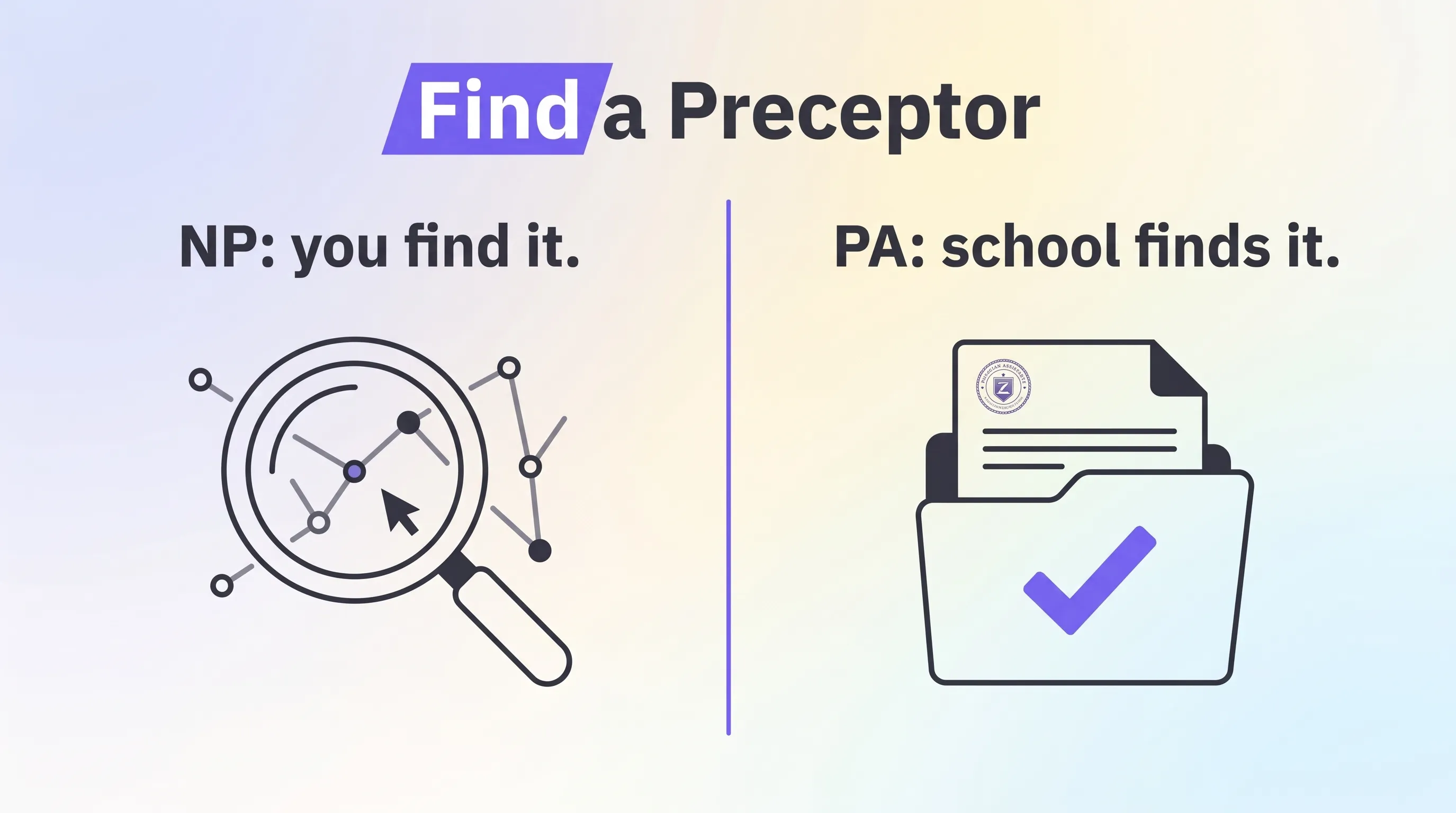
Your friend in PA school just told you her program handed her a clinical rotation. She didn't email a single clinic. You, meanwhile, are a few weeks out from a syllabus deadline, staring at an empty spreadsheet, realizing that your NP program isn't going to find your preceptor for you. The way PA students and NP students get placed really is different, and the gap has almost nothing to do with how hard you're working. This piece explains why the two paths split, what PA students actually get that you don't, and what you can do about it starting this week.
TL;DR
- Most PA programs arrange clinical rotations for students; many NP programs, especially online and fast-growing ones, expect students to find their own preceptors.
- The difference is structural, not personal. PA accreditation (ARC-PA) bars programs from making students source their own clinical sites, while NP placement got pushed onto students as the profession scaled.
- A national preceptor shortage, plus NP, PA, and medical students competing for the same clinical sites, is why so many nurse practitioner students end up searching alone.
- NP accreditation standards actually put responsibility for clinical placement on programs, so needing to find your own preceptor is not a reflection of your ability or your school's quality.
- You can still run a smart search: start 6 to 12 months early, target community clinics and federally qualified health centers, track every contact, and bring in a preceptor matching service if a deadline is closing in.
Would you rather skip the emailing marathon? Create a free NPHub account and connect with vetted NP preceptors in your specialty and state. Most students match in 2 to 3 weeks.
Short answer: Do NP programs find preceptors for nurse practitioner students?
Sometimes, but often not. Some NP programs place students in clinical rotations directly. Many others, especially large online and fast-growing programs, expect students to source their own preceptors and clinical sites. That's the reverse of most PA programs, where the school arranges rotations centrally and students aren't allowed to go find their own.
So if your program told you to line up your own nurse practitioner preceptor, you're in the majority of NP students, not an unlucky exception. And here's the part almost no one says out loud: accreditation standards for NP education actually expect programs to secure quality clinical placements. When that job lands on you instead, it isn't because you skipped a step. It's because of how the two professions built their training in the first place.
NP vs PA clinical rotations: the core difference
Line up NP and PA clinical rotations side by side, and the difference comes down to design.
Physician assistant education grew out of the medical model, and PA programs run their clinical year the way medical school does. The program owns placement. A clinical coordinator arranges rotations across required specialties like family medicine, internal medicine, and emergency medicine, and students rotate through them. This isn't just tradition. PA programs are held to it by their accreditor: under ARC-PA fair-practice standards, a PA program has to publish a policy stating that students are not required to find or solicit their own clinical sites or preceptors. A program that quietly pushed placement onto students would be putting its accreditation at risk.
Nurse practitioner education developed on a different track. NP training sits inside nursing, where advanced practice registered nurses enter a specific population focus (family, psychiatric mental health, adult-gerontology, and so on). As demand for nurse practitioners climbed, so did NP enrollment, and much of that growth came through distributed and online programs serving students spread across the country. Federal projections put NP employment growth near 40% this decade, well above most healthcare roles. In a model that scaled that fast and that wide, student-sourced placement became common, and then it became normal.
What this means is that one profession bakes clinical placement into the program, and the other often does not.
Why so many NP programs leave placement to NP students
If accreditation expects NP programs to secure sites, why do so many still hand the job to students? A few forces stack up.
The preceptor shortage is the big one. There simply aren't enough clinical preceptors willing and available to take every nurse practitioner student who needs a rotation. Practicing NPs and physicians point to real barriers to precepting: little or no financial incentive, no protected time to teach, unclear expectations about the preceptor role, and not much support from schools once they say yes.
On top of that, everyone is fishing in the same pond. NP students, PA students, and medical students often compete for the same clinical sites and the same qualified preceptors in a single city, and a busy clinic can only take so many learners at once.
Now add fast NP enrollment growth to a preceptor pool that hasn't grown at the same pace, and you get the exact gap you're standing in. Faced with more students than they can place, many programs, especially those enrolling nationally, shifted the search onto students. It became the default rather than a decision anyone set out to make. If you want the systemic view of how this broke and what programs can actually do about it, we go deeper on that in our piece on why finding preceptors is broken for NP programs.
For NP program faculty and clinical coordinators reading this: if you're on the other side of the same shortage, trying to place a whole cohort instead of a single rotation, NPHub's university team works directly with programs to secure vetted clinical placements at scale, so the search doesn't fall on students one email at a time. Talk to our university team.
What this means for you (and what it doesn't)
So let's be clear about what this situation is and isn't.
It is a structural gap in how NP education is funded and organized. It is not a verdict on your program's quality, and it is definitely not a verdict on you. Needing to find your own preceptor doesn't mean you picked a weak school or that you're behind your classmates. The required clinical hours you have to log are the same whether your school places you or you place yourself. What changes is only who does the legwork.
Read the accreditation standards for NP education, and the responsibility for clinical placement sits with programs, not students. So if the work has landed on you anyway, you're allowed to treat it as a logistics problem to solve efficiently, not a personal failing to grind through.
What to do when your NP program won't place you
You can't fix how the profession funds clinical education. You can run a smart preceptor search instead of a frantic one. The short version:
- Start early: Begin 6 to 12 months before your rotation, not the semester it starts. The strongest preceptors get claimed first.
- Target the right settings: Community clinics, urgent care, and federally qualified health centers place more students than big, competitive hospital systems. For some specialties, like psychiatric mental health NP rotations, telehealth is an option where state rules allow it.
- Track every contact: A simple spreadsheet of who you reached, when, and what they said keeps a long search from turning into chaos.
- Know when to bring in help: If you've burned weeks with no yes, a preceptor matching service can shortcut the search, especially close to a deadline.
You don't have to spend six months on this. See which vetted preceptors are available in your specialty right now. Free to browse, no card required.
The bottom line
The reason your NP program won't find your preceptor is structural, not personal. PA students get school-arranged rotations because their accreditor requires it. Many NP students source their own because a fast-growing profession outran its preceptor supply and pushed the search downstream. Knowing that won't place you by itself, but it should take the self-blame out of it and let you attack the search as the logistics problem it actually is.
You didn't choose this system, but you don't have to work it alone. Create a free NPHub account and see vetted preceptors matched to your specialty and state, so you can lock in your rotation and stay on track to graduate.
Frequently asked questions
Do NP programs find your preceptor for you?
Some do, but many don't. Some NP programs, especially large online and fast-growing ones, require students to find their own preceptors and clinical sites. This is different from most PA programs, where the school arranges clinical rotations. If your program asked you to source your own preceptor, that's common, not a sign that anything went wrong.
Why do PA students get placed and NP students don't?
It comes down to how each profession structures training. PA education follows the medical model, and PA accreditation standards prohibit programs from making students find their own clinical sites, so PA programs arrange rotations centrally. NP education grew rapidly, often through online programs enrolling students nationwide, and student-sourced placement became common. The difference is structural, not a matter of student effort.
Are NP schools required to provide preceptors?
Accreditation standards for NP education place responsibility for securing quality clinical placements on programs. In practice, enforcement varies, and many programs still expect students to find their own preceptors. So while the responsibility is meant to sit with the school, the day-to-day reality for many nurse practitioner students is that they arrange placement themselves.
How many clinical hours do NP students need?
Most NP programs require at least 500 direct patient care clinical hours, and many require 600, 750, or more, depending on the program and specialty. Requirements can also vary by your state board of nursing and degree type (MSN vs DNP), so confirm the exact number with your program and state board before you plan your rotations.
Is it normal to pay for a preceptor?
It's become common. Because of the preceptor shortage, some students pay for clinical placements or use paid matching services, and there's real debate in the profession about whether students should have to. If you do consider paying, look for services that vet preceptors, help with the paperwork and school coordination, and publish clear terms, so you know exactly what you're getting.
Definitions
Clinical preceptor: A licensed clinician (an NP, physician, or PA) who supervises and teaches you during a clinical rotation and signs off on your hours.
Clinical rotation (clinical placement): A block of supervised, hands-on patient care at a clinical site that counts toward the hours your NP program requires.
Affiliation agreement: The contract between your school and a clinical site that makes a rotation official. Your program handles this once you've found a site and preceptor.
Direct patient care hours: Time spent providing hands-on care to patients under your preceptor, as opposed to observation or coursework. These are the hours that count toward your requirement.
Advanced practice registered nurse (APRN): The license category nurse practitioners fall under. Scope of practice, including whether you can practice independently, varies by state.
NP preceptors: Experienced clinicians (nurse practitioners, physicians, or PAs) who take on nurse practitioner students during clinical rotations, teaching and supervising them in real patient care and evaluating their progress.
Nurse practitioner students: Registered nurses completing a graduate NP program who must log supervised clinical hours with a preceptor before they can be certified and licensed as an NP.
NP education: The graduate-level training that prepares registered nurses to become nurse practitioners, combining coursework with faculty-directed clinical rotations in a chosen population focus such as family or psychiatric mental health.
Clinical hours: The supervised time in clinical settings your NP program requires you to complete, tracked and signed off by your preceptor. The total varies by program, specialty, degree (MSN vs DNP), and state.
Preceptor shortage: The ongoing gap between the number of nurse practitioner students who need clinical placements and the number of preceptors available to take them, driven by limited incentives, little protected teaching time, and fast NP enrollment growth.
Psychiatric mental health NP (PMHNP): A nurse practitioner specialty focused on mental health, assessing, diagnosing, and treating psychiatric conditions across the lifespan. PMHNP rotations are among the hardest to place because demand is high and available preceptors are few.
NP schools: The nursing programs that grant NP degrees. Some arrange clinical placements for their students; many, especially large online programs, expect students to find their own preceptors.
Preceptor search: The process of finding, contacting, and securing a preceptor and clinical site for your rotation, from building a target list to outreach, follow-up, and getting the affiliation agreement signed.
Preceptor matching services: Companies that connect nurse practitioner students with vetted preceptors and often handle site vetting and paperwork, usually for a fee. They can shorten a stalled preceptor search, especially near a deadline.
Article details
- Last updated
August 19, 2026 - Fact-checked by
NPHub Clinical Placement Experts & Student Support Team - Sources
Find a preceptor who cares with NPHub
Book a rotation.webp)
.jpeg)

.webp)
.jpeg)


%20(3)%20(2).svg)
.webp)